The Architecture of Mental Resilience
Golden Hook & Introduction
SECTION
Nova: We often hear "just be tougher," or "suck it up," when facing life's inevitable curveballs. It’s this idea that mental strength is some innate, unchangeable trait.
Atlas: Right? Like you’re either born with that superhuman grit or you’re stuck with... well, whatever the opposite of superhuman grit is.
Nova: Exactly! But what if mental toughness isn't about some innate, fixed quality you either possess or don't? What if it's a skill, like learning to juggle, that anyone can actually acquire and hone?
Atlas: Oh, I like that. That immediately shifts the whole conversation from "am I good enough?" to "how do I get good?" That’s a fundamentally more empowering question.
Nova: Absolutely. And that’s precisely what we’re diving into today on Aibrary, as we explore what we call "The Architecture of Mental Resilience." We’re looking at how to build that inner fortress, brick by brick, thought by thought, even breath by breath.
Atlas: That’s a powerful metaphor. And it sounds like we’ve got some serious architects joining us.
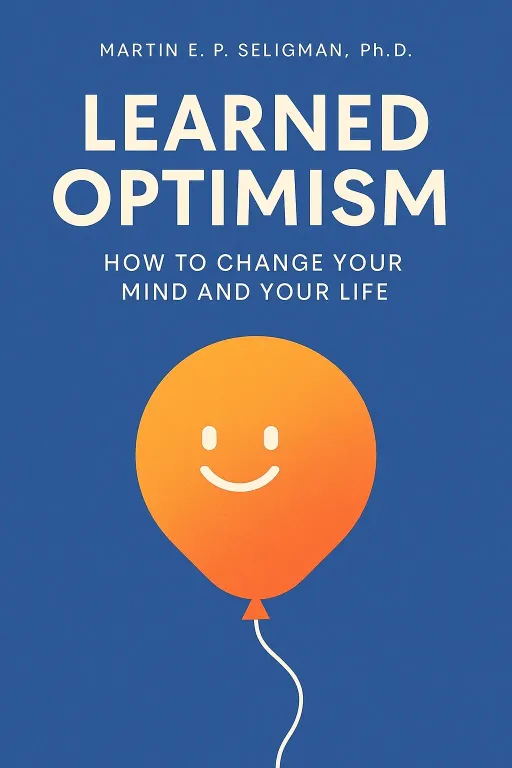
Nova: Indeed. We're drawing insights from two titans in the field of human potential. First, the pioneering work of in his seminal book, "Learned Optimism." Seligman is often credited as the father of positive psychology, a truly academic giant whose research on "learned helplessness" fundamentally reshaped our understanding of human agency before he pivoted to the profound possibilities of "learned optimism."
Atlas: And that’s a crucial pivot, because helplessness sounds… well, helpless. Optimism sounds like an active choice.
Nova: Precisely. And then, we’ll turn to the dynamic, results-driven framework of from his iconic book, "Awaken the Giant Within." Before he became the global phenomenon of personal development, Robbins started his journey driven by a personal mission to overcome his own humble beginnings and help others rapidly transform their lives. His approach is less about academic papers and more about immediate, visceral change.
Atlas: So, we’re talking about foundational cognitive science high-impact, practical application. It’s like having the blueprints from the master architect and the hands-on instruction from the master builder.
Nova: A perfect analogy. Because mental resilience isn't just about understanding; it’s about doing. And it’s about doing it in a way that’s both deeply rooted in how our minds work, and immediately actionable in our daily lives.
The Cognitive Reframe - Mastering Your Inner Dialogue
SECTION
Nova: So, let's start with Seligman and this revolutionary idea that optimism is a skill. For so long, we’ve treated optimism or pessimism like personality traits, right? You’re either a glass-half-full person or a glass-half-empty person.
Atlas: Yeah, and if you’re the latter, tough luck. You just have to… be that. There’s a certain resignation to it.
Nova: But Seligman’s clinical research utterly dismantles that notion. He shows us that our explanatory style—how we explain good or bad things happen to us—is a habit. And like any habit, it can be unlearned and replaced with a more empowering one.
Atlas: So, it’s not about the event itself, but the story we tell ourselves about the event? Like, if I get stuck in traffic, do I think, "This always happens to me, my day is ruined," or "Okay, this is annoying, but I can use this time to catch up on an audiobook"?
Nova: Exactly! That’s a brilliant everyday example. The pessimistic explanatory style tends to be permanent, pervasive, and personal. An optimistic style, conversely, sees setbacks as temporary, specific, and externalized.
Atlas: That makes sense. I can see how that kind of internal narrative would just drain your mental battery over time. You’re constantly fighting an uphill battle against yourself.
Nova: It’s exhausting, and it leads to what Seligman initially called "learned helplessness." If you believe you have no control, you stop trying. But the breakthrough, the hope, comes with "learned optimism." And the tool he gives us to achieve this is the ABCDE model.
Atlas: Okay, ABCDE. Sounds like a formula. Hit me with it.
Nova: It starts with A: the. This is the trigger. The traffic jam, the critical email, the missed deadline.
Atlas: Got it. Something happens.
Nova: Then B: your about that event. This is where your explanatory style kicks in. "I’m terrible at my job," "My boss hates me," "I’ll never get ahead."
Atlas: These are usually the automatic, often negative, thoughts, right? The ones that just pop up without an invitation.
Nova: Precisely. And from those beliefs comes C: the. This is how you feel and what you do. So, if your belief is "I’m terrible at my job," the consequence might be feeling demotivated, procrastinating, or even giving up.
Atlas: That’s the cycle. Activating event, negative belief, negative consequence. It’s a self-fulfilling prophecy of misery.
Nova: It can be. But here’s where the power of learned optimism truly lies, with D and E. D stands for. This is where you actively challenge your negative beliefs. You ask yourself: "Is this belief truly accurate? What’s the evidence for it? What are alternative explanations? Is this belief actually?"
Atlas: Oh, so it’s not just ignoring the negative thought, it’s actively arguing against it, almost like a lawyer in your own head?
Nova: Exactly! You become your own mental defense attorney. For instance, if the belief is "I’m terrible at my job," you might dispute it by recalling past successes, acknowledging external factors, or reframing the setback as a learning opportunity.
Atlas: That’s a huge shift. It’s not ignoring the problem, it’s just... fighting back against your own mind with logic and evidence. For someone who values efficiency and wants to make informed choices, this feels like a high-leverage skill. It stops the emotional spiral.
Nova: And finally, E is for. This is the feeling of relief and renewed energy you get when you’ve successfully disputed a negative belief. You feel more hopeful, more in control, and ready to take constructive action.
Atlas: So, it’s a process of re-wiring your internal narrative, step by logical step. It sounds powerful, but also like it takes conscious effort, especially at first.
The Embodied Shift - Changing State Through Focus and Physiology
SECTION
Nova: It absolutely does take conscious effort, Atlas. Seligman gives us the long game for mastering our inner dialogue. But what about those moments when you need a rapid mental reset? When you’re caught in a sudden wave of anxiety or overwhelm and don’t have time for a full ABCDE analysis?
Atlas: Oh, like when you're about to walk into a tough meeting, or you get some shocking news, and your heart's pounding, your breath is shallow. You don't have time to sit down and logically dispute beliefs then! You need something.
Nova: Precisely. And that’s where Anthony Robbins’ work on Neuro-Associative Conditioning, or NAC, comes in. Robbins provides a framework for almost instantaneously changing your mental and emotional state by changing two key things: your focus and your physiology.
Atlas: Focus and physiology. Okay, tell me more.
Nova: Think about it. When you’re feeling defeated, what’s your typical posture? You’re probably slumped, shoulders rounded, head down, shallow breathing. And what are you focusing on? Probably everything that’s going wrong.
Atlas: Yep, that’s my default "woe is me" stance. It’s almost involuntary.
Nova: That’s the point! Your body and your focus are sending powerful signals to your brain, reinforcing that negative state. Robbins’ insight is that you can interrupt that pattern. If motion creates emotion, then motion can create emotion.
Atlas: So, it’s almost like a physical hack? You can literally trick your brain by changing your body? That sounds almost too simple, but I can see how it works when you're in a pinch.
Nova: It’s not tricking, it’s leveraging the deep connection between mind and body. Stand taller, pull your shoulders back, put a smile on your face—even if it feels forced—and take a few deep, powerful breaths. You’ll instantly notice a shift. Your brain chemistry actually responds to these physical cues.
Atlas: I mean, I’ve heard of "power posing," but to apply it in the moment of distress… it makes sense. It’s hard to feel utterly defeated when you’re standing like a superhero.
Nova: Exactly. And the other part is focus. What are you asking yourself? What are you paying attention to? When you’re stressed, you might ask, "Why is this happening to me?" or "What else can go wrong?"
Atlas: Which just sends you down a rabbit hole of more negative thoughts.
Nova: Right. Robbins teaches us to interrupt that pattern by consciously changing our focus. Instead of "Why me?", ask "What’s great about this situation?" or "What can I learn from this?" or "What am I grateful for right now?" It redirects your mental energy.
Atlas: That’s fascinating, because it complements Seligman's work beautifully. One is about dismantling deeply ingrained, often subconscious, negative thought patterns over time. The other is about immediate, conscious state management through physical and attentional shifts. It's like a two-pronged attack on negativity.
Nova: It truly is. Robbins’ approach, while often high-energy and theatrical in his live events, is fundamentally about pattern interruption and creating new, empowering neuro-associations. It’s about creating a rapid, reliable pathway to a resourceful state, even when the external circumstances haven't changed yet.
Atlas: So, for our listeners, especially those juggling a lot, it sounds like these aren't mutually exclusive. You can work on your explanatory style over time, have those quick-hit tools in your back pocket for instant course correction.
Synthesis & Takeaways
SECTION
Nova: That’s the core insight, Atlas. Mental resilience isn’t a single, monolithic skill. It’s an architecture, built from different components. Seligman gives us the foundational cognitive framework for how we interpret the world and ourselves, allowing us to proactively build an optimistic mindset.
Atlas: And Robbins gives us the dynamic, in-the-moment tools to shift our emotional state, almost like a mental first-aid kit, when the weight of the world feels too heavy. It’s about having agency over your internal experience, no matter what’s happening outside.
Nova: It’s about recognizing that our internal world isn't just something that happens us; it's something we actively construct. We are the architects of our own mental landscape.
Atlas: That’s a profoundly empowering idea. It means we’re not victims of our thoughts or circumstances. We have levers we can pull.
Nova: And the beauty is, these aren't complex, inaccessible theories. They boil down to incredibly practical, tiny steps that build big momentum, exactly what our pragmatic explorers and insight seekers value.
Atlas: So, what’s the first brick in this architectural marvel for our listeners today?
Nova: Let’s go back to Seligman’s model for a moment. Our takeaway for everyone listening is this: Identify one recurring negative thought today. Just one. And explicitly try to reframe it using Seligman's ABCDE model.
Atlas: Don't just let it float by. Catch it. Question it. Disarm it. And I’d add, maybe even pair that with a physical component. Stand taller, take a deep breath before you dispute that thought. It’s about being the architect of your own internal experience.
Nova: Exactly. Because resilience isn't about avoiding challenges; it's about how you rebuild and re-energize yourself after each one. It's an ongoing process, a masterpiece in the making.
Atlas: And that, my friends, is a powerful journey worth undertaking.
Nova: This is Aibrary. Congratulations on your growth!