

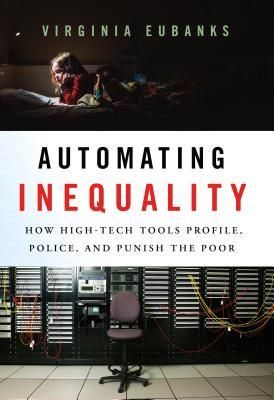
Automating Inequality
Introduction
Nova: In the fall of 2008, an Indiana woman named Omega Young received a letter telling her to recertify for Medicaid. She was battling ovarian cancer, and on the day of her appointment she was in the hospital receiving treatment. She called her local office to explain. The system registered her as "failure to cooperate." Her benefits were cut off. She lost her medication, her food stamps, her rent money, her transportation to medical appointments. Omega Young died on March 1, 2009. The very next day, she won her wrongful termination appeal, and all her benefits were restored — the day after she died.
Nova: It really happened. And it's the kind of story Virginia Eubanks tells in her 2018 book Automating Inequality: How High-Tech Tools Profile, Police, and Punish the Poor. The book is a deeply researched investigation into what happens when governments replace human caseworkers with algorithms and automated systems to decide who gets public assistance. The results are, to put it mildly, catastrophic.
Nova: Exactly. Eubanks spent years interviewing families, caseworkers, activists, and policymakers across the country. She weaves together three major case studies — from Indiana, Los Angeles, and Allegheny County, Pennsylvania — and makes a powerful argument: these automated systems are not making welfare more efficient or fair. They are creating what she calls the "digital poorhouse," a twenty-first-century version of the nineteenth-century institutions that confined, surveilled, and exploited the poor.
The Historical Roots of Digital Surveillance
From Poorhouse to Database
Nova: Eubanks opens the book with a history lesson that is essential to understanding the present moment. In the early to mid-nineteenth century, cities across America built poorhouses — institutions that housed the elderly, the disabled, the mentally ill, and anyone who couldn't find work. On paper they sounded charitable. In reality, they stripped inmates of their civil rights — the right to vote, to marry, to hold office. Conditions were horrific, and the poorhouse owners often exploited inmate labor for profit.
Nova: That's exactly right. And Eubanks argues we never really left that model behind. What changed was the technology. By the late nineteenth century, a movement called "scientific charity" emerged. Social scientists fanned out across the country with questionnaires and cameras, measuring people's heads, taking fingerprints, filling logbooks with labels like "imbecile," "feeble-minded," and "harlot." The idea was that data would make charity more objective and efficient. In reality, it just gave a scientific veneer to racism, classism, and ableism.
Nova: Right. And it got supercharged in the 1980s. After the welfare rights movements of the 1960s and 70s won major victories — including a court ruling that redefined welfare as personal property, not charity, meaning due process had to be provided before benefits were cut — there was a backlash. Ronald Reagan popularized the myth of the "welfare queen," and suddenly the political conversation wasn't about helping people. It was about rooting out fraud.
Nova: Tiny. But the narrative stuck. And here's Eubanks's key insight: that's when computers entered the picture. Politicians promised that automated systems would reduce fraud, cut costs, and make welfare more efficient. But Eubanks argues the real intention was simpler and darker: to degrade due process, break the relationship between caseworkers and families, and shrink the welfare rolls. She quotes this stunning statistic: in 1973, nearly half of Americans living below the poverty line received AFDC benefits. By the time she was writing, that number had dropped below 10 percent.
Nova: Exactly. It's what Eubanks calls a "political sleight of hand." Computers were marketed as neutral, objective arbiters. But they were deployed, she writes, to act "like walls, standing between poor people and their legal rights."
Case Study 1: Automating Welfare Eligibility
Indiana's Million Denials
Nova: Let's talk about Indiana. In 2006, Governor Mitch Daniels, a longtime critic of public assistance, decided to modernize the state's welfare system. The state signed a 1.3 billion dollar contract with IBM and a coalition of private companies to automate eligibility for Medicaid, food stamps, and cash benefits. The stated goal was to reduce bureaucratic overhead and free up caseworkers to focus on helping clients.
Nova: Almost everything. The state replaced about 1,500 local caseworkers with online forms and regional call centers. Face-to-face interactions vanished. Eubanks documents that the system was riddled with technical failures from day one — lost documents, incomprehensible notices, arbitrary denials. The error rate tripled. Over the first three years, there were more than one million benefits denials — a 54 percent increase compared to the three years before automation.
Nova: Yes. About 12 percent of people applying for food stamps were wrongly denied. And the human cost was staggering. Beyond Omega Young, there was the story of Sophie Stipes, a six-year-old girl with developmental delays who relied on Medicaid. Her parents made a minor paperwork error, and the automated system sent a letter saying her benefits would be cut off because she had "failed to cooperate." Sophie's parents were resourceful and persistent, and they managed to get her coverage reinstated in time. But her father told Eubanks: "My wife is persistent, intelligent — it should have been a breeze for her. I just can't imagine people with lesser skills. I know they couldn't, they didn't do it."
Nova: That's the brutal logic. And Eubanks raises this provocative question: did the Indiana system really fail? Sure, it was catastrophic for the people who needed help. But IBM walked away with hundreds of millions of dollars, and Indiana dramatically reduced its welfare rolls. Wasn't that the actual goal? Indiana later sued IBM for 437 million dollars, IBM countersued for 100 million, and the judge ultimately said neither side deserved to win — calling it a "perfect storm of misguided government policy and overzealous corporate ambition."
Case Study 2: Coordinated Entry and the VI-SPDAT
Halting the Homeless in Los Angeles
Nova: Our second case study takes us to Los Angeles, where about 58,000 people experience homelessness — the second-highest population in the United States. Seventy-five percent of them are completely unsheltered, living on the streets. In 2013, LA launched a Coordinated Entry System designed to match unhoused people with available housing using an assessment tool called VI-SPDAT — the Vulnerability Index Service Prioritization Decision Assistance Tool.
Nova: It's a survey that collects intensely personal data — Social Security numbers, mental health histories, legal histories, substance use records. The tool then ranks people on a vulnerability scale from 1 to 17 and uses those scores to match them with housing opportunities distributed across 168 organizations. On paper, the idea is to prioritize the most vulnerable — people with chronic health conditions, the elderly, those who've been homeless the longest.
Nova: Eubanks found that the system created a massive surveillance apparatus while delivering very little housing. There simply aren't enough units. As one unhoused man named T. C. Alexander told her: "Coordinated entry system? The system that's supposed to be helping the homeless? It's halting the homeless. You put all the homeless people in the system, but they have nowhere for them to go. Entry into the system but with no action."
Nova: And there's an even darker dimension. The survey asks people to disclose illegal behavior — sleeping in unauthorized places, panhandling, survival strategies that are technically crimes. That data is accessible to law enforcement. So the very act of honestly answering the survey, in hopes of getting housing, could expose someone to police scrutiny. Eubanks writes that the system "threatens to turn routine survival strategies of those living in extreme poverty into crimes."
Nova: Exactly. And Eubanks quotes a public interest lawyer named Gary Blasi who put it perfectly: "Homelessness is not a systems engineering problem, it's a carpentry problem." If you have ten houses for twenty people, no algorithm in the world will solve that. It doesn't matter how good your matching system is. The problem is a shortage of resources, not a failure of allocation.
Case Study 3: When Proxies Become Punishment
Predicting Child Abuse in Allegheny County
Nova: The third case study is perhaps the most technically sophisticated and the most deeply troubling. Allegheny County, Pennsylvania, which includes Pittsburgh, developed the Allegheny Family Screening Tool — a predictive risk model designed to help caseworkers assess which reports of child maltreatment should be investigated.
Nova: That's the idea. The model pulls data from a huge range of public databases — welfare records, criminal justice data, healthcare information, child protective services history. It crunches all that data and spits out a risk score. Families with the highest scores are automatically flagged for investigation, without manager override.
Nova: Several things. First, nearly all the indicators of child neglect are also indicators of poverty. A child of a poor single parent is more likely to spend time alone, to live in a less safe neighborhood, to live in a cluttered home. Those are risk factors in the model. But they're not evidence of abuse — they are evidence of being poor. The system conflates poverty with maltreatment.
Nova: Yes. Second, the model uses proxies instead of direct measures. One of its key proxies is something called "call re-referral" — how often a family gets reported. But here's the critical bias: anonymous reporters and mandated reporters call in Black and biracial families for suspected abuse and neglect three and a half times more often than they report white families. So the model takes that biased reporting data, treats it as ground truth, and amplifies the disparity.
Nova: That's Eubanks's core argument about all these systems. They don't remove human bias. They shift it, conceal it, and accelerate it. And third, all the data in the model comes from public systems — interactions poor families have with government agencies. Middle-class families use private therapists, private doctors, nannies, babysitters. None of that data is collected. Eubanks asks: imagine if Allegheny County proposed including data from Alcoholics Anonymous or luxury rehabilitation centers to predict child abuse among wealthier families. The professional middle class would never tolerate it.
Nova: There's also evidence that the model started shaping human judgment rather than the other way around. Caseworkers began deferring to the algorithm — if the human and the computer disagreed, the human was told to learn from the model. But risk models offer probabilities, not certainties. They are routinely wrong about individual cases. When you train humans to agree with the machine, the machine's biases become everybody's biases.
What These Systems Share and Why They Persist
The Empathy Override
Nova: So we have three very different cases — welfare eligibility in Indiana, homeless services in LA, child protection in Pennsylvania. But Eubanks identifies common threads running through all of them.
Nova: That's a great summary. But Eubanks's most provocative argument is that these systems function as what she calls an "empathy override." They allow policymakers and caseworkers to avoid confronting the hardest moral and political questions — about poverty, about racism, about how we distribute resources in the wealthiest country on earth — by outsourcing those decisions to machines.
Nova: Exactly. And there's a deeper political logic at work. Eubanks argues that collectively, we care less about the actual suffering of people living in poverty and more about the potential threat they might pose to others. These automated tools are designed to catch fraud, to screen out the undeserving, to predict risk. They are not designed to help people access what they need. The underlying philosophy is that it's better to deny benefits to many eligible people than to risk one ineligible person receiving support.
Nova: And proving that is getting harder. Between 1973 and today, the share of poor children receiving benefits dropped from four out of five to fewer than one in five. In the richest country in the history of the world. Eubanks is clear-eyed about what this means: these tools are not failing. They are doing exactly what they were designed to do — manage the political problem of poverty by making it harder for poor people to access public resources, while maintaining the appearance of neutral, efficient governance.
Solutions, Principles, and Hope
Dismantling the Digital Poorhouse
Nova: So what do we do? Eubanks doesn't leave us without hope. She offers concrete ideas for change.
Nova: Eubanks's solutions operate on multiple levels. On the policy front, she argues for returning to the economic ideas laid out by Martin Luther King Jr. fifty years ago — including universal basic income and robust public assistance that doesn't require people to prove their worthiness through invasive surveillance. The problem of poverty, she insists, cannot be solved by better algorithms for allocating scarcity. It requires addressing scarcity itself.
Nova: Right. On the technology front, she proposes a simple but powerful design principle: would this tool be tolerated if it were aimed at non-poor people? If a middle-class family wouldn't accept having their mortgage interest deduction tied to whether they'd ever been to therapy, then we shouldn't build that kind of surveillance into systems for the poor. She also proposes asking: does this tool increase the self-determination and agency of the people it's meant to serve?
Nova: Eubanks points to mRelief in Chicago, a platform that lets people quickly check whether they might be eligible for various government programs. But critically, mRelief doesn't just give you a yes or no and leave you to figure out the rest. Their staff helps walk people through the process — either in person or by text — to actually get enrolled. It uses technology to expand access, not restrict it.
Nova: Exactly. But Eubanks's deepest argument is that technology alone won't fix this. She calls for interracial, cross-class grassroots movements led by poor people themselves — a revival of the kind of organizing that won welfare rights in the 1960s and 70s. She argues for changing how we think and talk about poverty, for rebuilding empathy, for telling better stories. She writes: "Our ethical evolution still lags behind our technological revolutions."
Conclusion
Nova: Automating Inequality is one of those rare books that changes how you see the world. It takes something that sounds technical and abstract — algorithms, predictive models, data-driven policy — and shows you, through real human stories, that these systems have life-and-death consequences. Omega Young died because a machine registered her as noncompliant. A family in Pennsylvania lives in daily fear of losing their child because they fit a statistical profile. Fifty-eight thousand people in Los Angeles are asked to bare their most intimate struggles in exchange for a housing match that may never come.
Nova: And the digital poorhouse, as she calls it, is more dangerous than the physical poorhouses of the nineteenth century precisely because it's less visible. You can see a poorhouse. You can photograph it, protest outside it, hold officials accountable. An algorithm that quietly denies a million benefits is harder to fight. It doesn't have an address.
Nova: And that's where the book leaves us: with a call to action. Not to reject technology, but to demand that it be built around human dignity rather than suspicion. To insist that the question driving our public systems should not be "who deserves help?" but "how do we make sure everyone gets what they need?" Dismantling the digital poorhouse, Eubanks argues, will require all of us — policymakers, technologists, organizers, and citizens — to stop outsourcing our hardest moral decisions to machines and start making them together.