

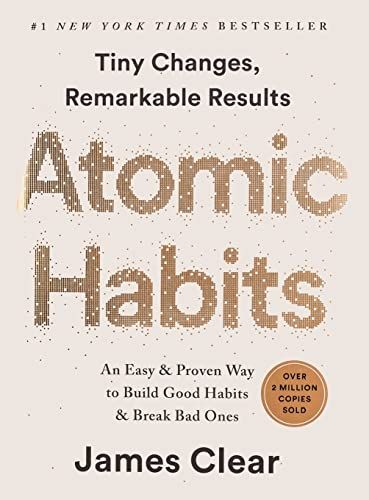
The Architect of Discipline: Building Your Leadership OS with Atomic Habits
Golden Hook & Introduction
SECTION
Nova: Sabbir, here’s a question for you as a leader. We all set ambitious goals—for our teams, for ourselves. But how often do we see a gap between that ambition and the messy reality of our daily routines?
Sabbir Ahmed: All the time. It's the classic strategy-execution gap. You have this beautiful vision on a PowerPoint slide, but Monday morning hits, and everyone just defaults to their old patterns.
Nova: Exactly! We want a culture of innovation, but our days are filled with reactive emails. We want to be strategic, but we're stuck in back-to-back meetings. What if the problem isn't our goals, but our? That's the core question James Clear's forces us to confront, and it reframes the book from simple self-help into a powerful manual for leadership.
Sabbir Ahmed: I love that framing. Not as a book about personal productivity, but as a guide to building a better operating system, for yourself and for your organization.
Nova: That's the perfect way to put it—an operating system. And that's what we're going to explore today. Today we'll dive deep into this from two perspectives. First, we'll explore the most fundamental shift: focusing on 'Identity over Goals' to define the kind of leader you want to become.
Sabbir Ahmed: The 'why' behind the 'what.'
Nova: Precisely. Then, we'll get tactical and discuss 'The Four Laws' as a practical engineering framework for building the habits that bring that identity to life. Ready to get architectural?
Sabbir Ahmed: Let's build.
Deep Dive into Core Topic 1: Identity over Goals
SECTION
Nova: Alright, so let's start with that first big idea, which is honestly a game-changer. Clear argues that we often try to change our habits on the wrong level. We focus on outcomes, like "I want to lose 20 pounds" or "I want to hit my sales quota." These are goals. But he says true, lasting change comes from a deeper level: identity.
Sabbir Ahmed: So it's not what you want to achieve, but who you wish to become.
Nova: You got it. He tells this brilliant, simple story to illustrate it. Imagine two people who are trying to quit smoking. Someone offers them a cigarette. The first person says, "No thanks, I'm trying to quit." The second person says, "No thanks, I'm not a smoker."
Sabbir Ahmed: Hmm. That's a subtle but profound difference.
Nova: Isn't it? The first person still holds the identity of a smoker who is trying to resist something. The struggle is part of their identity. The second person has already changed their internal narrative. Their identity is that of a non-smoker. For them, refusing a cigarette isn't a struggle; it's just a natural expression of who they are. There's no internal conflict.
Sabbir Ahmed: That's incredibly powerful. It completely reframes the challenge. In a leadership context, it's the difference between a manager saying, "I want my team to be more innovative," which is a goal, and a leader who starts by asking, "What does an innovative team every single day?" and then starts embodying that.
Nova: Yes! Tell me more about that.
Sabbir Ahmed: Well, the leader's identity shifts. It's no longer "I am a manager trying to force an outcome." It becomes "I am the leader of an innovative team." That identity then dictates your actions. You start asking different questions in meetings. You celebrate intelligent failures. You protect your team's time for deep work. The focus shifts from a distant, future goal to your immediate, present actions.
Nova: And every time you perform one of those small actions, you're casting a vote for that new identity. Clear says every action you take is a vote for the type of person you wish to become. A single vote won't change the election, but as you accumulate these tiny wins, you build up evidence of your new identity.
Sabbir Ahmed: It's a feedback loop. You decide the person you want to be, you prove it to yourself with small wins, and those small wins reinforce the identity, making the next action even easier. That applies just as much to my spiritual life as it does to my work.
Nova: How so?
Sabbir Ahmed: Well, a goal might be "I want to meditate for 20 minutes every day." That can feel daunting. But an identity is "I am a mindful and present person." Okay, what does a mindful person do? Maybe they just take three deep breaths before their first meeting. That's it. It's a tiny action, a small vote. But by doing it, you start to believe, "Oh, I the kind of person who is mindful." It builds from there.
Nova: I love that. The habits aren't the goal; they're the method you use to embody the identity. It's such a powerful, compassionate way to approach change because it's not about a pass/fail test. It's just about casting one more vote today than you did yesterday.
Sabbir Ahmed: Exactly. It's a system, not a single event. Which I think is the perfect bridge to the more tactical side of this.
Deep Dive into Core Topic 2: The Four Laws
SECTION
Nova: It really is. Because once you've defined that identity—your North Star—the next logical question is, "Okay, how do I actually those small wins? How do I cast those votes consistently?" And this is where it gets really practical for a systems-driven thinker like you, Sabbir. Clear gives us a brilliant engineering blueprint: The Four Laws of Behavior Change.
Sabbir Ahmed: The instruction manual for the operating system.
Nova: The perfect way to put it! The four laws are: Make it Obvious, Make it Attractive, Make it Easy, and Make it Satisfying. And the best way to understand them is to see how they work together. Let's take a classic example from the book: someone who wants to build a habit of writing every day to become "a writer."
Sabbir Ahmed: A classic identity shift.
Nova: Right. So, how do we apply the laws? First,. The cue to write needs to be unmissable. Instead of hiding your laptop away, you leave your writing software open on the screen before you go to bed. The environment itself becomes the cue.
Sabbir Ahmed: You're designing your environment to trigger the habit. That's habit stacking, right? Tying a new habit to an existing one.
Nova: Exactly! Like, "After I pour my morning coffee, I will sit down to write." The coffee is the obvious cue. Second,. You have to want to do it. So maybe you practice "temptation bundling." You say, "I'm only allowed to drink my favorite fancy coffee I'm writing." You pair an action you to do with an action you to do.
Sabbir Ahmed: So you're linking the dopamine hit of the coffee to the act of writing. That's clever.
Nova: It's hacking your own brain! Third, and this might be the most important one,. This is where the famous "Two-Minute Rule" comes in. The goal isn't to "write a chapter." The goal is to "write for two minutes." Or even just "open the document." Anyone can do that. It lowers the activation energy so much that it's harder to say no than to just do it.
Sabbir Ahmed: You're not trying to build the perfect habit from day one. You're just trying to master the art of showing up. The consistency is more important than the intensity at the beginning.
Nova: One hundred percent. And finally, number four:. The human brain loves immediate rewards. Writing a book is a long-term goal, the reward is far away. So you need an immediate win. Clear talks about using a habit tracker—a simple calendar where you put a big 'X' on every day you complete your two minutes of writing. The simple act of not breaking the chain becomes incredibly satisfying.
Sabbir Ahmed: You know, what I'm hearing is a diagnostic tool. This is fantastic. As a leader, if a desired behavior isn't sticking with my team, I can run it through this four-step checklist.
Nova: Oh, that's a brilliant application. Give me an example.
Sabbir Ahmed: Okay, let's say we want our software developers to write better documentation for their code—a notoriously unpopular task. The habit isn't sticking. So, we diagnose. Is it not? Maybe. So let's change the system: the official pull request template now has a mandatory, highly visible "Documentation Summary" section at the top. You can't miss it.
Nova: Okay, check. What about attractive?
Sabbir Ahmed: Is it? Definitely not. It feels like a chore. So we reframe it. We stop calling it 'documentation' and start calling it 'The Clarity Memo.' We frame it as 'clarifying your genius for future developers' or 'leaving a legacy.' We make it about craftsmanship, not compliance.
Nova: I love that. The narrative matters. Now, make it easy.
Sabbir Ahmed: Is it? No, it feels like a huge task. So we apply the Two-Minute Rule. We create a simple, fill-in-the-blanks template. "1. The purpose of this code is... 2. The key input it needs is... 3. The main output it produces is..." It should take no more than three minutes to complete. We're removing the friction.
Nova: Beautiful. And the final piece?
Sabbir Ahmed: Is it? The reward is too far off—someone might appreciate it in six months. It's not immediate. So, we create an immediate reward. In the daily team stand-up, the tech lead gives specific, public praise for a particularly clear and helpful 'Clarity Memo' from the day before. That immediate social recognition is a powerful reward.
Nova: Wow. You just took a vague goal—"better documentation"—and engineered a system that makes it almost inevitable. You made it obvious, attractive, easy, and satisfying. That's applied to leadership in a nutshell.
Sabbir Ahmed: It's about being an architect of your team's environment, not just a manager of their tasks. You design the system that produces the results you want.
Synthesis & Takeaways
SECTION
Nova: That is the perfect summary of everything we've talked about. It really is a simple, but not easy, two-step process. First, you use your identity as a compass. You ask that fundamental question: "Who do I wish to become?"
Sabbir Ahmed: Whether that's a 'strategic leader,' a 'present parent,' or a 'person of faith.' The identity comes first. It's your True North.
Nova: And then, once you have that direction, you use the Four Laws—Make it Obvious, Attractive, Easy, and Satisfying—as your practical toolkit. They are the architectural principles you use to build the path to that identity, one tiny, atomic habit at a time.
Sabbir Ahmed: Exactly. It's about being the architect of your habits, not a victim of them. The identity sets the vision for the building, and the laws are the principles of construction. You stop hoping for discipline and you start designing for it.
Nova: So, Sabbir, to leave our listeners with something truly actionable, what's the one piece of advice you'd give to someone who's heard all this and is feeling inspired to start?
Sabbir Ahmed: I'd say this: don't try to overhaul your life tomorrow. That's the path to failure. Instead, pick just one identity you want to embody more fully. Let's say it's "I am a leader who empowers my team."
Nova: Okay, I've got my identity.
Sabbir Ahmed: Now, ask yourself: What is one two-minute action that person would do every day? Not a big action. A tiny one. Maybe it's, "At the end of every meeting, I will ask one person 'What do you need from me to be successful?'" It's small. It's two minutes.
Nova: That's a great one.
Sabbir Ahmed: Then, use the Four Laws to make it so easy you can't say no. Make it Obvious: put a sticky note on your monitor. Make it Easy: it's just one question. Make it Satisfying: mentally check it off your list for the day. Start there. Just lay that one, single brick perfectly. That's the first vote for your new identity. That is the atomic habit that starts the chain reaction.