

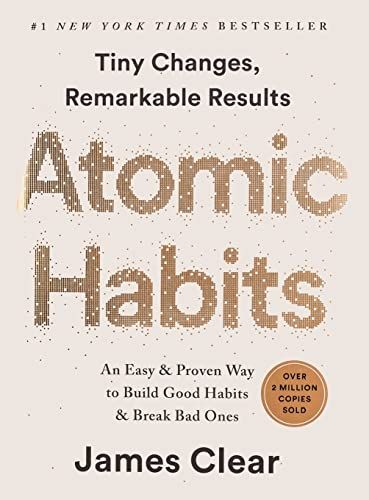
The Anatomy of Impact: Building a Better World with Atomic Habits
Golden Hook & Introduction
SECTION
Nova: We all have these huge, world-changing ambitions, right? Whether it's in our career, our community, or just our own life. But what if the secret to achieving those monumental goals wasn't some grand, heroic effort? What if it was hidden in a single, two-minute action you could take today? Welcome to the show, everyone. Today, we're diving into a book that has completely reshaped how we think about progress and success: "Atomic Habits" by James Clear. And I am so thrilled to explore it with Theresa Ayeshung, an anatomist and the founder of the ComfortHer Foundation, an organization dedicated to creating sustainable impact in education and gender equality. Theresa, thank you for being here.
Theresa Ayeshung: Thank you for having me, Nova. That opening question is something I grapple with every single day. My foundation has these massive, long-term visions, but the work happens in small, quiet moments. The gap between the two can feel overwhelming, so I'm excited to dig into a framework that promises to bridge it.
Nova: Exactly! And that's the magic of this book. Clear argues that real, lasting change comes from the compound interest of tiny, "atomic" habits. It's not about one giant leap; it's about a thousand tiny steps. Today we'll dive deep into this from two powerful perspectives. First, we'll explore the profound idea of identity-based habits—how becoming the right person makes doing the right thing effortless. Then, we'll discuss how to move beyond fleeting goals and build powerful systems that create sustainable, long-term change.
Theresa Ayeshung: I love that structure. It’s the 'who' and the 'how.' It sounds like a blueprint for purpose.
Deep Dive into Core Topic 1: The Power of Identity
SECTION
Nova: It really is. So let's start with that 'who.' James Clear says most people try to change the wrong thing. We focus on what we want to achieve—the outcome. Or we focus on what we need to do—the process. But he argues the deepest layer, the one that really sticks, is changing our identity. It's about changing who we believe we are.
Theresa Ayeshung: That immediately resonates. In my work, we can give a young woman all the resources in the world, but if she doesn't see herself as someone who is capable and deserving of success, the resources won't be used to their full potential. The internal story is everything.
Nova: Precisely. And Clear gives this incredible real-world example of how small actions build that internal story. He talks about the British Cycling team. For over a hundred years, they were completely mediocre. They’d never won a Tour de France. They were so bad, one top bike manufacturer refused to sell them bikes, fearing it would hurt their brand if other professionals saw the British team using their gear.
Theresa Ayeshung: Wow, that's a low point.
Nova: A very low point. But then, in 2003, they hired a new performance director, Dave Brailsford. He had a philosophy he called "the aggregation of marginal gains." His belief was that if you could just improve every single tiny thing you do by 1%, those gains would add up to remarkable improvement.
Theresa Ayeshung: So he wasn't looking for a single magic bullet. He was looking for hundreds of small advantages.
Nova: Exactly. And they went to obsessive lengths. They redesigned the bike seats to be more comfortable. They rubbed alcohol on the tires for better grip. They had the riders wear electrically heated overshorts to maintain ideal muscle temperature. But they didn't stop there. They tested different massage gels to see which led to the fastest muscle recovery. They hired a surgeon to teach each rider the best way to wash their hands to reduce the chances of catching a cold. They even determined the best type of pillow and mattress that led to the best night's sleep for each rider and brought them to hotels on the road.
Theresa Ayeshung: That's incredible. It's a holistic, almost microscopic, view of performance. As an anatomist, that speaks to me. You're not just looking at the big muscles; you're looking at the cellular level.
Nova: And the results were stunning. Within five years, the British Cycling team dominated the 2008 Olympic Games. They did it again in 2012. From 2012 to 2018, they won five Tour de France titles. It became the most successful run in cycling history. And Clear's point is this: each one of those tiny actions—testing a pillow, washing your hands a certain way—was a small vote. It was a vote that said, "I am the type of person who pursues excellence. I am a winner."
Theresa Ayeshung: That's the connection. The action reinforces the identity. It's not about telling a girl in one of our programs, "You are a leader." That's just words. It's about creating an opportunity for her to do one small thing a leader does—maybe it's asking one thoughtful question in a group discussion. The first time, it's an act. The second time, it's a pattern. The tenth time, it becomes part of her identity. She starts to see herself as "the kind of person who contributes valuable ideas."
Nova: Yes! You just articulated it perfectly. Every action you take is a piece of evidence for your identity. A two-minute workout might not transform your body, but it casts a vote for "I am someone who doesn't miss workouts." Writing one sentence casts a vote for "I am a writer."
Theresa Ayeshung: It reframes the purpose of the habit. The goal isn't just to get the task done. The goal is to become the person. This is a powerful shift for the young women we work with. We're not just teaching them to code; we're helping them become coders. We're not just teaching them public speaking; we're helping them become advocates. The identity is the sustainable part. The skill is just the tool.
Nova: I love that framing. The identity is sustainable. And that's the perfect bridge to our second big idea. Once you know the identity you're voting for, how do you make sure you keep showing up to the polls every single day?
Deep Dive into Core Topic 2: The Architecture of Consistency
SECTION
Nova: This is where James Clear says we need to forget about goals and fall in love with systems. What do you think when you hear that? It sounds a little counterintuitive.
Theresa Ayeshung: My first reaction is relief. Goals can be so paralyzing, especially the big ones we have, like "achieve gender equality." A goal like that is so distant, it doesn't tell you what to do at 9 a. m. on a Tuesday. It can actually be demotivating. A system, on the other hand, feels actionable. It feels like a process I can trust.
Nova: That's the core distinction. A goal is the result you want to achieve. The system is the collection of daily habits that will get you there. Clear uses a great sports analogy: The goal of any sports team is to win the championship. But it would be absurd for them to spend all game staring at the scoreboard. The winners and the losers have the same goal. What separates them is their system for practice, for execution, for improvement.
Theresa Ayeshung: Right. If you're a football coach, your system is your recruiting process, your assistant coaches, the drills you run every single practice. The championship is just a moment in time; the system is what runs all year long. It's what makes winning possible in the first place.
Nova: And if you focus only on the goal, you create this "yo-yo" effect. You work hard to run a marathon, you cross the finish line... and then what? You stop training because the goal is accomplished. But if your identity is "I am a runner," and your system is "I run three times a week," then the marathon is just one event along the journey. You continue the system long after the race is over.
Theresa Ayeshung: This is so critical for organizations, especially non-profits. Our goal isn't just to run one successful program. Our mission is to create "sustainable impact." Sustainability, by definition, cannot be a goal. It must be a system. From my perspective as an anatomist, it's like the human body. Being 'healthy' isn't a finish line you cross. Health is the emergent property of dozens of interlocking systems—your circulatory system, your digestive system, your immune system—all working in harmony. You don't "achieve" health; you maintain it through the continuous operation of these systems.
Nova: What a powerful analogy. Health is an emergent property of balanced systems. So, for your foundation, what does that look like in practice?
Theresa Ayeshung: It means we have to stop being obsessed with just the graduation numbers—that's the goal. We have to become obsessed with perfecting our systems. What is our system for identifying girls who need our help? What is our system for training mentors? What is our system for curriculum development that ensures it's always relevant? What is our system for following up with graduates to ensure they're thriving? If those systems are excellent, the positive outcomes—the "goals"—become a natural byproduct.
Nova: And you can see how the two ideas we've discussed are perfectly intertwined.
Theresa Ayeshung: Absolutely. The system is the machine that allows you to cast those votes for your identity, day after day, almost on autopilot. If you want to become a writer, your system is "I write for 15 minutes every morning at my kitchen table with a cup of coffee." You're not waiting for inspiration; the system runs itself. And every time the system runs, you cast another vote for "I am a writer." The system builds the identity.
Nova: And the identity makes running the system feel natural. It's a beautiful, self-reinforcing loop. You're no longer forcing yourself to do something. You're simply acting in alignment with who you believe you are.
Synthesis & Takeaways
SECTION
Nova: So, as we bring this all together, it feels like Clear has given us this elegant, two-part formula for achieving almost anything. First, you start with the 'who.' You decide the type of person you want to be. And second, you build the 'how.' You design a system of tiny, obvious, easy habits that prove that identity to yourself, every single day.
Theresa Ayeshung: It's a shift from chasing outcomes to cultivating an identity. It's less about the frantic pursuit of a goal and more about the patient cultivation of a character. For anyone in a leadership position, or anyone who is an educator or a parent, this is a profound insight. Our job isn't just to set targets for people. It's to help them build an identity that pulls them toward success.
Nova: That's so well said. It’s about creating pull, not just push. So, Theresa, as we close, what is the one core idea or question you'd want to leave our listeners with, especially those who, like you, are trying to make a real impact in the world?
Theresa Ayeshung: I think it comes down to making it practical. So I would ask everyone to think about two things. First, for yourself: What is one, almost laughably small, two-minute habit you can start tomorrow that casts a vote for the person you truly want to become? Don't overthink it. Make it tiny. The point is not the action itself, but the vote it represents.
Nova: I love that. A laughably small habit.
Theresa Ayeshung: Exactly. And second, for those of us who lead, manage, or mentor others, the question is slightly different: What is one system we can build that makes it easier for the people we serve to cast votes for best selves? How can we design an environment where doing the right thing, the thing that builds their desired identity, is the easiest and most obvious choice? Because that, I believe, is how we move from just having a mission to creating real, sustainable, atomic-level impact.
Nova: A powerful and perfect place to end. Theresa Ayeshung, thank you so much for sharing your wisdom and connecting these ideas in such a meaningful way.
Theresa Ayeshung: It was my absolute pleasure, Nova. This was a fantastic conversation.