

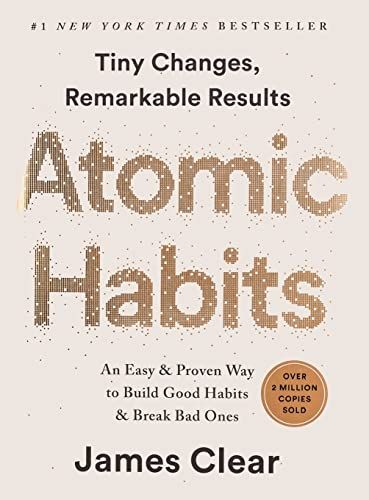
Deconstructing Discipline: A Systems-Thinking Approach to Atomic Habits
Golden Hook & Introduction
SECTION
Nova: What if I told you that becoming a more disciplined, consistent person has almost nothing to do with willpower? That the people we admire for their consistency aren't heroes—they're just better architects of their daily lives. For anyone who loves building systems, like our guest today, this idea is a game-changer.
Nova: Welcome to the show, everyone. Today, we're diving into James Clear's masterpiece, "Atomic Habits," with a very special guide: Leonardo Fuentes Pereira, a data analyst who spends his days optimizing complex systems in the world of logistics. Leonardo, welcome!
Leonardo Fuentes Pereira: Thanks for having me, Nova. That intro hits home. In my world, if a system fails, we don't blame the people; we fix the system. The idea of applying that to personal habits is fascinating.
Nova: Exactly! And that's our mission today. We're going to deconstruct this book from two perspectives. First, we'll explore the foundational shift from chasing goals to building an identity—the 'who' before the 'what'. Then, we'll get tactical and break down the four simple laws you can use as an engineer's toolkit to design the habits that make that identity inevitable.
Leonardo Fuentes Pereira: I'm ready. It sounds like we're moving from wishful thinking to deliberate design.
Nova: That's the perfect way to put it. Deliberate design.
Deep Dive into Core Topic 1: Identity Over Outcomes
SECTION
Nova: So let's start with that foundational idea, Leonardo. Clear argues that most of us try to change the wrong thing. We set goals focused on an outcome—like 'I want to run a marathon' or 'I want to write a book.' But he says the real change happens when we focus on our identity—'I want to become a runner,' or 'I want to become a writer.' What does that distinction feel like to you, as someone who thinks in systems?
Leonardo Fuentes Pereira: It feels like the difference between focusing on a single, lagging indicator versus improving the entire process that produces the indicators. A goal, like a Key Performance Indicator or KPI, is just a snapshot in time. It tells you what happened. But the process, the, is what generates those results consistently.
Nova: Ah, so the goal is the 'what,' the identity is the 'how.'
Leonardo Fuentes Pereira: Exactly. Clear's idea that every action you take is a vote for the type of person you wish to become is, from a data perspective, brilliant. Every time you lace up your shoes and run, even for five minutes, you're not just running. You're casting a vote for your identity as 'a runner.' You're collecting data points that prove your new identity to yourself. The goal of running a marathon might be months away, but the identity reinforcement is immediate.
Nova: I love that framing—'collecting data points' for your new identity. It makes it feel so much more tangible. This reminds me of the most powerful story in the book, the one about the British Cycling team.
Leonardo Fuentes Pereira: Oh, the aggregation of marginal gains. Yes.
Nova: For our listeners, let me set the scene. For about a hundred years, Great Britain's professional cycling was, frankly, mediocre. They'd had only one gold medal in a century of Olympics. No British cyclist had ever won the Tour de France. It was so bad that one of the top bike manufacturers in Europe refused to sell bikes to the team because they were afraid it would hurt their reputation if other pros saw the Brits using their gear.
Leonardo Fuentes Pereira: That’s a pretty low starting point.
Nova: The lowest. Then, in 2003, they hire a new performance director named Dave Brailsford. And his approach was completely different. He didn't come in and announce, "Our goal is to win the Tour de France." Instead, he introduced this concept he called "the aggregation of marginal gains."
Leonardo Fuentes Pereira: Which is just a fancy way of saying "let's get 1% better at everything."
Nova: Everything. And I mean everything. They started with the obvious things you'd expect: they redesigned the bike seats to be more comfortable, they tested different fabrics in a wind tunnel to find lighter, more aerodynamic racing suits. They had their outdoor riders train on indoor bikes to reduce wear and tear. But then they went further.
Leonardo Fuentes Pereira: This is the part I love.
Nova: Right? They tested different massage gels to see which one led to the fastest muscle recovery. They hired a surgeon to teach each rider the best way to wash their hands to reduce the chances of catching a cold. They figured out the type of pillow and mattress that led to the best night's sleep for each rider. They even painted the inside of the team truck white.
Leonardo Fuentes Pereira: And that was to spot any tiny specks of dust that could get into the finely tuned bike mechanics and degrade performance. It's so granular.
Nova: It's almost obsessive! But the results were staggering. Just five years after Brailsford took over, the British Cycling team dominated the 2008 Beijing Olympic Games, winning 60 percent of the gold medals available. Then they won the Tour de France multiple times. It was a complete transformation.
Leonardo Fuentes Pereira: Because he wasn't chasing a goal. He was building a system of excellence. The identity they were building was 'we are a team that relentlessly pursues tiny improvements.' The winning was just a byproduct of that identity. In logistics, a 1% efficiency gain in a truck's route, or a 1% reduction in package loading time... they seem insignificant on their own. But when you scale that across a million packages a day, the impact is monumental. Brailsford treated the cycling team like a complex supply chain to be optimized, not a single trophy to be won.
Nova: And that's so empowering for us as individuals. If you want to become a more spiritual or mindful person, the goal isn't to 'achieve enlightenment.' The identity is 'I am a mindful person.' And the atomic habit, that 1% improvement? Maybe it's just meditating for one minute when you wake up. You're casting a vote. You're painting the inside of your truck white.
Leonardo Fuentes Pereira: You're building the system. The results will follow.
Deep Dive into Core Topic 2: The Four Laws as an Engineering Toolkit
SECTION
Nova: Okay, so if the mission is to build an identity by casting these small, daily votes, that brings us to the big, practical question: how do we actually it? Especially when we're tired or unmotivated. This is where Clear gives us what I think of as an engineer's toolkit: The Four Laws of Behavior Change.
Leonardo Fuentes Pereira: This is the tactical part. I see this as the user interface for your own life.
Nova: A user interface! Tell me more about that.
Leonardo Fuentes Pereira: Well, the four laws are essentially principles of good design. You're designing your environment and your routines to make the desired action the path of least resistance. You're improving the user experience of your own habits.
Nova: I love that. Okay, so let's break them down. The framework is a simple loop: Cue, Craving, Response, Reward. And the four laws tell us how to engineer that loop. Law 1 is: Make it Obvious.
Leonardo Fuentes Pereira: Which is about designing a better cue. Making it impossible to miss.
Nova: Exactly. Clear tells a simple story about a woman who kept forgetting to take her daily medication. She tried setting reminders, but they didn't work. The solution? She just moved the pill bottle from the medicine cabinet in the bathroom to right next to her coffee maker on the kitchen counter. She never missed a day again. The cue—the pill bottle—became part of a routine she already did every single morning. It became obvious.
Leonardo Fuentes Pereira: She integrated the cue into an existing workflow. It's smart. The opposite is true for bad habits. If you want to stop snacking on junk food, you 'Make it Invisible.' You don't leave the cookies on the counter. You hide them in the back of the pantry. You're manipulating the cue.
Nova: Right. Then comes Law 2: Make it Attractive. This is about the craving. How do you make yourself to do the habit? My favorite technique here is what he calls "Temptation Bundling."
Leonardo Fuentes Pereira: This is where you hack your own reward system.
Nova: Totally! You pair an action you to do with an action you to do. For example, a student he coached loved watching Netflix but hated exercising. The rule became: 'I can only watch Netflix while I'm on the stationary bike at the gym.'
Leonardo Fuentes Pereira: So he's linking the dopamine hit of the 'want'—the show—to the 'need'—the exercise. The craving to find out what happens next in the show becomes the craving to get on the bike. It's an elegant way to pull yourself forward.
Nova: It really is. Okay, Law 3 is maybe the most important for getting started: Make it Easy.
Leonardo Fuentes Pereira: Reduce the friction. Any good systems designer knows that the number of steps between a user and a desired action is critical. The more steps, the lower the completion rate.
Nova: And this is where he gives us the magical "Two-Minute Rule." The idea is that any new habit should take less than two minutes to do. 'Read before bed each night' becomes 'Read one page.' 'Do thirty minutes of yoga' becomes 'Take out my yoga mat.'
Leonardo Fuentes Pereira: That's a Minimum Viable Habit.
Nova: A what?
Leonardo Fuentes Pereira: In software development, we talk about a Minimum Viable Product, or MVP. It's the simplest, most basic version of a product you can release to get started and gather feedback. This is the same principle for habits. 'Take out my yoga mat' is the Minimum Viable Habit. You're not trying to build the perfect, 30-minute yoga practice on day one. You're just trying to master the art of showing up. The system can be optimized later, but you can't optimize a habit that doesn't exist.
Nova: Master the art of showing up. That's the whole game. And finally, Law 4: Make it Satisfying. The habit has to deliver a reward.
Leonardo Fuentes Pereira: This closes the feedback loop. It tells your brain, 'Hey, that was good. Let's do it again.' The problem is that many good habits have a delayed reward. The benefit of exercising today won't show up for months. Bad habits are the opposite; their reward is immediate.
Nova: So we have to create an immediate reward. And his simplest tool is a habit tracker. Just a simple calendar where you put an 'X' on every day you complete your habit. That little 'X' is a small, immediate hit of satisfaction. It's visual proof that you're casting votes for your new identity.
Leonardo Fuentes Pereira: It's a short-term feedback loop for a long-term process. That 'X' is a satisfying data point that says the system is working. It's a visual representation of your momentum. And as anyone in data knows, momentum is a powerful force.
Synthesis & Takeaways
SECTION
Nova: So, when we put it all together, it's a surprisingly simple, two-step process. It's not about a massive, heroic effort. First, you decide who you want to be. Not what you want to achieve, but you want to be. A writer? A healthy person? A systems-driven leader?
Leonardo Fuentes Pereira: Exactly. You have to define the identity first. That's the target state for the system. Then, you use those Four Laws as your engineering toolkit to design a system of tiny, atomic habits that cast votes for that identity. You make the cues obvious, the actions attractive and easy, and the rewards satisfying. You stop trying to force an outcome and start designing an inevitable process.
Nova: I love that phrase. 'Designing an inevitable process.' It takes the pressure off willpower and puts the focus on intelligent design. So, for everyone listening, and for you, Leonardo, here's the challenge for this week. Pick one identity you want to build. Just one.
Leonardo Fuentes Pereira: And then find the two-minute version of a habit that casts a vote for it. Don't try to overhaul your entire life overnight. Just install one, tiny, atomic habit. Start there. That's your first 1% improvement. That's the first data point.
Nova: The first data point in a new system. Leonardo, this has been an incredibly insightful way to look at this. Thank you so much for bringing your systems-thinking brain to the conversation.
Leonardo Fuentes Pereira: It was my pleasure, Nova. It's powerful to think we can all be the architects of our own habits.
Nova: To everyone listening, what's the one identity you'll start building today? We'll see you next time.