

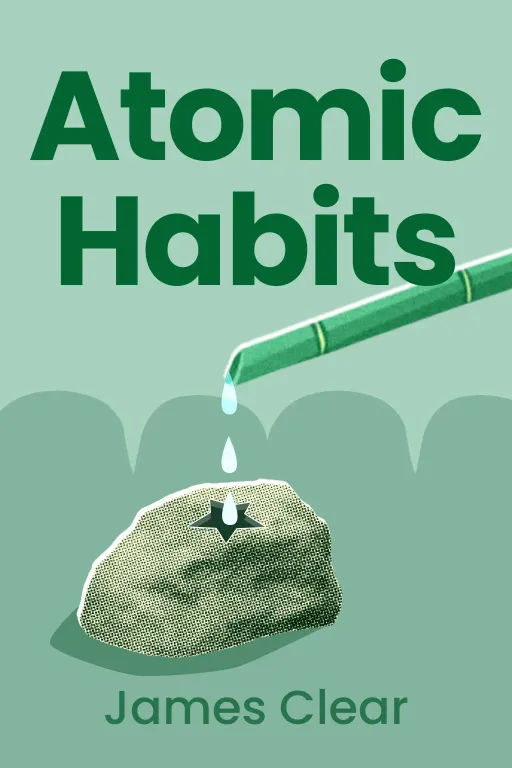
The Writer's Blueprint: Forging a New Identity with Atomic Habits
Golden Hook & Introduction
SECTION
Nova: Aracely, as a writer, you know better than anyone that a character isn't defined by what they say they want, but by what they do, day after day. A hero is a hero because of a thousand small, brave acts, not one grand declaration.
Aracely A. Valdivia P.: That's absolutely right. It's the classic rule: show, don't tell. Their actions write their story.
Nova: Exactly! So what if we applied that same principle to our own lives? What if the secret to lasting change isn't about setting big, audacious goals, but about consciously authoring a new identity, one tiny action at a time?
Aracely A. Valdivia P.: I love that framing. To become the author of your own character arc.
Nova: That’s the revolutionary idea at the heart of James Clear's 'Atomic Habits,' and it’s what we’re exploring today. Today we'll dive deep into this from two perspectives. First, we'll explore why true behavior change is actually identity change, and what it means to 'become the book' you want to write for your life.
Aracely A. Valdivia P.: And then, we'll get practical.
Nova: You got it. Then, we'll discuss how to build the real-world systems that make this new identity not just possible, but inevitable. So, for everyone listening, if you've ever felt stuck in a loop, making and breaking the same resolutions, this conversation is for you.
Deep Dive into Core Topic 1: True Change is Identity Change
SECTION
Nova: So let's start there, with this powerful idea of identity. Clear says there are three layers of change: outcomes, processes, and identity. Most of us, and I'm raising my hand here, we start at the wrong end, don't we?
Aracely A. Valdivia P.: We absolutely do. We say, "I want to lose 20 pounds," which is an outcome. Or "I'm going to go to the gym three times a week," which is a process. But we're missing the core.
Nova: Exactly. Clear gives this brilliant, simple example. Imagine two people who are trying to quit smoking. Someone offers them a cigarette. The first person says, "No thanks, I'm trying to quit."
Aracely A. Valdivia P.: Hmm, I see where this is going. That person still sees themselves as a smoker, just one who is currently resisting. The identity is still there.
Nova: Precisely. But the second person says, "No thanks. I'm not a smoker." The change is subtle, but it's everything. It's a statement of identity. They are no longer the person who does that thing. They've started to author a new character for themselves.
Aracely A. Valdivia P.: That's fascinating, Nova. It really is the ultimate 'show, don't tell.' A character in a book who brave doesn't walk around saying, 'I'm brave.' They just run into the burning building when the moment comes. Clear is saying we need to stop ourselves we want to change and start ourselves, through our actions, who we've decided to be.
Nova: And he has this quote that just sticks with you: "Every action you take is a vote for the type of person you wish to become." Every time you choose the salad, you're casting a vote for "I am a healthy person." Every time you write one page, you're casting a vote for "I am a writer."
Aracely A. Valdivia P.: And the votes add up. One vote doesn't win an election, but enough of them create a landslide. It's not about the one heroic, all-night writing session; it's about the hundred quiet mornings where you just showed up and cast your vote.
Nova: You know, this was forged in his own life. Clear tells this harrowing story from high school. He was a promising baseball player, and on the last day of his sophomore year, a loose bat flew through the air and hit him square in the face. It was a devastating injury. We're talking a broken nose, multiple skull fractures, shattered eye sockets. He was in a medically induced coma.
Aracely A. Valdivia P.: Oh my gosh, that's terrifying.
Nova: It was. And his recovery was painstakingly slow. When he finally got back on the field a year later, he was a shadow of his former self. He was cut from the varsity team. It would have been so easy for him to accept a new identity: "the guy who had a bad accident." But in college, he decided to focus on tiny, almost invisible habits. He didn't focus on the outcome of being a star player. He focused on the identity of a professional. He organized his sleep schedule. He kept his room clean. He studied better. He lifted weights consistently.
Aracely A. Valdivia P.: He was casting votes. Small, seemingly insignificant votes.
Nova: Vote by vote. And by his senior year, he was the top male athlete at his university and an Academic All-American. He didn't get there by setting a goal. He got there by deciding who he wanted to be—a professional, disciplined person—and then proving it to himself with tiny wins, every single day.
Aracely A. Valdivia P.: That's so powerful for a spiritual life, too. As an ENFJ, I'm always thinking about growth and connection. And this reframes it. It’s not about one big moment of enlightenment or a week-long retreat. It’s the small, daily 'votes'—a moment of gratitude when you wake up, an act of kindness for a stranger, choosing to listen instead of speak—that build the identity of a compassionate, mindful person. It makes it feel so much more accessible.
Nova: It makes it real. It takes it from a wish to a practice.
Deep Dive into Core Topic 2: Building a System for Your Identity
SECTION
Nova: Exactly! It's about making it accessible. And that brings us perfectly to our second point. If our identity is built by these 'votes,' how do we make sure we're consistently voting the right way, especially when life gets busy or we're not feeling motivated? Clear's answer is powerful: You don't rise to the level of your goals. You fall to the level of your systems.
Aracely A. Valdivia P.: I need that embroidered on a pillow. "You fall to the level of your systems." That's a line a writer can appreciate. It speaks to the structure beneath the story.
Nova: It's everything! And the best story he uses to illustrate this is the transformation of British Cycling. For a hundred years, they were mediocre. Just… nothing special. They’d won a single Olympic gold medal in their entire history. No British cyclist had ever won the Tour de France. Bike manufacturers wouldn't even sell them gear because they didn't want to be associated with them.
Aracely A. Valdivia P.: Wow, that's a pretty low starting point.
Nova: The lowest. Then, in 2003, they hired a new performance director, Dave Brailsford. And he had this philosophy he called "the aggregation of marginal gains." He believed if they could just improve every single tiny thing that goes into riding a bike by just 1 percent, the gains would compound into a massive victory.
Aracely A. Valdivia P.: So we're not talking about a new star athlete. We're talking about the small stuff.
Nova: The tiniest stuff! They redesigned the bike seats to be more comfortable. They rubbed alcohol on the tires for better grip. They tested different massage gels to see which one led to the fastest muscle recovery. They hired a surgeon to teach the riders the best way to wash their hands to avoid getting sick. They even painted the inside of the team truck white to spot dust that might compromise the finely tuned bikes.
Aracely A. Valdivia P.: That is an obsession with the system. It's not about the goal of 'winning the Tour de France.' It's about building the identity of a team that overlooks nothing, that is 1% better everywhere.
Nova: And the results were staggering. In the 2008 Beijing Olympics, they won 60% of the available gold medals. In 2012, they set nine Olympic records. They went on to win five Tour de France titles in six years. They didn't get better by trying harder. They got better by building a system where excellence was the inevitable outcome.
Aracely A. Valdivia P.: I love that. As a writer, 'writer's block' is the great enemy. We treat it like this mystical force. But what if it's not a block, but a system failure? Maybe my system for writing is just 'I hope I feel inspired today.' That's a terrible system!
Nova: A terrible system!
Aracely A. Valdivia P.: But a new system, an Atomic Habits system, could be different. It's based on Clear's Four Laws, right? Make it Obvious, Attractive, Easy, and Satisfying. So the system isn't 'write a chapter.' The system is: 'Make the cue obvious'—my laptop is already open to the document when I get my coffee. 'Make it attractive'—my favorite tea and a special playlist are right next to it. 'Make it easy'—I only have to write for two minutes. Anyone can do that. That's a system that invites you in.
Nova: That's it! You're designing the path of least resistance to lead directly to your desired identity. Look at the hospital cafeteria study Clear mentions. A hospital wanted to improve the eating habits of its staff. They could have run a motivation campaign, put up posters...
Aracely A. Valdivia P.: The usual stuff that doesn't really work.
Nova: Right. Instead, they just changed the environment. They added bottled water to every single drink refrigerator in the cafeteria. Before, it was just soda. Over three months, soda sales dropped by 11 percent, and water sales shot up by 26 percent. They didn't change anyone's motivation. They just made the good habit the obvious, easy choice.
Aracely A. Valdivia P.: So, the real secret to self-control isn't having more willpower, it's needing to use it less because you've designed a world where you're not constantly fighting temptation? As a leader, that's a huge insight. How do I design a system for my team where the 'right' work, the deep, focused work, is the most obvious and easy path? Is the system encouraging distraction or focus?
Nova: That's the question. Is your environment casting votes for or against the identity you want to build?
Synthesis & Takeaways
SECTION
Nova: This has been so good. We have these two powerful, interconnected ideas from "Atomic Habits." First, focus on the identity you want to build—the kind of person you want to be—not the goal you want to hit.
Aracely A. Valdivia P.: Start with 'who' before 'what.' Become the person who could achieve those things.
Nova: Exactly. And second, build a system, an environment, that makes casting votes for that identity the most natural, obvious, and easy thing in the world. Design your life to make good habits the default.
Aracely A. Valdivia P.: It's about moving from being a character in a story that's happening you, to being the author who is consciously designing the plot.
Nova: Beautifully put. So, what's the final takeaway for our listeners? Where do they start?
Aracely A. Valdivia P.: I think we can get overwhelmed by the idea of building a whole new identity. It sounds so big. But Clear's whole point is that it's not. It's atomic. It's tiny. So maybe the best way to start is to ask yourself a simple question: The person I want to be in a year—the disciplined writer, the present parent, the compassionate leader—what's one small, two-minute action would do today?
Nova: The Two-Minute Rule. I love it.
Aracely A. Valdivia P.: Don't think about writing the whole book, just write the first sentence. Don't think about meditating for an hour, just sit on the cushion for one minute. Start there. That single vote, that one tiny piece of evidence you give yourself, might be the one that changes everything.









