

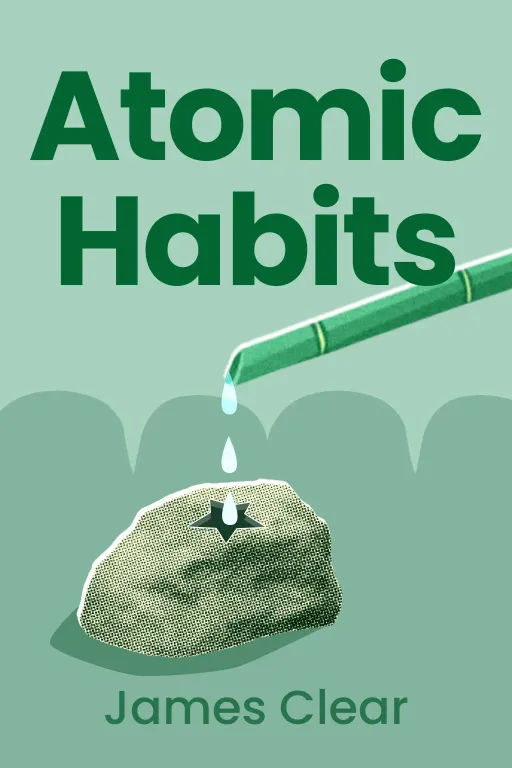
The Product Blueprint: Deconstructing Atomic Habits for Tech Innovators
Golden Hook & Introduction
SECTION
Atlas: You're a product manager. Your goal is to ship a game-changing feature that skyrockets user engagement. But what if I told you that focusing on that goal is the very thing holding your product back? That the secret to remarkable results lies not in the finish line, but in the tiny, almost invisible steps you take every single day.
Susu: That's a provocative start, Atlas. It's counterintuitive, but it immediately rings true. We're so conditioned to aim for the big, shiny objective.
Atlas: Exactly. And today, we are tearing down James Clear’s mega-bestseller,, and rebuilding it for the world of tech and product. We're here with Susu, a product manager intern at a tech company who lives and breathes this stuff. Welcome, Susu.
Susu: Thanks for having me, Atlas. I'm excited. This book feels like it was written for anyone trying to build something, whether it's a career or a piece of software.
Atlas: I couldn't agree more. Together, we'll tackle this from two powerful perspectives. First, we'll explore why focusing on your 'systems' rather than your 'goals' is the secret weapon for any product team. Then, we'll get personal and discuss how your habits actually shape your professional identity, and why that's the real key to lasting change. Ready to build?
Susu: Let's do it.
Deep Dive into Core Topic 1: Systems Over Goals
SECTION
Atlas: Alright, Susu, let's jump right in. Systems over goals. To make this real for everyone, Clear tells this absolutely incredible story about British Cycling. Picture this: for a hundred years, they were the definition of mediocre. They had won a single gold medal in a century. Top bicycle manufacturers wouldn't even sell them bikes because they didn't want to be associated with the team's poor performance.
Susu: Wow. That's a tough place to start from. It sounds like a startup with zero traction.
Atlas: Precisely. Then, in 2003, they hire a new performance director, Dave Brailsford. And his approach is completely different. He doesn't plaster "Win the Tour de France" on the wall. Instead, he introduces a philosophy he calls "the aggregation of marginal gains."
Susu: I love that phrase. It sounds like something you'd hear in a sprint planning meeting.
Atlas: It is! His idea was simple: if you improve every single thing that goes into riding a bike by just 1 percent, you'll get a significant increase when you put it all together. And I mean. They redesigned the bike seats to be more comfortable. They tested different massage gels to see which one led to the fastest muscle recovery. They hired a surgeon to teach the riders the best way to wash their hands to avoid getting sick.
Susu: Wait, hand washing? That seems so far removed from cycling.
Atlas: That's the point! It's the system. They even painted the inside of the team truck white. Why? To make it easier to spot tiny bits of dust that could compromise the performance of the finely tuned bikes. The goal wasn't "win." The system was "find and improve a thousand tiny things."
Susu: Okay, so what happened? Did this obsessive focus on the system actually work?
Atlas: Did it ever. The results were staggering. Within five years, the British Cycling team dominated the 2008 Beijing Olympics, winning 60% of the available gold medals. At the 2012 London Olympics, they set nine Olympic records. Then, a British cyclist won the Tour de France for the first time ever in 2012, and they kept winning it for years after. They went from a laughingstock to arguably the most successful team in cycling history. They didn't rise to the level of their goals; they fell to the level of their systems. Susu, connect this to your world. How is this not just a sports story, but a product management playbook?
Susu: Oh, it's a perfect playbook. In product, we live by this, even if we don't call it "marginal gains." Think about A/B testing. We rarely launch a massive, brand-new homepage and hope it works. Instead, we test a dozen small things. What if we change the button color? That's a 1% conversion lift. What if we tweak the headline? Another 0.5% lift. What if we reduce the page load time by 100 milliseconds? Another 1% of users don't bounce.
Atlas: So you're not aiming for one giant win.
Susu: Exactly. The goal, "Increase user retention by 20%," is just a direction. The is our weekly experimentation cycle, our process for analyzing user data, the daily stand-up where we remove blockers, the way we write user stories. That's the engine. The British Cycling story is so powerful because it shows that if your system is excellent, the results, the goals, they almost take care of themselves. You're not hoping to win; you're building a machine that's designed to win.
Atlas: A machine designed to win. That's it. And that machine, that system, does more than just produce results. It starts to change the people running it.
Susu: Yes, it changes their identity.
Atlas: That's a perfect bridge. Because the system you build doesn't just produce a better product... it forges an identity. This brings us to the second, and maybe more profound, idea from the book: identity-based habits.
Deep Dive into Core Topic 2: Identity-Based Habits
SECTION
Atlas: Clear breaks down change into three layers. At the surface, you have changing your outcomes—like losing weight or hitting a revenue target. Deeper, you have changing your process—like implementing a new workout routine or, as we just discussed, a new system. But the deepest level, the core, is changing your identity. Your beliefs. Who you see yourself as.
Susu: And he argues that most people start at the wrong end, right? They focus on the outcome they want, the "what."
Atlas: Exactly. But the most powerful change starts from the inside out. It starts with "who." He gives this brilliant example. Imagine two people who are offered a cigarette. The first person says, "No thanks, I'm." The second person says, "No thanks,."
Susu: Mmm, that's a huge difference. The first person still identifies as a smoker who is fighting an urge. The second person's identity has already shifted. It's not a struggle; it's just who they are.
Atlas: You nailed it. The "I'm not a smoker" statement isn't about willpower; it's a declaration of identity. And every time you perform a habit, you are casting a vote for a certain type of identity. Clear tells another story about a man who lost over 100 pounds. His whole strategy was to ask himself one question before every action: "What would a healthy person do?" Would a healthy person take the elevator or the stairs? Would a healthy person order a burger or a salad?
Susu: So he wasn't just following a diet plan. He was trying to embody an identity. Each choice was a small win, a little piece of evidence that he was, in fact, becoming a healthy person.
Atlas: That's the core of it. True behavior change is identity change. The goal isn't to read a book; it's to become a reader. The goal isn't to run a marathon; it's to become a runner. As someone who's just starting out and building your professional identity as a product manager, how does this idea land with you?
Susu: It's incredibly powerful, Atlas. It reframes my entire daily to-do list. It's easy to get bogged down in tasks and think, "Okay, I need to write this product spec, I need to answer these emails." That's outcome-based thinking.
Atlas: Right, just checking boxes.
Susu: But the identity-based approach changes the question. Instead of "What do I need to do?" I can ask, "Who do I want to be as a product manager?" I want to be a PM who is deeply user-centric. So, before I open my email, I can ask, "What would a user-centric PM do right now?" Well, they'd probably spend five minutes reading the latest customer support tickets or watching a user session recording. That's a small action, a tiny vote for that identity.
Atlas: I love that. A vote for your identity.
Susu: And as an ENFJ, a "Protagonist," this resonates on a leadership level, too. When you're leading a team, you're not just trying to hit a deadline. You're trying to build a team identity. Are we a team that values speed over quality? Are we a team that's obsessed with data? Every decision, every process you implement is a vote for that collective identity. It's a much more inspiring way to lead than just managing a project plan.
Atlas: So you're saying the system you build is the mechanism for casting votes for the identity you want to create, for yourself and for your team.
Susu: That's the connection! The two ideas are perfectly intertwined. Your system of marginal gains isn't just about improving a metric; it's about repeatedly proving to yourself, "This is who we are."
Synthesis & Takeaways
SECTION
Atlas: That's it. It's a one-two punch. First, you stop chasing shiny goals and instead build a robust system of continuous, 1% improvements.
Susu: And second, you recognize that every action within that system is a vote. A vote that shapes your identity into the very person or team capable of achieving remarkable things.
Atlas: It's a fundamental shift from "having" to "being." You don't just want to a successful product; you want to the kind of team that consistently builds successful products.
Susu: And that's a journey, not a destination. The book makes it clear that this is an endless process of refinement.
Atlas: Which brings us to the final takeaway. This isn't about a massive overhaul. It's about starting small. Atomically small. So for everyone listening, especially those building a career or a product, here's the challenge: What is one, tiny, two-minute habit you can start today that casts a vote for the professional you want to become?
Susu: I'll give a concrete example. If you want to be a more data-driven PM, don't set a goal to "master data analytics." That's too big. Instead, use the Two-Minute Rule from the book. Your new habit is: "Every morning, before I check Slack, I will open our product's analytics dashboard and look at one metric for two minutes." That's it.
Atlas: Just two minutes.
Susu: Just two minutes. It's so small you can't say no. But it's a vote. You're casting a vote for "I am a data-driven PM." And those votes, as James Clear shows us, are what compound into results that last.
Atlas: Build the system. Become the person. Susu, thank you for breaking this down with us.
Susu: This was a blast, Atlas. Thanks for having me.









