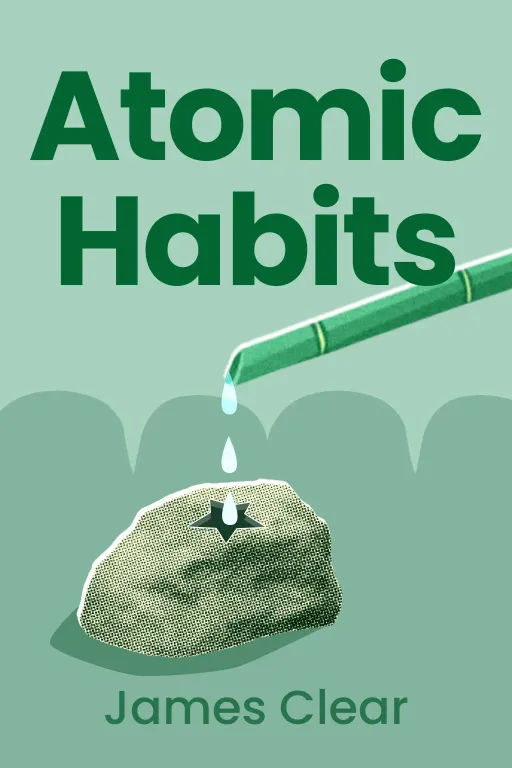
The Leader's Operating System: Forging Identity with Atomic Habits
Golden Hook & Introduction
SECTION
Nova: What if I told you that the secret to becoming a world-class leader has almost nothing to do with setting ambitious goals? That your big, audacious targets might actually be holding you back. It sounds crazy, right? But that’s the provocative idea at the heart of James Clear’s. He argues that you don’t rise to the level of your goals; you fall to the level of your systems. And today, with my guest Kehinde Olayiwola, a strategist and data analyst, we’re going to build the ultimate operating system for success. Welcome, Kehinde!
Kehinde Olayiwola: Thanks for having me, Nova. That opening question is already making my brain spin. It goes against so much of what we're taught about ambition.
Nova: Exactly! And that’s why I’m so excited to have you here. Your background is perfect for this. Today we'll dive deep into this from two powerful perspectives. First, we'll explore why you should forget about goals and focus on systems instead. Then, we'll discuss the most profound concept of all: how to use your habits to literally become the person you want to be.
Kehinde Olayiwola: I'm ready. Let's deconstruct this.
Deep Dive into Core Topic 1: Systems Over Goals
SECTION
Nova: Alright, let's jump right in. Kehinde, as a strategist, you're constantly dealing with targets, KPIs, and objectives. What's your initial gut reaction to this idea of 'forgetting goals'?
Kehinde Olayiwola: Honestly, it’s both jarring and intriguing. My world revolves around metrics and outcomes. But I also know that hitting a target is meaningless if the process is broken or unsustainable. You can hit a quarterly number through burnout and chaos, but that’s not a winning strategy. So, the idea that the is the real prize… that resonates.
Nova: That’s the perfect entry point. Clear argues that winners and losers often have the same goals. Every Olympian wants a gold medal. Every startup wants to be a unicorn. The goal isn't the differentiator. The system is. And there's no better story to illustrate this than the transformation of British Cycling.
Kehinde Olayiwola: Ah, I've heard bits of this. I'm curious to hear the full story.
Nova: So, picture this. For a hundred years, British Cycling was the definition of mediocrity. They’d won a single gold medal since 1908. No British cyclist had ever won the Tour de France. Things were so bad that top bike manufacturers refused to sell them bikes, afraid it would hurt their brand.
Kehinde Olayiwola: Wow. That's not just bad, that's a toxic brand.
Nova: Totally. Then, in 2003, they hire a new performance director, Dave Brailsford. He wasn't focused on a goal like "Win the Tour de France." Instead, he was obsessed with a system he called "the aggregation of marginal gains." His philosophy was simple: if we improve every single thing that goes into riding a bike by just 1 percent, those gains will compound and deliver remarkable results.
Kehinde Olayiwola: So he was a process-oriented thinker. A systems-thinker.
Nova: To an almost absurd degree! They started with the obvious things—redesigning bike seats for more comfort, testing different massage gels for the best muscle recovery. But then they went further. They hired a surgeon to teach the riders the best way to wash their hands to avoid getting sick. They tested pillows and mattresses to see which one led to the best night's sleep for each individual rider. They even painted the inside of the team truck white.
Kehinde Olayiwola: Wait, why paint the truck white?
Nova: To spot tiny specks of dust that could compromise the finely-tuned bikes! Each of these things, on its own, is a tiny, almost laughable improvement. A better pillow? A clean truck? It seems trivial. But Brailsford believed in the system.
Kehinde Olayiwola: He was collecting data points. Each improvement was a small, successful experiment.
Nova: Exactly. And the results were staggering. Just five years after Brailsford took over, the British Cycling team dominated the 2008 Beijing Olympics, winning 60% of the available gold medals. Four years later in London, they set nine Olympic and seven world records. Then, a British cyclist won the Tour de France in 2012, and they kept winning it. In a decade, they went from a laughingstock to arguably the most successful team in cycling history. They didn't just get a little better; they created a dynasty.
Kehinde Olayiwola: That's incredible. It’s the principle of compounding, but applied to human performance. In data analysis, we see this all the time—small, consistent trends, positive or negative, lead to massive divergences over time. Brailsford was essentially running thousands of tiny A/B tests on reality and implementing every winner.
Nova: So how does a leader, someone like you aspire to be, apply this? Is it just about micromanaging tiny details?
Kehinde Olayiwola: I don't think so. It's about designing the. The leader's job is to create an environment where those 1% improvements are the default, where they are easy and encouraged. It's about the process, not just the outcome. It's asking, 'What system would make success the path of least resistance for my team?' For example, instead of just saying 'we need better communication,' a systems-thinker asks, 'What's the 1% change we can make to our weekly meeting format to make it more effective?' or 'How can we change our documentation process to make information 1% easier to find?' You fix the system, and the goal takes care of itself.
Nova: I love that phrase, 'the path of least resistance.' It’s like you’re an architect of behavior.
Kehinde Olayiwola: That's what a good strategist or leader should be.
Deep Dive into Core Topic 2: Identity-Based Habits
SECTION
Nova: And that brings us to the deepest layer of this book. It's not just about what you, but who you. Clear argues that true, lasting change is identity change.
Kehinde Olayiwola: This is the part that really speaks to my INFJ side. The 'why' behind the 'what'.
Nova: Precisely. Clear outlines three layers of change. The outermost layer is changing your outcomes—losing weight, publishing a book. The middle layer is changing your process—your habits and systems. But the deepest layer, the core, is changing your identity—your beliefs, your self-image. Most people start from the outside in. They say, "I want to lose weight."
Kehinde Olayiwola: An outcome-based goal.
Nova: Right. But an identity-based approach starts from the inside out. It doesn't start with what you want, but you wish to become. It's not "I want to run a marathon," it's "I want to be a runner." The most powerful example he gives is about quitting smoking. Imagine two people at a party. Someone offers them a cigarette. The first person says, "No thanks, I'm trying to quit."
Kehinde Olayiwola: They still identify as a smoker who is resisting. The identity is "smoker."
Nova: Exactly. The second person says, "No thanks, I'm not a smoker."
Kehinde Olayiwola: It's a statement of fact. A declaration of identity. It's a completely different psychological universe. The choice is already made because of who they are.
Nova: It’s so powerful, isn't it? The first person is hoping their behavior will change their identity. The second person is letting their identity drive their behavior. Kehinde, you're passionate about leadership. How does this idea of 'identity' change how you think about your own personal development?
Kehinde Olayiwola: It's profound. It reframes everything. It shifts the focus from a checklist of 'leader-like actions'—like 'speak up in meetings' or 'delegate more'—to an internal, guiding question: 'What would a truly effective, empathetic leader do in this situation?' Every email I write, every piece of data I analyze, every meeting I participate in… it becomes a vote for that identity.
Nova: A vote! That's the exact word Clear uses. Every action you take is a vote for the type of person you wish to become.
Kehinde Olayiwola: And it's not just work. You mentioned my interest in spiritual growth. This applies directly. It's not about just performing rituals or going through the motions. It's about asking, in any given moment, 'What would a person of faith and integrity do right now?' The small choices—how you speak to a stranger, whether you choose honesty when it's hard—those are the votes that build a spiritual identity.
Nova: So how do you start? It can feel daunting to just 'decide' to be a new person. Clear gives a simple two-step process: First, decide the type of person you want to be. Second, prove it to yourself with small wins.
Kehinde Olayiwola: And those small wins are data points. They build a new belief system about yourself. You're literally building a body of evidence for your new identity. It's a feedback loop. If I want to be a 'disciplined person,' I don't start by trying to work 12 hours straight. I start by making my bed. That's one vote. Then I do a two-minute meditation. That's another vote. These tiny, undeniable actions tell my brain, 'Hey, maybe I a disciplined person.'
Nova: You're building self-trust with every vote.
Kehinde Olayiwola: Exactly. You become the identity you consistently demonstrate.
Synthesis & Takeaways
SECTION
Nova: This has been so insightful. So, if we put it all together, it's like we're building a two-part operating system for personal and professional growth.
Kehinde Olayiwola: I think that's a perfect way to put it.
Nova: Part one is the external architecture: you build the systems that make success easy and automatic, just like the British Cycling team did. You design your environment for that 1% improvement.
Kehinde Olayiwola: And part two is the internal code: you use those systems to cast votes for the identity you want to have. You focus on the person who naturally achieves the goals you desire. It’s about being an architect of your habits, not a victim of them. You design the system, and in turn, the system designs you.
Nova: Beautifully said. It’s a powerful, proactive way to live. So, our question for our listeners today is the one Kehinde and I have been wrestling with. It's simple but it's not easy.
Kehinde Olayiwola: It's the only question that really matters at the end of the day.
Nova: What is one small, atomic vote you can cast today for the person you want to become tomorrow?
Kehinde Olayiwola: Think about it. Just one.
Nova: Kehinde, thank you so much for bringing your strategic and thoughtful mind to this conversation. It was fantastic.
Kehinde Olayiwola: The pleasure was all mine, Nova. This was a great system for exploring a great book.