

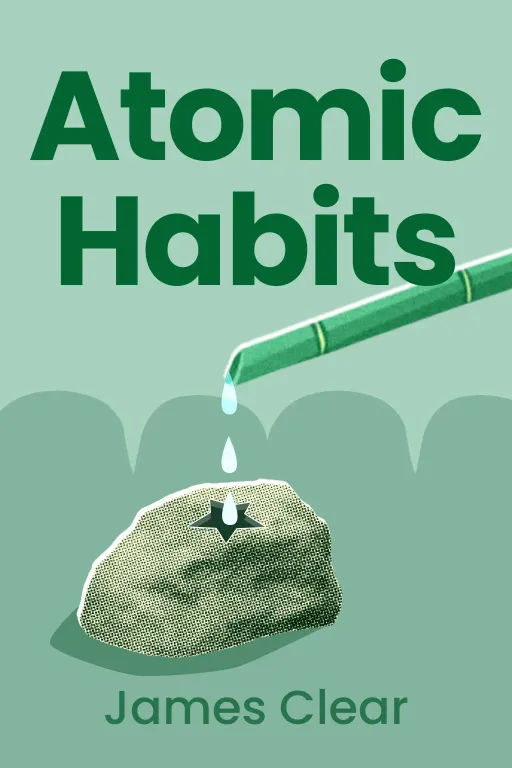
The Architecture of Identity: Building a Leader's System, One Habit at a Time
Golden Hook & Introduction
SECTION
Nova: What if I told you that the secret to becoming a world-class leader has almost nothing to do with your goals? That your ambitious targets for your team, your career, even your spiritual life, might actually be holding you back. It sounds counterintuitive, right? But today we're diving into James Clear's 'Atomic Habits' to uncover a more powerful path: building systems and, most importantly, building an identity. Paul, as someone who thinks deeply about leadership and growth, this book feels like it was written for you.
Paul Gekpe Kelechi: It really does, Nova. That opening idea is jarring because we're so conditioned to be goal-oriented. Everything is about the quarterly target, the five-year plan. The idea that this might be a flawed approach is... well, it's both unsettling and incredibly exciting.
Nova: Exactly! And James Clear himself is living proof of this philosophy. He starts the book with his own story—a horrific high school baseball accident where a bat struck him in the face. He was in a coma, had seizures, and his recovery was painstakingly slow. He didn't get back on the field by setting a goal to be a star player again. He did it by focusing on one tiny, perfect habit at a time—going to bed early, studying for an extra 15 minutes. These were the atomic habits that compounded and eventually made him the top athlete at his university. It's all about the system.
Paul Gekpe Kelechi: That personal story gives the whole framework so much weight. It’s not just theory; it’s forged in real-world adversity.
Nova: It really is. And that's our map for today. Today we'll dive deep into this from two powerful perspectives. First, we'll explore why you need to forget about goals and focus on the incredible compounding power of systems instead. Then, we'll discuss the most profound concept in the book: how to use your daily habits to literally build the identity of the person you want to become.
Deep Dive into Core Topic 1: Beyond Goals: The Compounding Power of Systems
SECTION
Nova: So let's start with that provocative idea: systems over goals. What does Clear even mean by that? He has this fantastic quote: "You do not rise to the level of your goals. You fall to the level of your systems."
Paul Gekpe Kelechi: Wow. Say that again. "You fall to the level of your systems." That hits hard. It implies that goals are fragile, but systems are what catch you. They're your default state.
Nova: Precisely! Goals are about a momentary outcome. A system is the process that leads to those outcomes. Winners and losers often have the same goals, right? Every Olympian wants a gold medal. The goal doesn't differentiate them. The of daily practice does. Clear illustrates this with the simple math of 1% improvement. If you get 1% better each day for a year, you end up 37 times better. It’s the power of compounding.
Paul Gekpe Kelechi: It's the 'aggregation of marginal gains' I've heard about. It sounds small, but the math is undeniable.
Nova: You nailed it. And the most powerful story he uses to illustrate this is the transformation of British Cycling. For a hundred years, they were the definition of mediocre. They'd won a single gold medal since 1908. No British cyclist had ever won the Tour de France. Bike manufacturers wouldn't even sell them gear because they didn't want to be associated with the team's poor performance.
Paul Gekpe Kelechi: So they were a case study in failure, essentially.
Nova: A complete case study. Then, in 2003, they hired a new performance director, Dave Brailsford. His strategy was exactly what you said: the aggregation of marginal gains. He believed if they could just improve every single thing that goes into riding a bike by 1 percent, the cumulative effect would be enormous.
Paul Gekpe Kelechi: And what kind of things are we talking about? I assume tires and bike frames?
Nova: Oh, it went so much deeper. Yes, they redesigned the bike seats to be more comfortable and rubbed alcohol on the tires for better grip. But they also tested different massage gels to see which one led to the fastest muscle recovery. They hired a surgeon to teach the riders the best way to wash their hands to avoid getting sick. They figured out the perfect pillow and mattress for each rider to optimize their sleep. They even painted the inside of the team truck white.
Paul Gekpe Kelechi: Wait, why white?
Nova: To spot tiny specks of dust that might otherwise find their way onto the finely tuned bikes and degrade performance. That's a 1% improvement.
Paul Gekpe Kelechi: That is an unbelievable level of detail. It's a total commitment to the process, not the outcome. You're not thinking about the finish line; you're thinking about dust.
Nova: And the results were staggering. Just five years after Brailsford took over, the British Cycling team dominated the 2008 Beijing Olympics, winning 60% of the available gold medals. At the 2012 London Olympics, they set nine Olympic records. Then a British rider won the Tour de France in 2012, and they kept winning it for years. They went from a century of mediocrity to a decade of dominance. They didn't change their goal; they changed their system.
Paul Gekpe Kelechi: That's a paradigm shift for a leader. We're so often focused on the 'win'—the product launch, the sales number. But this suggests the real win is perfecting the system that those outcomes. The daily habits of the team, the quality of the code reviews, the efficiency of the customer support calls... those are the true leading indicators, not the lagging indicator of the goal itself.
Nova: Exactly. The goal is the finish line, but the system is the game you play every day.
Paul Gekpe Kelechi: But that raises a question for me, Nova. How do you keep a team, or even yourself, motivated on these tiny, seemingly insignificant changes? Painting a truck white doesn't feel like winning the Tour de France.
Deep Dive into Core Topic 2: Identity-Based Habits: Becoming the Person You Want to Be
SECTION
Nova: That's the perfect transition, Paul. The motivation doesn't come from the tiny change itself, but from what that change. This brings us to the most powerful and, I think, most personal idea in the book: Identity-Based Habits.
Paul Gekpe Kelechi: Okay, I'm intrigued. This sounds like it gets to the 'why' behind the 'what'.
Nova: It's the absolute core. Clear says there are three layers to behavior change. The outermost layer is changing your —losing weight, publishing a book. The middle layer is changing your —your habits, your systems, like what we just discussed with British Cycling. But the deepest, most powerful layer is changing your —your beliefs, your self-image.
Paul Gekpe Kelechi: So, changing what you do versus changing who you are.
Nova: Exactly. And most people start from the outside in. They say, "I want to lose weight, so I'll start running." But the habit often fails because their identity is still that of a non-runner. Clear argues we need to work from the inside out. The goal isn't to run a marathon; the goal is to.
Paul Gekpe Kelechi: And how does that practically work?
Nova: He gives this brilliant, simple example. Imagine two people trying to quit smoking. Someone offers them a cigarette. The first person says, "No thanks, I'm." What's their identity?
Paul Gekpe Kelechi: They still see themselves as a smoker. They're just resisting their nature at that moment. It's an act of willpower.
Nova: Exactly. The second person says, "No thanks, I'm." It's a simple shift in language, but it reflects a profound shift in identity. It's no longer a sacrifice; it's just inconsistent with who they are. The behavior follows the identity.
Paul Gekpe Kelechi: That's... incredibly powerful. It reframes everything. So for my own growth, the goal isn't 'read scripture for 15 minutes.' The identity is 'I am a person who seeks wisdom daily.' The action is just a vote for that identity.
Nova: You've got it! Every action you take is a vote for the type of person you wish to become. Waking up early is a vote for being a disciplined person. Calling your parents is a vote for being a thoughtful son. Each tiny habit reinforces the identity you're building.
Paul Gekpe Kelechi: And for a team... wow. The goal isn't 'complete all your tickets by Friday.' The identity is 'we are a team that finishes what we start.' Every closed ticket is a vote for identity. It gives so much more meaning to the mundane tasks. It makes the 'why' behind the habit so much more powerful than the 'what'.
Nova: It transforms the feeling of the work. It's not a chore you have to do; it's an affirmation of who you are. Clear tells a story of a man who lost over 100 pounds just by asking himself one question before every action: "What would a healthy person do?" Would a healthy person take the elevator or the stairs? Would a healthy person order a soda or water? He started casting votes for his new identity, and eventually, he became it.
Paul Gekpe Kelechi: That's the system right there. The question is the system. And the answers are the votes. It connects everything we've talked about. The 1% improvements are the votes, and the votes build the identity.
Synthesis & Takeaways
SECTION
Nova: That's the perfect synthesis, Paul. We have these two incredible layers. First, you build the system of 1% improvements, just like British Cycling did. You focus on the process. But second, and most importantly, you anchor every one of those tiny actions in the identity you want to build, making every habit a vote for who you're becoming.
Paul Gekpe Kelechi: It's a two-part architecture. The system is the blueprint, but the identity is the foundation everything is built on. Without that strong foundation of 'who I am,' the structure is just going to collapse under pressure.
Nova: Beautifully put. You can have the best system in the world, but if it conflicts with your self-image, you'll find a way to sabotage it. But if your habits are an extension of your identity, they become effortless.
Paul Gekpe Kelechi: It really boils down to one question we can all ask ourselves. The book puts it perfectly: 'Every action you take is a vote for the type of person you wish to become.' So the takeaway for me, and for everyone listening, is to stop and ask: What small, 'atomic' action can I take today that casts a vote for the leader, the partner, the spiritual person, the healthy person I truly want to be?
Nova: A powerful question to end on. It's not about massive transformation tomorrow; it's about casting one small vote today. Paul, thank you for exploring this with me.
Paul Gekpe Kelechi: The pleasure was all mine, Nova. This has given me a whole new lens to look through.









