

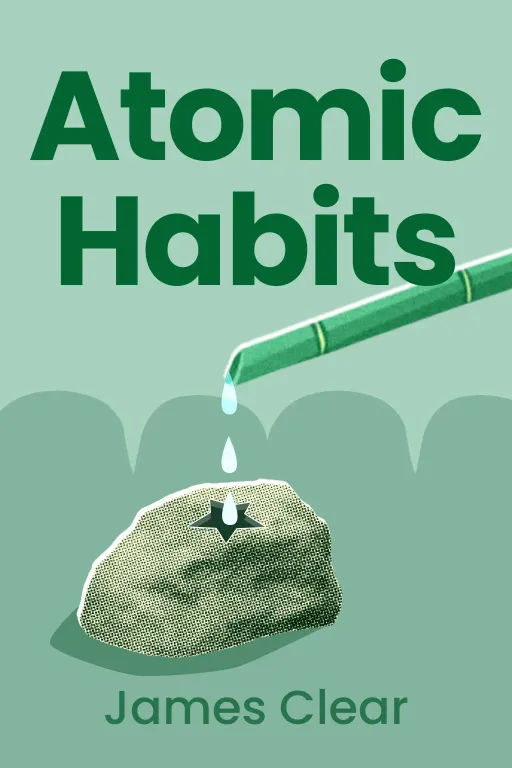
The Anatomy of Healing: How Tiny Habits Shape Clinical and Personal Wellness
Golden Hook & Introduction
SECTION
Dr. Celeste Vega: When we think of healing, we often picture dramatic interventions. We think of a life-saving surgery, a breakthrough pharmaceutical, or a radical, overnight lifestyle overhaul. But what if the true engine of recovery is completely invisible? What if clinical success and personal wellness aren't about massive, heroic goals, but about the compounding interest of tiny, daily systems? Welcome to the show. I'm Dr. Celeste Vega, and joining me today is rosenwenyohmbotoako, a healthcare professional and PhD student whose analytical, empathetic approach to medicine is going to help us look at a modern classic in a completely new light. We are diving into James Clear's Atomic Habits, but we are looking at it through the lens of health, healing, and clinical practice. Rosenwenyohmbotoako, it is wonderful to have you here.
rosenwenyohmbotoako: Thank you, Celeste. It is an absolute pleasure to be here. As someone deeply immersed in the healthcare world, I often see this massive disconnect between what we prescribe to patients and what they can actually sustain in their daily lives. We tell someone to manage their chronic illness by completely changing their diet, exercising an hour a day, and tracking a dozen biometrics, and then we are surprised when compliance rates are low. Clear's book, to me, isn't just a self-help guide. It is a blueprint for systemic clinical change and compassionate patient care.
Dr. Celeste Vega: I love that perspective. Today, we are going to tackle this from three distinct angles. First, we will explore the architecture of wellness, looking at how environmental design dictates health choices far more than willpower. Second, we will discuss the identity of recovery, examining the profound shift from goal-oriented health to identity-based healing, backed by the neuroscience of dopamine. And finally, we will focus on the Goldilocks Zone of rehabilitation, applying the rule of just manageable difficulty to patient recovery and the critical issue of clinician burnout. Let's start with the environment. Rosenwenyohmbotoako, Clear makes a bold claim: environment is the invisible hand that shapes human behavior. In medicine, we often blame a lack of willpower or motivation for poor health outcomes. But Clear points to a fascinating study by Dr. Anne Thorndike at Massachusetts General Hospital in Boston. Tell us about that.
Deep Dive into Core Topic 1: The Architecture of Wellness
SECTION
rosenwenyohmbotoako: Oh, the hospital cafeteria study is a brilliant piece of research. Dr. Thorndike and her team wanted to improve the eating habits of hospital staff and visitors, but they did not want to use verbal persuasion, educational posters, or willpower. They simply altered what behavioral economists call the choice architecture of the cafeteria. Initially, the primary refrigerators next to the cash registers were stocked only with soda. The researchers added bottled water to those refrigerators and placed baskets of water throughout the food stations. Soda was still available, but water was now highly visible and easily accessible.
Dr. Celeste Vega: And the results were staggering, right? Over just three months, soda sales dropped by over eleven percent, while bottled water sales jumped by over twenty-five percent. No lectures, no diets, just a shift in physical placement.
rosenwenyohmbotoako: Exactly. And as a healthcare professional, this speaks volumes to me. It proves that people often choose products not because of what they are, but because of where they are. If a patient leaves the hospital with a prescription but has to drive across town, wait in a long line, and navigate a complex insurance portal to get it, the friction is too high. The environment is working against them. But if we design the environment to make the healthy choice the default choice, compliance skyrockets.
Dr. Celeste Vega: It is the law of least effort in action. Our brains are wired to conserve energy. If we want patients to heal, we have to stop asking them to swim upstream against a hostile environment. This reminds me of another incredible story in the book, the Vietnam War heroin addiction study. In 1971, the public was terrified because research showed that over fifteen percent of U. S. soldiers stationed in Vietnam were addicted to heroin. The Nixon administration was bracing for a massive public health crisis when these soldiers returned home. But researcher Lee Robins conducted a landmark study tracking these veterans. What did she find?
rosenwenyohmbotoako: Her findings completely shocked the scientific community at the time. Only about five percent of the addicted soldiers became re-addicted within a year of returning home, and only twelve percent relapsed within three years. In contrast, typical re-addiction rates for civilian heroin users leaving rehab were around ninety percent. Why? Because in Vietnam, the soldiers were surrounded by constant environmental cues that triggered drug use: the stress of war, easy access to heroin, and a peer group of fellow users. When they returned to the United States, they underwent a radical change in environment. The cues were completely gone.
Dr. Celeste Vega: That is a profound insight. It suggests that addiction, and by extension many of our chronic health behaviors, are deeply context-dependent. If you try to heal a patient but send them back into the exact same toxic environment that made them sick, you are setting them up for failure.
rosenwenyohmbotoako: Absolutely, Celeste. In healthcare, we often treat the individual in isolation, as if their choices exist in a vacuum. But we have to realize that behavior is a function of the person in their environment. If we want to foster healing, we have to help patients audit their home environments. For example, if a patient needs to take medication daily, placing the pill bottle inside a closed cabinet is making the cue invisible. But if they stack that habit, placing the bottle right next to their toothbrush, which they use every morning, they are leveraging an existing environmental cue. It is about making the cue obvious.
Dr. Celeste Vega: Yes, habit stacking. The formula is simple: after my current habit, I will perform my new habit. It is a brilliant way to anchor a new, healthy behavior to an established routine. But let's take this a step deeper. It is not just about changing what we do; it is about changing who we believe we are. This brings us to our second core topic: the identity of recovery.
Deep Dive into Core Topic 2: The Identity of Recovery
SECTION
Dr. Celeste Vega: Clear talks about three levels of behavior change: outcomes, processes, and identity. Outcomes are what you get, processes are what you do, and identity is what you believe. He argues that most people start with outcomes. They say, I want to lose twenty pounds, or I want to lower my blood pressure. But the most sustainable change happens when we focus on identity. He uses the example of two people resisting a cigarette. When offered a smoke, the first person says, No thanks, I am trying to quit. The second person says, No thanks, I am not a smoker. What is the difference there, rosenwenyohmbotoako?
rosenwenyohmbotoako: The difference is fundamental. The first person still identifies as a smoker who is trying to behave differently. They are relying entirely on willpower to override their self-image. The second person has shifted their identity. Smoking is no longer aligned with who they are. In clinical practice, this is the holy grail of healing. I think of a patient who successfully lost over one hundred pounds by constantly asking herself one simple question before making any decision: What would a healthy person do?
Dr. Celeste Vega: That is incredibly powerful. She didn't focus on the scale; she focused on embodying the identity of a healthy person.
rosenwenyohmbotoako: Exactly. Every choice she made, whether it was choosing water over soda or taking the stairs instead of the elevator, was a vote for that new identity. Clear writes that every action you take is a vote for the type of person you wish to become. And this is where the neuroscience gets really fascinating. Our brains are driven by dopamine feedback loops. Many people think dopamine is about pleasure, but neuroscientists have shown that it is actually about anticipation and desire.
Dr. Celeste Vega: Right, the famous 1954 experiment by James Olds and Peter Milner with rats. They implanted electrodes in the brains of rats to block the release of dopamine. What happened to those poor creatures?
rosenwenyohmbotoako: It was heartbreaking but highly revealing. The rats lost all will to live. They wouldn't eat, they wouldn't mate, they didn't crave anything. They literally died of thirst within a few days, even though water was right in front of them. Yet, when researchers squirted sugar water directly into their mouths, the rats still showed facial expressions of pleasure. They still liked the sugar, but they did not want it. The desire, the motivation to act, was completely gone because the dopamine pathway was blocked.
Dr. Celeste Vega: That distinction between wanting and liking is crucial. Wanting is driven by the anticipation of a reward, which activates a massive portion of the brain's reward center, the nucleus accumbens. Liking is just a tiny, fleeting sensation.
rosenwenyohmbotoako: Yes, and this explains why bad habits are so incredibly sticky. Modern society is filled with supernormal stimuli, exaggerated versions of reality that hijack our dopamine pathways. Think of highly processed junk food, engineered to have the perfect crunch and flavor profile, or social media feeds designed for endless scrolling. These stimuli trigger massive dopamine spikes during the anticipation phase, creating an intense craving. If we want to help patients build healthy habits, we have to make those habits attractive. We have to bundle temptations.
Dr. Celeste Vega: Temptation bundling is a brilliant strategy. Clear shares the story of Ronan Byrne, an engineering student in Dublin. He wanted to exercise more but loved watching Netflix. So, he hacked his stationary bike, wrote a computer program, and made it so Netflix would only play if he was pedaling at a certain speed. If he slowed down, the show paused. He bundled a need, exercising, with a want, watching Netflix.
rosenwenyohmbotoako: It is pure genius because it leverages the dopamine-driven anticipation of the reward to power the behavior we need to perform. In healthcare, we can apply this to patient rehabilitation. If a patient needs to do painful physical therapy exercises, we can bundle that with something they love, like listening to their favorite podcast or audio book, but only allowing them to listen while they are doing their exercises. We are pairing the immediate reward with the difficult process, making the habit attractive.
Dr. Celeste Vega: That is a beautiful, practical application of the second law of behavior change. But as we talk about rehabilitation, we have to acknowledge that recovery is a long, often tedious journey. This leads us to our third core topic: the Goldilocks Zone of rehabilitation and the prevention of clinician burnout.
Deep Dive into Core Topic 3: The Goldilocks Zone of Rehabilitation and Burnout
SECTION
Dr. Celeste Vega: Clear introduces the Goldilocks Rule, which states that humans experience peak motivation when working on tasks that are right on the edge of their current abilities. Not too easy, which leads to boredom, and not too difficult, which leads to anxiety and discouragement. He points to the Yerkes-Dodson Law in psychology, which shows that performance is optimized at a moderate level of arousal or challenge. Rosenwenyohmbotoako, how does this apply to physical and emotional recovery?
rosenwenyohmbotoako: This is incredibly relevant to physical therapy and occupational therapy. If we give a stroke survivor exercises that are too advanced, they will experience profound frustration and anxiety. They might give up entirely because the friction is too high and the task feels impossible. On the other hand, if the exercises are too simple, they get bored, and the brain stops adapting. We have to find that sweet spot, that four-percent zone beyond their current ability, where they are challenged but capable of achieving a small win.
Dr. Celeste Vega: Small wins are so important. They provide that immediate satisfaction, which is the fourth law of behavior change: make it satisfying. Clear talks about Trent Dyrsmid, a young stockbroker who used a simple visual tracking system. He had two jars on his desk, one with one hundred and twenty paper clips and one empty. Every time he made a sales call, he moved a paper clip. It was a visual measure of progress that made the habit satisfying.
rosenwenyohmbotoako: Yes, visual tracking is incredibly motivating because it provides immediate feedback. In patient recovery, we can use simple visual charts or habit trackers to show progress. But we also have to talk about the other side of the healthcare equation: the clinicians themselves. Burnout among doctors, nurses, and healthcare students is at an all-time high. And a lot of it comes down to a violation of the Goldilocks Rule. Clinicians are constantly pushed far beyond their cognitive and emotional limits, facing high-friction administrative tasks, endless charting, and systemic pressure.
Dr. Celeste Vega: It is a massive crisis. We are asking healthcare workers to operate in a state of chronic anxiety and overload, and then we wonder why they are burning out.
rosenwenyohmbotoako: Exactly. And this is where Clear's advice on standardizing before optimizing is so crucial. In medicine, we are obsessed with optimization, with maximizing efficiency and output. But you cannot optimize a habit that does not exist, and you cannot sustain a system that is constantly redlining. We need to simplify the clinical environment. We need to reduce the cognitive friction for healthcare workers. For example, instead of complex, multi-step charting protocols, we should design intuitive, automated systems that allow clinicians to focus on what they actually care about: patient care.
Dr. Celeste Vega: That is a powerful call to action. We need to apply the same behavioral science to the design of our healthcare systems that we do to patient care. We have to make the right thing easy for the clinician, too. Clear quotes Pat Riley, the legendary coach of the Los Angeles Lakers, who created the Career Best Effort program. He didn't ask his players to make massive, unsustainable leaps. He asked them to improve their performance by just one percent in various tracking categories. That tiny, collective improvement led to back-to-back championships.
rosenwenyohmbotoako: It is the power of compounding. If a hospital system, or an individual clinician, focuses on reducing friction by just one percent each day, the cumulative effect over a year is transformative. But we also have to be careful about the downside of habits. Clear warns that once a habit becomes automatic, we can become complacent. We stop paying attention to feedback. That is why reflection and review are so essential. Elite performers, like marathon runner Eliud Kipchoge or swimmer Katie Ledecky, don't just rely on automatic habits. They keep detailed training logs and review them constantly with their coaches.
Dr. Celeste Vega: They standardize, then they optimize, and then they reflect. It is a continuous loop of improvement.
rosenwenyohmbotoako: Exactly. It is about maintaining a flexible identity. Clear writes that the tighter we cling to an identity, the harder it becomes to grow beyond it. As clinicians, we can't let our identity as experts prevent us from being curious, analytical learners. We have to keep our identities small, as investor Paul Graham says, so we can adapt to new evidence and better ways of healing.
Synthesis & Takeaways
SECTION
Dr. Celeste Vega: This has been an incredibly rich conversation, rosenwenyohmbotoako. We have covered so much ground, from the physical layout of hospital cafeterias to the neurological pathways of dopamine, and finally to the systemic challenges of clinician burnout. As we wrap up, let's synthesize the core message of today's discussion. If you had to boil down the secret to results that last in health and healing, what would it be?
rosenwenyohmbotoako: I would point to the Sorites Paradox, which Clear mentions in his conclusion. It is the ancient Greek philosophical puzzle about a heap of sand. If you place a single grain of sand on the ground, it is not a heap. You add another, still not a heap. But at some point, through the continuous addition of single grains, a heap is formed. Healing is exactly like that. A single healthy meal does not cure diabetes. A single physical therapy session does not restore mobility. A single moment of mindfulness does not cure burnout. But these tiny, one-percent improvements are the individual grains of sand. Over time, they compound into a magnificent heap of wellness.
Dr. Celeste Vega: That is a beautiful metaphor. It shifts the burden of recovery from an overwhelming, impossible mountain to a simple, manageable grain of sand.
rosenwenyohmbotoako: Yes, and my final recommendation for our listeners, whether you are a patient managing a chronic condition, a student struggling to find balance, or a healthcare professional on the front lines, is to ask yourself this one question: What is the single, smallest action I can take today to reduce friction in my environment? Don't worry about the massive goal. Just focus on making the cue obvious, the habit attractive, the process easy, and the reward satisfying. Focus on the system, and the outcomes will take care of themselves.
Dr. Celeste Vega: A perfect note to end on. Rosenwenyohmbotoako, thank you so much for sharing your deep, analytical insights and your profound empathy with us today. This has been an absolute masterclass in the anatomy of healing.
rosenwenyohmbotoako: Thank you, Celeste. It has been an honor.
Dr. Celeste Vega: And to our listeners, thank you for tuning in. Remember, success is not a finish line to cross; it is a system to improve, an endless process to refine. Until next time, keep building those systems, and take care of yourselves.









