

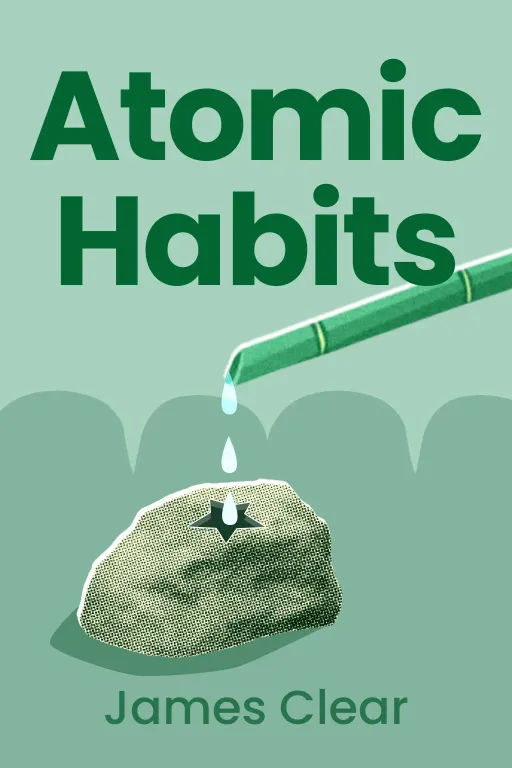
Systems of Success: Scaling Atomic Habits from Personal Growth to Global Governance
Golden Hook & Introduction
SECTION
Nova: If you shift the flight path of an airplane leaving Los Angeles by just three and a half degrees south, you don't land in New York City. You end up in Washington, D. C. A tiny, almost invisible adjustment at the cockpit wheel completely changes the destination. The same is true for our lives, our careers, and even our global institutions. Welcome to the show, everyone! I'm Nova, and today we are diving into James Clear's masterpiece,, but we're doing it through a very special, highly analytical lens. We are joined by the brilliant Goodness Awosika, someone who is deeply passionate about self-growth, systems building, and the fascinating intersections of international law, geopolitics, and sovereign finance. Goodness, it is so wonderful to have you here with us today!
Goodness Awosika: Thank you, Nova! It's an absolute pleasure to be here. I've always believed that whether you're looking at a sovereign state managing its debt or an individual trying to master their morning routine, the underlying architecture of success is always the same: it's all about the systems we build.
Nova: Oh, I love that! "The architecture of success." That is the perfect way to frame this. Today, we're going to tackle this book from three distinct angles. First, we'll explore how shifting our identity from the inside out builds unbreakable systems. Then, we'll discuss how to design our environments to make success the path of least resistance. And finally, we'll focus on how to embed rigorous accountability and reflection to ensure our habits never plateau. So, Goodness, let's start with that first point. James Clear talks about the difference between outcome-based habits and identity-based habits. Why did that resonate so strongly with you?
Goodness Awosika: Well, Nova, in my world, we often see organizations and countries setting massive, lofty goals—like balancing a sovereign budget or reforming a legal framework. Those are outcomes. But Clear argues that the real magic happens when you focus on —on who you wish to become. He outlines three levels of change: outcomes, processes, and identity. Outcomes are about what you get. Processes are about what you do. But identity is about what you believe. If you don't change the underlying belief system, any behavioral change is just temporary.
Nova: Right! It's like that classic example he gives of the two people resisting a cigarette. When offered a smoke, the first person says, "No thanks, I'm trying to quit." It sounds reasonable, but they still identify as a smoker who is trying to be different. But the second person says, "No thanks, I'm not a smoker." That is a fundamental identity shift!
Goodness Awosika: Exactly! And that shift changes everything. When you adopt the identity of the person you want to be, your habits naturally align. For me, applying this to spiritual life, work performance, and personal growth means asking a simple, powerful question before making any decision: "What would a disciplined, systems-driven leader do?" Or, "What would a spiritually grounded person do?" Every action you take is literally a vote for the type of person you wish to become.
Deep Dive into Core Topic 1
SECTION
Nova: "Every action is a vote." That is such a powerful metaphor. It reminds me of the research Clear mentions about voting behavior. People who were asked if they wanted to "be a voter"—which is an identity—were significantly more likely to actually go out and vote than those who were simply asked if they wanted to "vote," which is just an action.
Goodness Awosika: Yes! That study is a perfect empirical demonstration of this principle. When we internalize an identity, we feel a deep, psychological need to act in alignment with it. If I identify as a "systems builder," then organizing my workflow or setting up an accountability structure isn't a chore; it's simply an expression of who I am. It's the same in our spiritual lives. If you identify as a "person of prayer" or a "seeker of wisdom," then daily reflection isn't a box to check on a to-do list. It's the natural output of your identity.
Nova: That makes so much sense. It takes the friction out of the process because you aren't fighting yourself anymore. But how do we actually build that identity? Clear talks about a two-step process: decide the type of person you want to be, and then prove it to yourself with small wins. He tells the story of Brian Clark, an entrepreneur who stopped chewing his fingernails after decades of trying. He didn't just use willpower; he got a manicure, took pride in his healthy nails, and suddenly, his identity shifted to "someone who takes care of his hands."
Goodness Awosika: I love Brian's story because it shows that identity isn't this abstract, mystical thing. It's built on evidence. Every time you write a page, you are a writer. Every time you practice an instrument, you are a musician. In my own journey, as I prepare to work in highly complex fields like sovereign finance and international law, I have to build the identity of a rigorous, analytical thinker today. I do that by reading complex briefs, analyzing geopolitical trends, and writing consistently. Those are my small wins, my "votes" for my future self.
Nova: And those votes compound! Just like compound interest in finance, habits are the compound interest of self-growth. Clear uses the incredible story of British Cycling to illustrate this. In 2003, they hired Dave Brailsford as the performance director. At the time, British Cycling was so mediocre that bike manufacturers literally refused to sell them bikes because they were worried it would hurt their sales!
Goodness Awosika: Think about that! A century of underachievement. And Brailsford didn't try to completely overhaul the team overnight. Instead, he implemented what he called the "aggregation of marginal gains." He looked for 1% improvements in everything. They redesigned the bike seats for comfort, rubbed alcohol on the tires for better grip, and had the riders wear electrically heated overshorts to maintain muscle temperature.
Nova: Yes! And they didn't stop there. They hired a surgeon to teach the riders the best way to wash their hands to avoid catching colds. They tested different massage gels, and they even painted the inside of the team truck white so they could spot tiny dust particles that might degrade the performance of the bikes!
Goodness Awosika: It's mind-blowing attention to detail. And what was the outcome? Just five years later, at the 2008 Beijing Olympics, the British Cycling team dominated, winning 60 percent of the gold medals. By the 2012 London Olympics, they set nine Olympic records and seven world records. That is the power of a system. As Clear famously wrote, "You do not rise to the level of your goals. You fall to the level of your systems."
Nova: That quote gives me chills every time! "You fall to the level of your systems." It completely flips the traditional goal-setting advice on its head.
Goodness Awosika: It really does. In international relations or sovereign finance, we see this constantly. Two countries can have the exact same goal—say, economic stability. But the country with the superior institutional system, the better regulatory feedback loops, and the more transparent accountability structures is the one that succeeds. The goal didn't make the difference; the system did.
Deep Dive into Core Topic 2
SECTION
Nova: That transition from personal systems to macro-systems is so fascinating, Goodness. And it brings us perfectly to our second core topic: environmental design and choice architecture. Clear argues that motivation is highly overrated; environment often matters much more. Our surroundings are constantly whispering cues to us, shaping our behavior without our conscious awareness.
Goodness Awosika: Absolutely. We like to think of ourselves as highly rational, independent decision-makers, but the truth is, we are deeply influenced by our "choice architecture." Take the study conducted by Dr. Anne Thorndike at Massachusetts General Hospital in Boston. She wanted to improve the eating habits of hospital staff and visitors without using any verbal persuasion or motivational posters.
Nova: Oh, this is a classic! What did she do?
Goodness Awosika: She simply changed the physical layout of the cafeteria. Originally, the refrigerators next to the cash registers were only stocked with soda. She added bottled water to those refrigerators and placed baskets of water throughout the food stations. Over the next three months, soda sales decreased by 11.4 percent, while bottled water sales shot up by 25.8 percent! No one was told to drink water. The environment simply made the healthy choice the easy choice.
Nova: It's so simple, yet so profound. We naturally gravitate toward the path of least resistance. Clear calls this the "Law of Least Effort." If you want to build a good habit, you have to make the cues highly obvious and reduce the friction. If you want to break a bad habit, you make the cues invisible and increase the friction.
Goodness Awosika: And this principle of environmental friction actually scales up to a global, historical level. Clear references Jared Diamond's work on the spread of agriculture. Have you ever wondered why agriculture spread so much faster across Europe and Asia than it did in the Americas or Africa?
Nova: I have! It's one of those massive historical puzzles, isn't it?
Goodness Awosika: It is! And the answer is purely environmental. Europe and Asia have an east-west orientation. This means that as agriculture spread, it traveled along the same latitude. Locations at the same latitude share a similar climate, rainfall, and day length. So, a crop domesticated in one part of Asia could easily be grown thousands of miles away in Europe with very little friction.
Nova: Ah! Whereas the Americas and Africa have a north-south orientation.
Goodness Awosika: Exactly. Traveling north-south means crossing radically different climate zones, soil types, and rainfall patterns. The environmental friction was incredibly high. A crop that grew beautifully in one region would die just a few hundred miles north or south. As a result, agriculture spread two to three times faster across the east-west axis of Eurasia. This geographical layout—this macro-environment—shaped the entire trajectory of human civilization, technology, and power.
Nova: That is an incredible connection, Goodness! It shows that whether we are talking about a bottle of water in a cafeteria or the rise of empires across continents, friction is the invisible hand that guides human behavior.
Goodness Awosika: It really is. And we can use this to our advantage through "commitment devices." A commitment device is a choice you make in the present that controls your actions in the future. It's a way to lock in good behavior before temptation strikes. Think of Victor Hugo in the summer of 1830. He was facing an impossible deadline from his publisher to finish. He had spent the previous year procrastinating, entertaining guests, and avoiding his writing.
Nova: Oh, I love Hugo's solution. It was so dramatic!
Goodness Awosika: It was brilliant! He gathered up all his clothes, handed them to his assistant, and ordered her to lock them in a large chest. He was left with nothing to wear except a large, knitted gray shawl. Since he couldn't go outside without looking ridiculous, he was forced to stay in his study and write. He wrote furiously through the fall and winter, and he actually finished the book two weeks ahead of schedule!
Nova: Talk about increasing friction for a bad habit! He literally made leaving the house physically impossible. And we can do the same thing today with technology, right? Like Nir Eyal, the habits expert, who plugged an outlet timer between his internet router and the power outlet. At 10:00 p. m. every night, the timer cuts the power, the internet goes dead, and his entire family knows it's time to wind down for bed.
Goodness Awosika: Yes! That is a modern-day knitted shawl. By automating these boundaries, we free up our mental energy. We don't have to rely on willpower to turn off the screen or close the laptop. The system does it for us. In my own life, I've started using app blockers during my deep-work hours. I make the distraction highly inconvenient to access, which immediately channels my focus back to my research and writing.
Deep Dive into Core Topic 3
SECTION
Nova: It's all about designing a world where doing the right thing is the default option. But even with the best environment, we still need a way to keep ourselves on track over the long haul. And that brings us to our third core topic: the accountability engine and continuous refinement. Goodness, you are incredibly passionate about accountability. How does Clear suggest we build this into our daily systems?
Goodness Awosika: Clear emphasizes that while the first three laws—making it obvious, attractive, and easy—help us start a habit, the fourth law—making it satisfying—is what helps us sustain it. And one of the most powerful ways to make a habit satisfying is through immediate feedback and visual tracking. He shares the story of Trent Dyrsmid, a young stockbroker in a small Canadian suburb who achieved massive success using what he called the "Paper Clip Strategy."
Nova: Oh, this is such a simple and elegant method. Tell us how it worked!
Goodness Awosika: Every morning, Trent started with two jars on his desk. One was filled with 120 paper clips, and the other was completely empty. After making a sales call, he would move one paper clip from the full jar to the empty one. That was it. He didn't leave his desk until all 120 paper clips had been moved. The visual progress of seeing that jar fill up provided an immediate, satisfying hit of dopamine. Within 18 months, he was bringing in five million dollars in assets to his firm!
Nova: It's the visual proof of progress! It makes the effort tangible. But Clear also warns us about the dark side of tracking, doesn't he? He mentions Goodhart's Law: "When a measure becomes a target, it ceases to be a good measure."
Goodness Awosika: Yes, that is a critical warning, especially for analytical thinkers. We can easily get so obsessed with the metrics—the number of pages read, the hours meditated, the steps walked—that we lose sight of the actual purpose behind the habit. If I'm just flipping pages to hit my reading goal without actually absorbing the material, I'm playing a game of metrics, not building wisdom. We have to ensure our measurements are serving our identity, not replacing it.
Nova: Absolutely. And that's where reflection and review come in. Clear talks about how habits are necessary for mastery, but they can also lead to complacency. Once we can do something on autopilot, we stop thinking about how to do it better. To combat this, elite performers use systems of continuous review. He points to the Los Angeles Lakers' "Career Best Effort" or CBE program, created by their legendary head coach, Pat Riley, in 1986.
Goodness Awosika: The CBE program is a masterclass in institutional accountability. Riley tracked his players' statistics all the way back to high school to establish a baseline. Then, he asked each player to improve their output by just 1 percent over the course of the season. But he didn't just track points or rebounds; he tracked "unsung hero" deeds, like diving for loose balls, blocking out opponents, or helping a teammate. By comparing their current performance to their historical data, the players had a clear, objective mirror showing them whether they were growing or stagnating.
Nova: And it worked beautifully! The Lakers won back-to-back NBA championships in 1987 and 1988. It shows that even at the highest level of performance, you need a structured system of reflection to keep your habits sharp.
Goodness Awosika: Exactly. And for personal growth, we can implement this through "habit contracts" and accountability partners. Clear shares the story of Bryan Harris, an entrepreneur who wrote a formal, binding contract signed by himself, his wife, and his personal trainer to lose weight. If he failed to track his food, he had to pay his trainer $200. If he failed to weigh himself, he had to dress up in full business attire on a hot summer day and do yard work for his neighbors!
Nova: Oh, my goodness! That is some serious social friction. I would definitely track my food to avoid doing yard work in a three-piece suit in July!
Goodness Awosika: It sounds extreme, but it leverages our deep, evolutionary desire to avoid social shame and maintain our standing in the tribe. When there is an immediate, painful cost to inaction, we are infinitely more likely to follow through.
Synthesis & Takeaways
SECTION
Nova: It really is about aligning our short-term incentives with our long-term identity. Well, Goodness, we have covered some incredible ground today! We've looked at how identity-first systems build disciplined leaders, how environmental design and friction shape our choices, and how to embed rigorous accountability to sustain our growth. As we wrap up this conversation, how would you synthesize these principles for someone who wants to apply them to their spiritual life, work performance, or personal growth?
Goodness Awosika: I would say it all starts with a shift in perspective. Stop focusing so much on the finish line, and start focusing on the system. If you want a deeper spiritual life, don't just set a goal to read the entire Bible or meditate for an hour a day. Start by identifying as a "spiritually grounded person." Then, make the cue obvious—put your journal or sacred text on your pillow in the morning. Use the Two-Minute Rule: commit to just two minutes of reflection every single day. Standardize before you optimize. You can't improve a habit that doesn't exist.
Nova: "Standardize before you optimize." That is a golden rule! Just show up, even if it's for two minutes.
Goodness Awosika: Exactly. And then, build in accountability. Find a partner, write a contract, or simply use a visual tracker like Trent's paper clips to celebrate your daily wins. Remember, success is not a destination or a finish line to cross. As Clear beautifully concludes, "Success is a system to improve, an endless process to refine."
Nova: What a perfect note to end on. Goodness, thank you so much for sharing your brilliant insights and connecting these dots so beautifully for us today. This has been an incredibly enriching conversation!
Goodness Awosika: Thank you, Nova! It's been an absolute joy. Here's to building better systems, one small habit at a time.
Nova: To our listeners, we leave you with this question to ponder: What is one tiny, 1% shift you can make in your environment today that will make your desired identity inevitable tomorrow? Let us know, and we'll see you next time!









