Micro-Levers, Macro-Impact: Deconstructing the System of Atomic Habits
Golden Hook & Introduction
SECTION
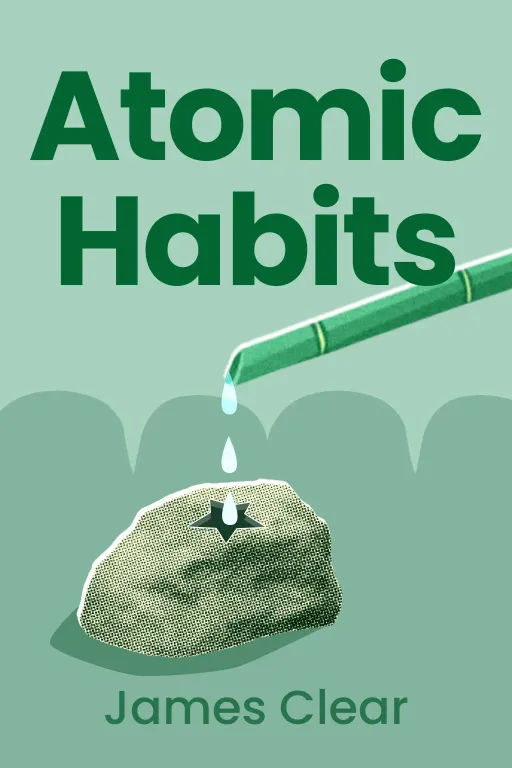
Nova: What if I told you that the key to changing your life isn't to dream bigger, but to get 1% better every day? And that the most disciplined people aren't heroes of willpower, they're just better architects of their environment? Welcome, everyone. Today, we're diving into a book that has become a phenomenon for a reason: "Atomic Habits" by James Clear. It's not just a book about habits; it's an operating manual for continuous improvement, and it starts with a radical idea: you don't rise to the level of your goals. You fall to the level of your systems.
Dana Coleen Pineda: That line is so powerful, Nova. It completely flips the script on how we think about success. It suggests that achievement isn't about occasional bursts of intensity, but about the quality of our daily processes. As someone who loves digging into systems, that idea just resonates so deeply.
Nova: I knew you'd love that one, Dana! And that's exactly why I'm so excited to have you here. Your mind is perfect for deconstructing this. Today we'll dive deep into this from three perspectives. First, we'll explore the surprising power of starting with your identity, not your goals. Then, we'll discuss why the most disciplined people are actually just masters of environmental design. And finally, we'll uncover the secret mindset that allows professionals to stay consistent when everyone else gives up. Ready to rebuild from the ground up?
Dana Coleen Pineda: Let's do it. I'm ready to get into the architecture of it all.
Deep Dive into Core Topic 1: Identity-Based Habits
SECTION
Nova: Alright, so Dana, let's start with that first, really provocative idea. Most self-help says 'set a goal!' Write it down, make it specific, you know the drill. But Clear says, 'start with identity.' What does that even mean?
Dana Coleen Pineda: It's a great question, because it feels so abstract at first. We're used to thinking in terms of tangible outcomes, right? "I want to lose 20 pounds," or "I want to write a novel." Those are goals.
Nova: Exactly. But Clear argues there are three layers of change. The outermost layer is changing your outcomes—the number on the scale, the finished manuscript. The middle layer is changing your process—your workout routine, your writing schedule. But the deepest layer, the core, is changing your identity—your beliefs, your self-image.
Dana Coleen Pineda: And his argument is that most people start from the outside in. They focus on the outcome, and hope their identity will change as a result.
Nova: Precisely. But that's why it's so hard to stick with. You're fighting against your own self-image. Clear gives this brilliant example. Imagine two people who are trying to quit smoking. Someone offers them a cigarette. The first person says, "No thanks, I'm trying to quit."
Dana Coleen Pineda: Okay, I see where this is going. That person still identifies as a smoker who is currently resisting. The struggle is right there in the language.
Nova: You got it. The second person says, "No thanks, I'm not a smoker." The difference is subtle but profound. The second statement signals a true identity shift. They aren't a smoker anymore. So, for them, turning down a cigarette isn't a sacrifice; it's a natural action that aligns with who they are.
Dana Coleen Pineda: That's a fundamental shift in perspective. It's the difference between running a software patch and upgrading the entire operating system. The person who says 'I'm not a smoker' has already accepted the new identity. The behavior—not smoking—is just the natural output of that identity. It's no longer a struggle against a craving; it's just... who they are.
Nova: It's who they are! And this is where it gets really practical. Clear says, "Every action you take is a vote for the type of person you wish to become." If you go for a run, you cast a vote for being a runner. If you write a page, you cast a vote for being a writer. It's not about the outcome of that single action; it's about accumulating evidence for your new identity.
Dana Coleen Pineda: So the habit isn't the goal, the habit is the evidence. You're building a case for your new self, to yourself. That's a much more powerful motivator than just checking a box on a to-do list. It reframes the entire purpose of daily action. It's not about what you get, it's about who you become.
Deep Dive into Core Topic 2: Environment over Willpower
SECTION
Nova: And that idea of making the behavior a 'natural output' is the perfect bridge to our second point: environment over willpower. Because if your identity is the 'who,' your environment is the 'how'—it's the invisible hand shaping your actions.
Dana Coleen Pineda: This is the part that really appeals to the analyst in me. It takes the pressure off of 'being strong' and puts the focus on 'being smart.'
Nova: Totally. We have this myth of the stoic hero who resists temptation through sheer force of will. Clear argues that's a losing strategy. He says, and I love this, "The people with the best self-control are typically the ones who need to use it the least." They're not fighting temptation; they've designed their lives to avoid it.
Dana Coleen Pineda: They've curated their environment. They've reduced the friction for good habits and increased the friction for bad ones.
Nova: Exactly! The most stunning example of this is the story of British Cycling. For a hundred years, they were mediocre. They'd won a single gold medal. Bike manufacturers wouldn't even sell to them because they didn't want to be associated with their poor performance. Then, in 2003, they hired a performance director named Dave Brailsford.
Dana Coleen Pineda: And he had a different philosophy.
Nova: A completely different philosophy. He called it "the aggregation of marginal gains." The idea was to break down everything you could think of that goes into riding a bike, and then improve it by 1%. Just one percent. And Dana, they went to incredible lengths. They redesigned the bike seats for more comfort. They tested different massage gels to see which led to faster muscle recovery. They hired a surgeon to teach the riders the best way to wash their hands to avoid getting sick. They even painted the inside of the team truck white.
Dana Coleen Pineda: Wait, why white?
Nova: To spot any little bits of dust that could get into the finely tuned bike mechanics and degrade performance. It was that granular. Each change was tiny, almost unnoticeable. But the cumulative effect was staggering.
Dana Coleen Pineda: It's a system that assumes human fallibility. It doesn't rely on a cyclist waking up and motivated to be 1% better. The system is already in place to make that improvement the path of least resistance.
Nova: And the results speak for themselves. Within five years, they dominated the 2008 Beijing Olympics. At the 2012 London Olympics, they set seven world records. Over a decade, they won 178 world championships. It's one of the most successful runs in cycling history, all built on the back of tiny, atomic habits. It's the same principle as a study done in a hospital cafeteria. They wanted people to drink more water.
Dana Coleen Pineda: Let me guess. They didn't put up posters about the benefits of hydration.
Nova: Nope! They just added water bottles to every single drink fridge in the cafeteria, which were previously only filled with soda, and put baskets of water next to the food stations. Soda sales dropped 11%, and water sales shot up 26%. They didn't change anyone's mind; they just changed the environment.
Dana Coleen Pineda: It's choice architecture. They made the better choice the easier, more obvious choice. It's brilliant because it's humble. It acknowledges that we are profoundly influenced by our surroundings, and instead of fighting that, it uses it to our advantage. It's not about willpower; it's about wisdom.
Deep Dive into Core Topic 3: The Professional's Secret
SECTION
Nova: Exactly! You design a system that works for you, not against you. But, Dana, what happens when the system is in place, the habit is formed... and it just gets... boring? This is where Clear separates the amateurs from the pros.
Dana Coleen Pineda: Ah, the dreaded plateau. The excitement of starting something new has worn off, and now it's just... the work.
Nova: It's just the work. And this is where most of us fall off. We think we've lost motivation. But Clear shares this incredible anecdote. He was talking to an elite weightlifting coach who had trained Olympians, and he asked him, "What's the difference between the best athletes and everyone else?"
Dana Coleen Pineda: I'm guessing it wasn't just genetics.
Nova: The coach said genetics and luck play a role, of course. But then he said, "At some point, it comes down to who can handle the boredom of training every day, doing the same lifts over and over and over."
Dana Coleen Pineda: Wow. That really lands. We're so conditioned to chase the 'flow state' and the feeling of excitement. But this suggests that true mastery lies on the other side of boredom. It's about falling in love with the process, not just the outcome.
Nova: That's the heart of it. The greatest threat to success isn't failure; it's boredom. We get a habit going, and then we get distracted by the next shiny object. But professionals are different. Clear says, "Professionals stick to the schedule; amateurs let life get in the way."
Dana Coleen Pineda: It's the difference between someone who goes to the gym when they feel like it, and someone who goes to the gym because it's Monday. The professional shows up even when the muse doesn't. They understand that the work itself is what generates the motivation, not the other way around.
Nova: Yes! You don't wait to be motivated; you create a habit of showing up, and that the motivation. It's about embracing the repetition. It's about understanding that every time you do the boring work, you're still casting a vote for that identity we talked about. You're reinforcing the fact that you are the kind of person who shows up.
Dana Coleen Pineda: So the real secret isn't some magic trick to make the work perpetually exciting. The secret is developing the resilience to continue when it's not. That's a much more realistic and, frankly, more empowering message.
Synthesis & Takeaways
SECTION
Nova: It really is. And I think that brings our three big ideas together beautifully. It's a three-part system for lasting change. First, you start with identity. You decide who you want to be.
Dana Coleen Pineda: Then, you act as an architect. You design your environment to make the actions of that person the path of least resistance. You make the good habits obvious and easy, and the bad habits invisible and difficult.
Nova: And finally, you cultivate the discipline of a professional. You learn to handle the boredom, to stick to the schedule, and to show up even on the days you don't feel like it, because you know that's where true mastery is forged.
Dana Coleen Pineda: It all comes back to those small, atomic actions. So I think the question for everyone listening is: What's one tiny change you can make to your environment —moving your running shoes by the door, putting a book on your pillow, deleting a distracting app from your phone's home screen—that casts a vote for the person you want to become tomorrow?
Nova: A perfect question to end on. Don't aim for a revolution. Just cast one, tiny vote. And then another tomorrow. That's the secret of Atomic Habits. Dana, this was fantastic. Thank you for helping us deconstruct this.
Dana Coleen Pineda: My pleasure, Nova. It was a system worth analyzing.