

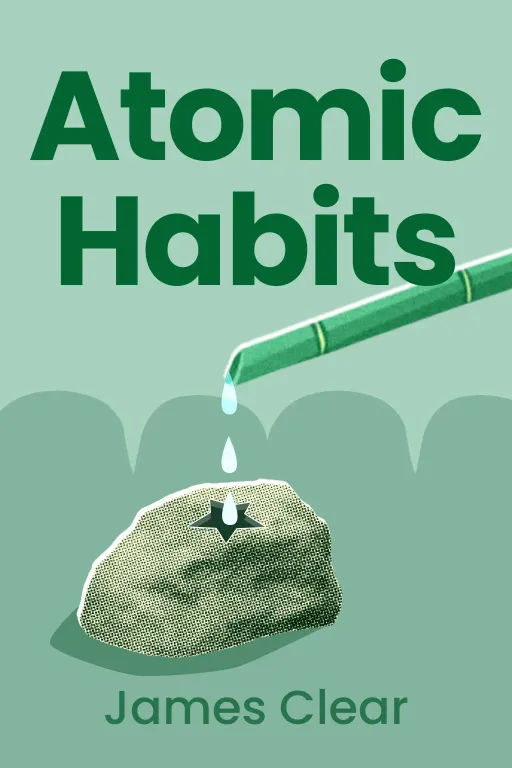
Designing the Self: Systems, Identity, and the UX of Habits
Golden Hook & Introduction
SECTION
Nova: Think about the last time you downloaded an app and uninstalled it within minutes because the interface was just too frustrating. We demand seamless, frictionless user experiences from our technology, don't we? But how often do we look at our own daily routines and realize we’ve designed a terrible user experience for ourselves? Today, we’re looking at habit formation through a brand-new lens. I'm Nova, and we are joined by UX designer, researcher, and deep analytical thinker, Eseosa Gift Richard! We're diving headfirst into James Clear’s groundbreaking book,. Eseosa, welcome to the show!
Eseosa Gift Richard: Thanks, Nova! It is so great to be here. You know, when I first read, my designer brain immediately started making connections. In UX, we talk constantly about reducing friction, understanding mental models, and designing intuitive pathways. James Clear is essentially giving us a masterclass in how to design the user experience of our own lives.
Nova: Oh, I love that! "The UX of our own lives." That is the perfect way to frame this. Today, we are going to tackle this book from three distinct, powerful angles. First, we'll explore how to design our environment and systems to make good habits the path of least resistance. Second, we'll discuss the profound shift of identity-based habits and how to apply them to our spiritual, professional, and personal growth. And finally, we'll focus on how to stay motivated and continuously iterate on our progress using the Goldilocks Rule and deliberate reflection. So, Eseosa, let's start with the foundation. Clear says we don't rise to the level of our goals; we fall to the level of our systems. Why does that resonate so deeply with you?
Eseosa Gift Richard: It resonates because, in product strategy, a great goal without a system is just a wish. You can design a beautiful mockup of a product, but if you don't have the engineering, the user testing, and the deployment pipeline, that product will never succeed. It's the same with us. We get so obsessed with the "destination"—the goal—that we ignore the "journey"—the system. As an INTP, I love breaking things down into their core components, and Clear's focus on systems over goals is the ultimate analytical framework for personal growth.
Deep Dive into Core Topic 1
SECTION
Nova: It really is. And to show just how powerful a system can be, Clear shares this incredible story about British Cycling. Back in 2003, British Cycling was in a really sad state. They had won only a single gold medal since 1908, and they were so mediocre that one of the top bike manufacturers in Europe actually refused to sell them bikes because they were worried it would hurt their brand! Enter Dave Brailsford, the new performance director. He didn't try to overhaul everything overnight. Instead, he committed to a concept he called the "aggregation of marginal gains." The idea was simple: if you break down everything you can think of that goes into riding a bike, and improve it by just one percent, you will get a significant increase when you put them all together.
Eseosa Gift Richard: This is classic iterative design! It's the exact same way we build software. You don't build a perfect app in one giant leap; you make tiny, continuous improvements. What did Brailsford actually change?
Nova: Oh, it is fascinating! They redesigned the bike seats to make them more comfortable. They rubbed alcohol on the tires for better grip. They had the riders wear electrically heated overshorts to maintain the perfect muscle temperature while riding. But they didn't stop there. They tested different massage gels for faster muscle recovery. They hired a surgeon to teach the riders the absolute best way to wash their hands to avoid catching a cold. They even tested different pillows and mattresses to ensure each rider got the best night's sleep possible! And my absolute favorite detail: they painted the inside of the team truck white so they could spot tiny dust particles that might get on the finely tuned bikes and degrade their performance.
Eseosa Gift Richard: That is mind-blowing attention to detail! Painting the truck white to spot dust is the ultimate way to make a hidden friction point obvious. It's brilliant. And the results speak for themselves, right?
Nova: Absolutely! Just five years later, at the 2008 Beijing Olympics, the British Cycling team dominated, winning an astonishing sixty percent of the gold medals. Four years later in London, they set nine Olympic records and seven world records. Bradley Wiggins became the first British cyclist to win the Tour de France, and Chris Froome went on to win it multiple times. All of this came from compounding those tiny, one percent improvements. It's the mathematical reality of compounding interest applied to human performance. If you get one percent better each day for a year, you end up thirty-seven times better!
Eseosa Gift Richard: That math is so encouraging because it takes the pressure off. You don't need a massive, heroic transformation today. You just need a one percent shift. In design, we call this "choice architecture"—structuring the environment so that the desired action is the easiest one to take. Clear talks about this with the hospital cafeteria study, right?
Nova: Yes! Dr. Anne Thorndike at Massachusetts General Hospital wanted to improve the eating habits of hospital staff and visitors, but she didn't want to use willpower or preach to them. She wanted to see if she could change their behavior simply by changing the "choice architecture" of the cafeteria. Originally, the refrigerators next to the cash registers were only stocked with soda. Thorndike's team added bottled water to those refrigerators and placed baskets of water throughout the food stations. Soda was still there, but water was now highly visible and accessible. Over the next three months, soda sales decreased by over eleven percent, while bottled water sales shot up by nearly twenty-six percent!
Eseosa Gift Richard: No lectures, no motivational posters, just a change in the physical layout. As a UX designer, this is exactly how we guide users. If you want a user to click a button, you make it big, colorful, and place it right in their natural eye path. If you want to discourage an action, you hide it behind three menus. We can do the exact same thing with our personal environments. If I want to practice my UI design skills daily, I shouldn't keep my laptop zipped up in a bag in the closet. I need to leave it open on my desk, with my design software already running. I'm "priming the environment," just like Oswald Nuckols' strategy of "resetting the room."
Nova: Oh, tell me about that! Oswald's strategy is so practical.
Eseosa Gift Richard: He's an IT developer who realized that cleaning up shouldn't just be about reacting to a mess; it should be about preparing the room for the next action. So, when he finishes watching TV, he doesn't just walk away. He puts the remote back on the stand, arranges the pillows, and folds the blanket. He's reducing the friction for his future self. When he walks into the living room the next day, the environment is already welcoming him to sit down and relax, rather than stressing him out with clutter. It's a beautiful way to apply the Third Law of Behavior Change: Make It Easy.
Identity-Based Habits
SECTION
Nova: It really is. It's like leaving a little gift for your future self! Now, let's transition to the second core topic, which I know you are incredibly passionate about: identity-based habits. Clear argues that there are three levels of behavior change. Picture them as concentric circles. The outer layer is changing your —what you get, like losing weight or publishing a book. The middle layer is changing your —what you do, like your gym routine or your writing schedule. But the deepest, most powerful layer is the inner circle: changing your —what you believe about yourself. Clear says the real reason habits matter is not because they get you results, but because they change your beliefs about yourself.
Eseosa Gift Richard: This is the absolute core of the book for me, especially when applying it to my spiritual life, my work, and my personal growth. Most people start from the outside in. They say, "I want to read the Bible more", so "I will set an alarm for 6:00 AM". But they haven't changed their identity. They still view themselves as a night owl who struggles with discipline. So, when the alarm goes off, their old identity wins. Clear uses that brilliant example of two people resisting a cigarette.
Nova: Yes! When offered a smoke, the first person says, "No thanks, I’m trying to quit." It sounds reasonable, but they still identify as a smoker who is trying to be different. The second person says, "No thanks, I’m not a smoker." That is a massive difference! They no longer identify with the behavior. The cigarette is no longer a temptation because it doesn't align with who they are.
Eseosa Gift Richard: Exactly! True behavior change is identity change. Every action you take is a vote for the type of person you wish to become. If you write one page, you are a writer. If you practice a design tool for fifteen minutes, you are a designer. If you sit in quiet reflection and prayer, you are a spiritual seeker. You don't need to be perfect; you just need to win the majority of the votes. This completely reframes how I look at my spiritual life. Instead of guilt-tripping myself with outcomes like "I must read fifty pages of theology this week," I ask myself, "What would a person of deep faith and curiosity do?" They would probably take five minutes to sit in stillness and connect with God. It shifts the focus from a chore to an embodiment of who I am.
Nova: That is a beautiful, liberating shift. It reminds me of the story of the woman who lost over one hundred pounds simply by asking herself, "What would a healthy person do?" Every time she had to choose between walking or taking a taxi, or ordering a salad versus a burger, she would ask that question. She realized that a healthy person would walk and eat the salad. By consistently acting like a healthy person, she eventually that person. The weight loss was just a natural side effect of her identity shift.
Eseosa Gift Richard: It's so powerful because it builds self-trust. As an INTP, I can sometimes get stuck in my own head, overanalyzing and theorizing. But this framework forces me into action. It says, "Don't just think about being a designer or a spiritual person. Go cast a vote." And those small wins accumulate. They provide the cognitive evidence our brains need to update our self-image. It's a feedback loop: your identity shapes your habits, and your habits shape your identity.
The Goldilocks Rule & Continuous Iteration
SECTION
Nova: It's a beautiful, continuous cycle. But what happens when we get bored? Or when we feel like we've hit a plateau? That brings us to our third core topic: the Goldilocks Rule and the practice of reflection. Clear introduces the Goldilocks Rule, which states that humans experience peak motivation when working on tasks that are right on the edge of their current abilities. Not too hard, not too easy, but. He uses the legendary comedian Steve Martin to illustrate this. Steve Martin spent nearly fifteen years honing his craft. He started at Disneyland at age ten, selling guidebooks, then working in the magic shop, learning tricks, and experimenting with jokes. He didn't become a wild success overnight. He spent ten years learning, four years refining, and four years as a massive star. He kept his act engaging by constantly adding new material that was just slightly more challenging than the old stuff, keeping himself in that optimal "flow state."
Eseosa Gift Richard: The Goldilocks Rule is so crucial for maintaining momentum. In psychology, this aligns with the Yerkes-Dodson law, which shows that performance is optimized at a moderate level of arousal or challenge. If a task is too easy, we get bored and complacent. If it's too hard, we experience anxiety and give up. Clear mentions that to maintain this flow state, a task should be roughly four percent beyond your current ability. For my personal growth and design work, this means I need to constantly push myself just a little bit. If I'm designing the same basic landing pages every day, I'll get bored and my habits will decay. I need to introduce a small challenge—like learning a new animation tool or conducting a more complex user research method.
Nova: Yes! But there is a danger here, right? Once a habit becomes automatic, we can fall into the trap of complacency. Clear says that habits create the foundation for mastery, but they can also lead to a lack of self-awareness. When you can do something "good enough" on autopilot, you stop thinking about how to do it better. To combat this, we need reflection and review. He shares the story of the Los Angeles Lakers and their head coach, Pat Riley, back in the 1980s. The Lakers were incredibly talented, but they kept falling short of the championship. So, Riley created the Career Best Effort, or CBE, program. He tracked every player's statistics all the way back to high school to establish a baseline, and then he asked them to improve their output by just one percent over the course of the season. This included not just points scored, but "unsung hero" deeds like diving for loose balls or blocking opponents. By reflecting on and reviewing these metrics weekly, the Lakers won back-to-back championships in 1987 and 1988!
Eseosa Gift Richard: That story is a perfect example of how reflection keeps us conscious of our performance. It's like Eliud Kipchoge, the greatest marathon runner of all time, who still takes notes after every single practice session, reviewing his training and looking for tiny areas to improve. Or Katie Ledecky, the gold medal swimmer, who tracks her wellness, sleep, and nutrition on a scale of one to ten, and then reviews it with her coach every week. In UX design, we have "retrospectives" at the end of every project to ask: What went well? What went wrong? How can we iterate? We need to run retrospectives on our own lives!
Nova: We really do! How do you run a personal retrospective, Eseosa?
Eseosa Gift Richard: I like to do a weekly review. I look at my calendar, my design projects, and my spiritual routines. I don't just look at the metrics; I look at the. If I missed my morning reflection three times this week, I don't beat myself up. I look at the system. Was the friction too high? Did I stay up too late? By auditing my habits with curiosity rather than judgment, I can adjust the choice architecture for the next week. It keeps me from going on autopilot.
Synthesis & Takeaways
SECTION
Nova: That is such an empowering way to live. It's about being the active designer of your life, rather than just a passive user. We've covered so much ground today, Eseosa! From the British Cycling team's one percent compounding gains, to the hospital cafeteria's choice architecture, to the deep, soul-level shift of identity-based habits, and finally, the continuous iteration of the Goldilocks Rule and personal retrospectives. If you had to leave our listeners with one actionable, systems-driven challenge today, what would it be?
Eseosa Gift Richard: I would challenge everyone to use the Two-Minute Rule to cast a vote for their desired identity today. Clear says that when you start a new habit, it should take less than two minutes to do. Don't try to write a whole article; just open Figma and draw one frame. Don't try to pray for an hour; just sit in silence for two minutes. Standardize before you optimize. You can't improve a habit that doesn't exist. Make it so easy that you can't say no, and let that tiny action be a vote for the person you are becoming.
Nova: "Standardize before you optimize." That is a golden takeaway. Eseosa, thank you so much for bringing your incredible analytical mind and design perspective to the show today. This has been absolutely inspiring!
Eseosa Gift Richard: Thank you, Nova! It was an absolute pleasure. Let's all go design some better systems today!
Nova: Yes! And to our listeners, remember: your life is a product, and you are the designer. What is one tiny, one percent shift you can make in your choice architecture today? Let us know, and we'll see you next time on Designing the Self. Bye for now!









