

Unlocking Your Inner Potential: Harnessing the Power of Habits & Mindset
Golden Hook & Introduction
SECTION
Nova: Atlas, if I asked you for a five-word review of 'change' or 'self-improvement,' what would you give me? No overthinking.
Atlas: Oh, man. Okay, five words. Let's see... "Hard. Necessary. Annoying. Worth it. Maybe."
Nova: "Maybe"? That's a very Atlas answer! I love the subtle cynicism. And it actually perfectly sets the stage for our discussion today. Because for many, 'change' truly feels hard, necessary, annoying, and often, the 'worth it' part is a big 'maybe.'
Atlas: Right? We want the glow-up, the transformation, but the actual of getting there? That's where the 'maybe' comes in.
Nova: Exactly. And that's why we're diving into two books that, while distinct, offer a truly complementary blueprint for making that 'maybe' a resounding 'absolutely.' We're talking about James Clear's widely acclaimed and incredibly practical "Atomic Habits," and Carol S. Dweck's groundbreaking research in "Mindset." Clear, with his background in habit formation, gives us the how-to, while Dweck, a Stanford psychologist, provides the foundational belief system.
Atlas: Ah, so it's not just about to do, but about doing it. That's a powerful combination. I imagine a lot of our listeners, who are always looking to explore new knowledge and improve, probably hit walls when trying to implement big changes.
Nova: Absolutely. And that's where the first big idea comes in: the power of the.
The Blueprint for Consistent Growth: Atomic Habits and System Design
SECTION
Nova: See, we're often conditioned to believe that for remarkable results, we need remarkable efforts. Grand gestures, massive overhauls, dramatic shifts. But James Clear, in "Atomic Habits," flips that on its head. He argues that true progress isn't about massive action, but about tiny, incremental changes that compound over time. Think of it like this: if you improve by just one percent every day, by the end of a year, you'll be nearly 37 times better.
Atlas: Whoa. Thirty-seven times better from one percent? That sounds almost... deceptively simple. Like, how can something so small lead to something so massive? It feels counterintuitive to the 'go big or go home' mentality.
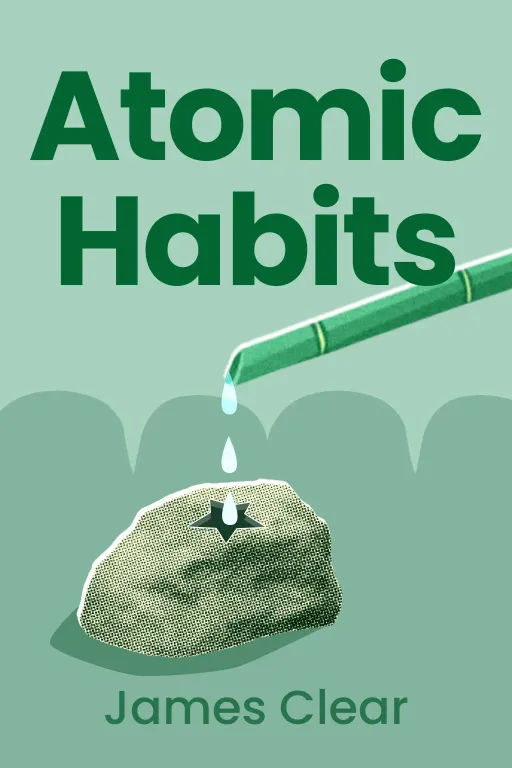
Nova: It does, doesn't it? But that's the magic of compounding. It's the same principle that makes investing grow exponentially, or how a single drop of water, over millennia, can carve a canyon. Clear's genius is in showing us how to apply this to our behavior. He's not just talking about goals, but about designing.
Atlas: Okay, so what's the difference between a goal and a system in this context? Because I've always been told to set ambitious goals!
Nova: Right. A goal is your desired outcome – "I want to write a book," "I want to learn a new skill." A system, on the other hand, is the collection of processes that lead to those outcomes. For writing a book, the goal is the finished manuscript. The system is the daily habit of writing 500 words, setting up a distraction-free workspace, editing regularly. Clear says, "You do not rise to the level of your goals. You fall to the level of your systems."
Atlas: That's a great way to put it. So if my system is robust, the outcome is almost inevitable, regardless of how I about the goal on any given day. But how do you even start building these 'atomic habits'? It still sounds like it requires a lot of discipline to even start that one percent.
Nova: That's the beauty of it. Clear outlines four laws of behavior change: Make it obvious, make it attractive, make it easy, and make it satisfying. Let's take 'make it easy.' If your goal is to read more, don't aim for an hour a day. Aim for one page. And make it easy: leave the book on your pillow, or open on your coffee table. The friction to start is so low, you almost can't do it.
Atlas: One page. That's it? I mean, I could definitely read one page. But then, is that really going to make me a well-read person?
Nova: That's where the compounding comes in. That one page becomes two, then five, then a chapter. More importantly, it creates the of a reader. You're not just someone who to read; you're someone who. Clear's approach is about identity-based habits: focusing on who you want to become, rather than what you want to achieve.
Atlas: I like that. It shifts the focus from a daunting end result to the consistent person you're building yourself into. It's like the British cycling team that won so many championships. They didn't just train harder; they analyzed every tiny aspect, from the type of massage gel to the pillow their athletes slept on. They called it the 'aggregation of marginal gains.' Every tiny improvement, every 'atomic habit' if you will, added up to an unbeatable system.
Nova: Exactly! That's a perfect real-world example. They weren't looking for one big breakthrough; they were looking for hundreds of tiny improvements that would compound. And it worked. They transformed a mediocre team into a dominant force. But here's the thing, Atlas. Even with the best systems, we inevitably face setbacks. We miss a day, we feel discouraged. That's where our second book, "Mindset," comes in, because it addresses the mental framework that allows us to stick with those systems even when the going gets tough.
Unlocking Potential: The Power of a Growth Mindset
SECTION
Nova: So, if "Atomic Habits" gives us the blueprint for to do, Carol Dweck's "Mindset" gives us the internal operating system for we approach those efforts. Dweck's research revealed that people generally operate from one of two mindsets: a fixed mindset or a growth mindset.
Atlas: Fixed versus growth. I'm guessing one is good, and the other... less so?
Nova: Well, it's not about good or bad, but about their impact on our potential. Someone with a fixed mindset believes their abilities, intelligence, and talents are static traits. They think, "I'm either good at this or I'm not." Failure, for them, is a sign of inadequacy. It's a judgment on their core being.
Atlas: Oh, I've definitely felt that. Like, if I try something new and I'm not immediately good at it, I just assume, 'Nope, not for me,' and move on. That's a fixed mindset in action, then?
Nova: Precisely. And that's why it's so limiting. Because if you believe your abilities are fixed, why would you put in effort? Why embrace a challenge if failure means you're fundamentally not smart or talented enough? This often leads to avoiding challenges, giving up easily, and feeling threatened by the success of others.
Atlas: That makes me wonder, how does this play out in real life for someone constantly trying to learn new things, like many of our listeners? If I'm trying to learn a new programming language, and I hit a really complex bug, a fixed mindset would just tell me I'm not cut out for coding.
Nova: Exactly. But a growth mindset, on the other hand, sees intelligence and abilities as qualities that can be developed through dedication and hard work. For someone with a growth mindset, challenges are opportunities to learn and grow. Failure isn't a dead end; it's feedback. It's information.
Atlas: So, sticking with the coding example, if I have a growth mindset and hit that complex bug, instead of quitting, I'd see it as a puzzle to solve, a chance to deepen my understanding?
Nova: Exactly! You'd say, "This is hard, but I can learn to do this. What strategies can I try? Who can I ask for help? What resources can I use?" Dweck's research shows that this belief system fundamentally changes how we approach effort, setbacks, and even criticism. It's not just about positive thinking; it's a deep conviction about the malleability of our own potential. Her work has been incredibly influential, particularly in education, showing how fostering a growth mindset in students can dramatically improve their academic outcomes and resilience.
Atlas: That's actually really inspiring. It means that our potential isn't some fixed ceiling we're born with, but more like a muscle we can continuously strengthen. It really challenges the conventional thinking that some people are just 'naturally' good at things while others aren't.
Nova: It’s a profound shift. And here's where the two books beautifully intertwine: a growth mindset provides the mental resilience and belief in improvement necessary to the atomic habits. If you believe your abilities can grow, you're far more likely to stick with those one-percent improvements, even when they feel small or difficult.
Synthesis & Takeaways
SECTION
Nova: So, when we put "Atomic Habits" and "Mindset" together, we get a holistic approach to unlocking potential. It's not about waiting for a sudden burst of motivation or some grand epiphany. It's about consciously designing systems for small, consistent actions, while simultaneously cultivating a belief that our efforts truly matter and can lead to profound development.
Atlas: That makes so much sense. One without the other feels incomplete. A great system won't last if your mindset crumbles at the first sign of difficulty. And the strongest mindset won't achieve anything without concrete, consistent actions.
Nova: Exactly. True progress isn't about grand gestures, but the deliberate, often tiny, choices you make every single day. And it's about cultivating a mindset that embraces those challenges as opportunities for growth, rather than threats to your self-worth. It's about understanding that the person you want to become is built brick by brick, one small habit at a time, fueled by the conviction that you become that person.
Atlas: So, for our curious learners out there, always seeking to expand their knowledge and skills, what's one 'micro-revolution' they can start today, combining these two ideas?
Nova: I love that. Here's a challenge: Identify one small habit you can start today that aligns with a larger goal. It could be reading one page of a challenging book, writing one sentence in a journal about a new concept you learned, or taking a five-minute walk to clear your head before tackling a complex problem. Then, consciously remind yourself, "This isn't about perfection; it's about progress. This small action is making me 1% better, and I believe my ability to learn and grow is infinite." Stick with it for a week and observe the shift. It's an experiment in belief and action.
Atlas: I love that. A five-minute walk to reflect on a new concept... that's totally doable. And framing it as an experiment in belief and action makes it less daunting. It really shows how these ideas, when integrated, can lead to powerful, lasting change.
Nova: It truly can. And that's all for this episode of Aibrary.
Atlas: This is Aibrary. Congratulations on your growth!









