

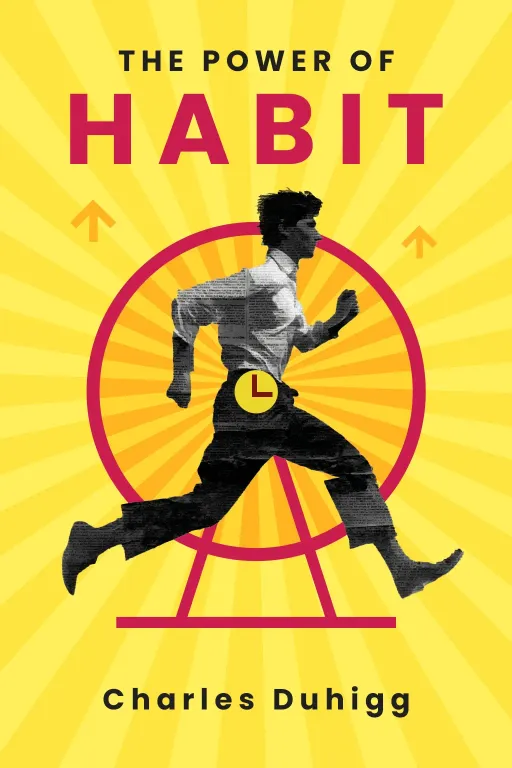
The Power of Habit: Understanding Why We Do What We Do in Life and Business.
Golden Hook & Introduction
SECTION
Nova: Alright, Atlas, five words to describe "The Power of Habit" and "Atomic Habits" combined. Go!
Atlas: Invisible forces, intentional design, profound change.
Nova: Ooh, I really like that! Mine would be: "You are not your choices!"
Atlas: Whoa, that's a bold claim right out of the gate! You're saying we're all just... robots?
Nova: Not robots, but creatures of habit, more than we realize. Today, we're diving deep into two groundbreaking books that fundamentally reframe how we understand our actions: Charles Duhigg's "The Power of Habit" and James Clear's "Atomic Habits."
Atlas: Ah, the dynamic duo of behavior change! I know Duhigg is a Pulitzer-winning investigative reporter, which means his insights are backed by some serious digging, right? And Clear comes from a world of practical application.
Nova: Exactly! Duhigg, with his journalistic rigor, unveils the underlying science and real-world case studies of habits. Clear, with his entrepreneurial and personal development focus, then gives us the actionable framework to actually something with that knowledge. It's a powerful one-two punch for anyone curious about how we tick and how we can intentionally design better systems for ourselves, our teams, even technological adoption.
Atlas: That makes me wonder, if so much of our lives is governed by these automatic routines, how do we even begin to untangle them? It feels like trying to grab smoke.
The Habit Loop: Unveiling the Invisible Architecture
SECTION
Nova: That's the perfect question, Atlas, because to untangle them, we first need to understand their fundamental architecture. Duhigg calls it the "habit loop." It's a three-part neurological pattern: Cue, Routine, Reward.
Atlas: Okay, a loop. So, it's like a perpetual motion machine for our brains?
Nova: Precisely. The is the trigger, the stimulus that tells your brain to go into automatic mode and which habit to use. The is the behavior itself—physical, mental, or emotional. And the is the positive reinforcement that helps your brain remember this loop for the future.
Atlas: So, a cue, a behavior, and then a little treat at the end. Can you give me an example that really brings this to life? Something that feels relatable, but also shows its power.
Nova: Absolutely. Think about Procter & Gamble and their product, Febreze. When it first launched, it was a disaster. They marketed it as an odor eliminator, perfect for cleaning up after pets or smoky rooms. But it wasn't selling.
Atlas: Huh. That seems like a pretty clear problem to solve. What went wrong?
Nova: What went wrong was they didn't understand the habit loop. For people with perpetually smelly homes, the odor was constant, so there was no clear 'cue' to use Febreze. And there was no immediate 'reward' beyond the absence of a smell, which isn't very satisfying.
Atlas: Oh, I see! So, it wasn't integrated into an existing routine.
Nova: Exactly! P&G sent researchers into people's homes and observed. They noticed that many people use Febreze, but only they had already cleaned a room. After scrubbing, vacuuming, and tidying, they'd spray Febreze.
Atlas: So the cue wasn't the smell, it was the?
Nova: You got it! The reward wasn't just eliminating a bad smell; it was the sensory pleasure of a clean, fresh-smelling room. That feeling of accomplishment, of a job well done, amplified by a pleasant scent. So, P&G shifted their marketing. The new ads showed women spraying Febreze they finished cleaning, not to hide odors, but to celebrate the fresh, clean feeling.
Atlas: Wow, that's kind of groundbreaking. They weren't selling a product; they were selling the satisfying completion of a task. The reward was the feeling of a job well done, elevated by a pleasant scent.
Nova: Exactly! Febreze became a massive success because it tapped into an existing habit loop and amplified the reward. It highlights how powerful these invisible forces are, and how understanding them is the first step to changing behavior, whether personal or organizational.
Atlas: That gives me chills, thinking about how many things I do without ever realizing the cue or the true reward. It's like I'm on autopilot for half the day.
Atomic Habits: Hacking the Loop with Tiny Changes
SECTION
Nova: And that naturally leads us to the second key idea we need to talk about, which is how we actually that loop. Understanding it is one thing, but how do we intentionally build good habits and break bad ones? That's where James Clear's "Atomic Habits" comes in, focusing on the power of tiny, almost imperceptible changes.
Atlas: So, it's not about willpower, it's about environment design? Because honestly, for a lot of our listeners who are trying to integrate new technologies or change team workflows, "just try harder" isn't a strategy.
Nova: Absolutely. Clear offers four laws for building good habits and four for breaking bad ones. For building, it's: Make it Obvious, Make it Attractive, Make it Easy, and Make it Satisfying. It's about designing your world so that good habits are the path of least resistance.
Atlas: "Make it easy" – that resonates. We often think we need these grand, heroic efforts to change, but that usually just leads to burnout.
Nova: Precisely. And the cumulative effect of these small changes is what Clear calls "atomic." Think about the British Cycling team. For years, they were mediocre. Then, a new performance director, Dave Brailsford, came in and focused on the "aggregation of marginal gains."
Atlas: Oh, I've heard about this! It's legendary.
Nova: He looked for 1% improvements everywhere. Not just the bikes, but the pillow the riders slept on, the type of hand soap they used to prevent illness, the specific massage gels. Every tiny detail was optimized.
Atlas: So, it wasn't one massive breakthrough. It was hundreds of tiny, almost invisible shifts that, when added together, became monumental.
Nova: Exactly! Within five years, they dominated the Tour de France and the Olympics. This isn't about grand gestures; it's about consistent, almost invisible shifts in the cue, routine, and reward. Making the cue for a good habit obvious, making the routine so easy you can't do it, and making the reward immediately satisfying.
Atlas: That’s actually really inspiring. So, for our listeners trying to, say, adopt a new software system or integrate a new process at work, it's not about a huge training overhaul, but making the incredibly obvious and easy?
Nova: Yes! And making it satisfying. Small wins compound. If you want to read more, don't aim for a book a day. Start with one page, one paragraph. Make it so easy that you can't say no. That small victory, that feeling of having completed something, even tiny, is the satisfying reward that reinforces the loop.
Atlas: So, the "atomic" part is that these changes are so small they almost feel insignificant, but they're the building blocks that accumulate into something massive. It's like compound interest for your personal growth.
Synthesis & Takeaways
SECTION
Nova: That's a perfect analogy, Atlas. What these two brilliant authors show us is that Duhigg gives us the "what"—the foundational understanding of the habit loop. And Clear gives us the "how"—the practical, atomic strategies to actually manipulate that loop. When you combine that awareness with intentional, small actions, that's where true transformation happens.
Atlas: So, it really boils down to this: our choices aren't always conscious, but our of those choices can be. We can be the architects of our own behavior, rather than just passengers.
Nova: Exactly. And it starts with asking yourself: What is one routine in your day that you perform without thinking, and what might be its hidden cue and reward? Just identifying that is a powerful first step.
Atlas: That makes me reflect on so many things I do on autopilot. And it gives me hope that even these deeply ingrained patterns aren't my destiny. We can actually re-engineer them.
Nova: We absolutely can. The power isn't in sheer willpower, but in understanding the system and making those subtle, consistent adjustments. It’s about being mindful of the invisible forces and then intentionally designing your environment to guide you towards your goals.
Atlas: I imagine a lot of our listeners are now thinking about their own habit loops and how they can apply these ideas to everything from personal productivity to organizational change. I invite everyone to share their discoveries and "atomic insights" with the Aibrary community. We'd love to hear what you uncover!
Nova: This is Aibrary. Congratulations on your growth!









