

The Paradox of Time and Atomic Progress
Golden Hook & Introduction
SECTION
Nova: Productivity is a lie. We treat time like a resource to be managed, like a budget where we can just cut costs and increase revenue, but it is actually a container that starts leaking the moment we are born.
Atlas: That is an incredibly grim way to start a conversation, Nova. I came here for life hacks, not an existential crisis.
Nova: The crisis is the point. We are obsessed with the idea that if we just find the right app or the right morning routine, we can finally get on top of everything. But the reality is that the "everything" is infinite, and our time is strictly finite.
Atlas: Okay, that makes sense. I have definitely felt that crushing weight of an infinite to-do list where the more I check off, the more appear. So, how do we fix that?
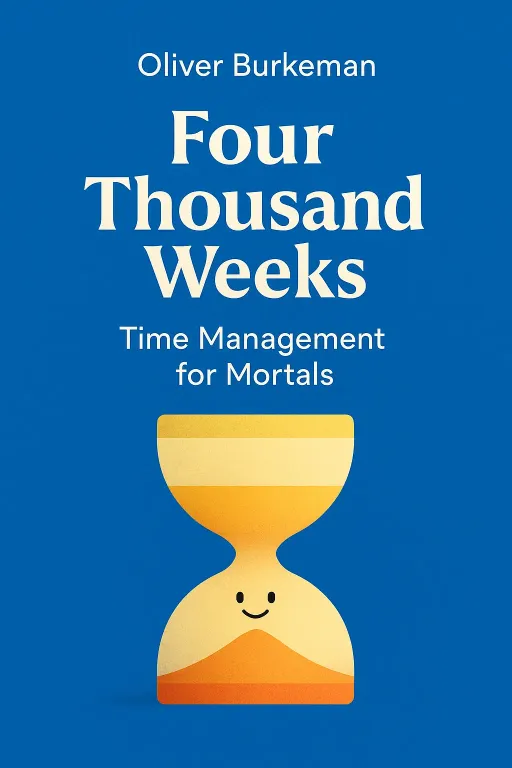
Nova: We don't fix it. We change our relationship with it. Today, we are looking at two very different, yet oddly complementary, perspectives. We are diving into Four Thousand Weeks by Oliver Burkeman, a journalist who essentially realized that time management was making him miserable, and Atomic Habits by James Clear, who turned the science of behavior into a blueprint for life.
Atlas: I know those two. Burkeman is the one who basically tells you to stop trying to be so efficient, right? And Clear is the guy who tells you that you are one tiny habit away from being a different person. They seem like they are giving completely different advice.
Nova: They are, and that is exactly why they are perfect to pair together. Burkeman gives you the philosophy to decide what is worth doing, and Clear gives you the mechanical system to actually do it.
The Paradox of Finitude
SECTION
Atlas: I am curious about the Burkeman angle first. I have seen his work cited everywhere, usually by people who are tired of the hustle culture grind. What is the core mechanism he is pointing at?
Nova: The core mechanism is what he calls the finitude trap. Most of us operate under the delusion that if we just optimize our lives enough, we will eventually reach a state where we are on top of everything. We keep waiting for that moment where the inbox is empty and our commitments are balanced.
Atlas: And the spoiler alert is that it never happens.
Nova: Exactly. Burkeman points out that the more efficient you become, the more work people dump on you. It is the efficiency trap. If you become a master at clearing your emails, you just get more emails. He argues that the anxiety we feel isn't because we are bad at time management; it is because we are human, and humans are finite. We have four thousand weeks on this planet, on average. That is it.
Atlas: That is a staggering number when you put it that way. It is not even that many.
Nova: It is not. And the problem is that we spend those weeks trying to fit an infinite amount of ambition into a very small bucket. Burkeman’s argument is that we need to embrace the fact that we will never get everything done. We need to consciously choose what to fail at.
Atlas: That is a hard pill to swallow. Consciously choosing to fail? That goes against every instinct I have as someone who likes to get things done.
Nova: It is counterintuitive, but it is the only way to retain your sanity. Think about it. If you have ten things you want to do and time for three, you are going to fail at seven of them regardless. The question is whether you fail at them intentionally or by accident.
Atlas: When you frame it like that, it sounds like a strategy. If I choose to let the laundry go until the weekend, I am intentionally failing at household maintenance to succeed at deep work.
Nova: Precisely. That is the shift. It is about moving from "how do I do it all" to "what am I willing to leave undone." Burkeman isn't saying to be lazy. He is saying to be brutal with your priorities.
Atlas: I can see how that would change the stress levels. But here is the pushback. If I just decide to ignore half my tasks, I might lose my job. How do we distinguish between "productive ignoring" and just being irresponsible?
Nova: That is the million-dollar question. The distinction lies in the intentionality. If you are ignoring tasks because you are overwhelmed and paralyzed, that is a reaction. If you are ignoring tasks because you have identified a clear hierarchy of value, that is a strategy. Burkeman talks about the importance of "strategic incompetence" in areas that don't move the needle for you.
Atlas: I love that term. Strategic incompetence. It sounds like something I could use in my weekly team meeting.
Nova: It is powerful. But this is where the conflict arises for most people. We feel the anxiety of the undone task. We feel that itch to just clear the deck.
Atlas: That is exactly where I get stuck. I can intellectually agree that I should ignore the low-value stuff, but the emotional pull to just "get it done" is so strong. It feels like a relief to cross something off, even if it is meaningless.
Nova: That is the dopamine loop. We are addicted to the feeling of completion, not the feeling of progress. And that is why we need to pivot. We need to stop looking at time as a bucket to be filled and start looking at it as a reality to be navigated.
The Micro-Habit Solution
SECTION
Atlas: So, we have established that we need to stop trying to do it all. We have accepted our own finitude. But that still leaves the problem of actually getting the important stuff done. That is where James Clear comes in, right?
Nova: Right. Once you have used Burkeman’s lens to decide what actually matters, you need a system to ensure you don't just collapse under the weight of even the important stuff. James Clear’s Atomic Habits is all about the micro-level.
Atlas: I have read that one. He talks about 1% improvements. It sounds almost too simple to be true.
Nova: The simplicity is the disguise. People think it is about the goal. They think, "I want to write a book," or "I want to get fit." Clear argues that the goal is the outcome, but the system is the process. He says you do not rise to the level of your goals; you fall to the level of your systems.
Atlas: That hit me hard when I first read it. Because I have plenty of goals, but my systems are usually non-existent. I just rely on willpower.
Nova: Willpower is a finite resource. Clear’s genius is in showing how to make the system require zero willpower. He talks about habit stacking and environmental design. If you want to read more, don't rely on the willpower to sit down and read. Put the book on your pillow. Make the cue obvious.
Atlas: It is about reducing the friction.
Nova: Exactly. Friction is the enemy of consistency. If you want to build a habit, make it easy to start. If you want to break a habit, make it hard to start. It is behavioral engineering.
Atlas: I see how this bridges the gap. Burkeman tells me what to focus on, and Clear tells me how to make sure I actually do it without burning out.
Nova: That is the synthesis. Imagine you have identified your "big rocks," the three things that actually matter for your long-term goals. That is your Burkeman phase. You have consciously decided to ignore everything else. Now, you have these three big rocks. You need to turn them into atomic habits.
Atlas: So, instead of having a to-do list of fifty items, I have, say, three habits that I focus on every single day.
Nova: Yes. And you design your environment so that doing those three things is the path of least resistance. You aren't forcing yourself to work; you are setting up your day so that working is the most natural thing to do.
Atlas: What about the resistance? I know that even with the best environment, I sometimes just don't want to do the work.
Nova: That is when you lean into the identity-level change. Clear talks about this a lot. The ultimate form of intrinsic motivation is when a habit becomes part of your identity. You don't say "I am trying to run." You say "I am a runner."
Atlas: That sounds like a subtle shift, but I bet it is powerful.
Nova: It is seismic. When you view yourself as the type of person who does X, you don't have to debate whether to do it. You just do it because that is who you are. The habit is no longer a chore; it is an expression of your self-image.
The Synthesis of Strategy and Execution
SECTION
Atlas: Okay, let's bring this together. If I am an aspiring leader, or someone who is trying to build a foundation that lasts, how do I actually apply this? I feel like there is a danger of becoming too obsessed with the system and forgetting the purpose.
Nova: That is a brilliant point. The danger of Atomic Habits is that you can become hyper-efficient at doing things that don't matter. You can be the most organized person in the room, but if you are organized about the wrong things, you are just fast-tracking your own irrelevance.
Atlas: So, we need the Burkeman filter first.
Nova: Always. You must start with the filter. You have to ask, "If I only have four thousand weeks, is this task worth one of them?" If the answer is no, delete it. Automate it. Delegate it. Or just let it sit there and rot. Then, and only then, do you apply the Clear system to the things that passed the filter.
Atlas: It is like a funnel. The wide top is everything that could possibly be done, the filter is the Burkeman "finitude" assessment, and the narrow bottom is the Clear "atomic habit" execution.
Nova: That is a perfect analogy. And most people try to build the system at the top of the funnel. They try to find a productivity system to manage their entire life, which is impossible. They are trying to optimize the chaos instead of curating the focus.
Atlas: I have been that person. I have spent hours setting up a project management tool, color-coding my tasks, only to realize I was just rearranging the deck chairs on the Titanic.
Nova: We all have. It feels like work. It feels like progress. But it is just avoidance. The real work is in the difficult choice of what to ignore.
Atlas: And that is scary. Because when you ignore something, you are accepting that it won't get done. You are accepting that you are not going to be everything to everyone.
Nova: Acceptance is the key. Burkeman calls it "embracing your finitude." It is not a defeat; it is a liberation. When you accept that you cannot do it all, you stop comparing yourself to an impossible standard. You start comparing yourself only to your own potential.
Atlas: I want to dig into the "identity" part of Clear’s work again, because I think that is the bridge to the long-term. If I want to be a leader, for instance, I don't need a habit of "doing more work." I need a habit of "thinking more clearly."
Nova: Exactly. What is the atomic habit for clear thinking? Maybe it is a twenty-minute deep-work session every morning. Maybe it is reading one article from a field completely unrelated to your own to spark cross-pollination.
Atlas: So the habit isn't the work itself, it is the preparation for the work.
Nova: Often, yes. The habit is the cue that tells your brain, "It is time to be the person I want to be." If you want to be a writer, the habit isn't writing a novel; the habit is opening your laptop at 8:00 AM. If you do that, the writing follows.
Atlas: This feels like it takes the pressure off. If I don't have to write the novel today, I just have to open the laptop, the friction is gone.
Nova: And that is the beauty of it. You are playing the long game. You are not trying to win the week; you are trying to win the decade.
Synthesis & Takeaways
SECTION
Atlas: This has been a great synthesis. We have moved from the existential reality of our limited time to the practical, daily systems of getting things done.
Nova: It really comes down to this: Don't optimize your life for productivity. Optimize it for meaning. Productivity is just the byproduct of doing the right things consistently.
Atlas: I like that. Let's give our listeners something they can walk away with right now. What is the one thing they should do today?
Nova: I would suggest they look at their to-do list for tomorrow. Don't look at how to get it all done. Look at it and ask: "Which of these tasks is just busy work that I am doing to feel productive, but which doesn't actually align with my long-term identity?"
Atlas: And then?
Nova: And then, you cross it out. You let it go. You give yourself permission to fail at that task. And in that freed-up space, you design one tiny, atomic habit that moves the needle on the one thing that actually matters.
Atlas: I’m going to do that tonight. I have a recurring weekly report that takes me two hours and I am pretty sure nobody reads. I’m going to see what happens if I stop doing it.
Nova: That is the spirit. That is the beginning of reclaiming your four thousand weeks. It’s not about doing more; it’s about doing what matters, and doing it with the consistency that builds a life.
Atlas: This has been a fantastic exploration of how to balance the philosophy of time with the mechanics of life.
Nova: It is the only way to build a foundation that lasts. You curate the focus, then you build the system.
Atlas: Thanks for walking through this with me, Nova. It feels like I have a bit more breathing room now.
Nova: My pleasure, Atlas. And to everyone listening, remember: you don't need to read everything to know enough. You just need to apply one thing.
Atlas: This is Aibrary. Congratulations on your growth!









