

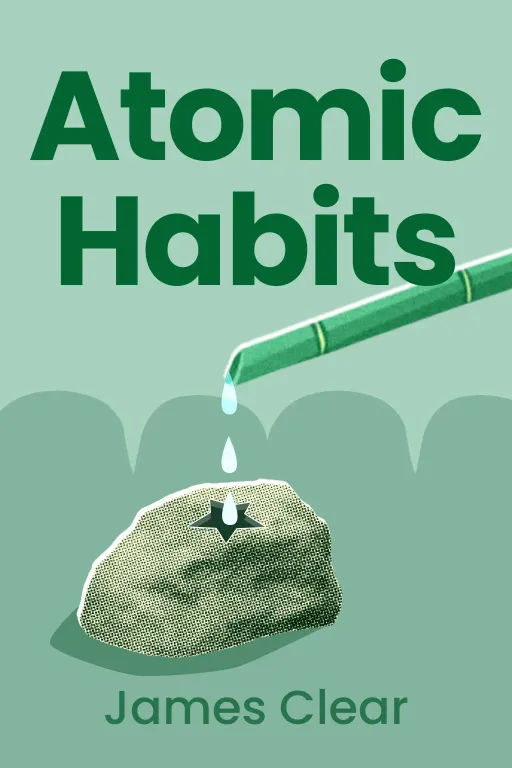
The Hidden Power of Habits: How Small Choices Shape Your Destiny.
Golden Hook & Introduction
SECTION
Nova: Most of us are chasing big goals with big, dramatic plans. We think the bigger the dream, the bigger the effort needed. What if that's exactly why we often stumble, procrastinate, or just… give up? What if the secret to massive, lasting change isn't about grand gestures, but about something so tiny, you almost overlook it?
Atlas: That's a provocative thought, Nova. Because honestly, the conventional wisdom screams "Go big or go home!" It’s in our culture, our business models. It’s what you expect to hear from someone trying to make a change.
Nova: Absolutely. But today, we're flipping that script. We're diving into the wisdom of two titans in the world of personal development: James Clear's "Atomic Habits" and Charles Duhigg's "The Power of Habit." Clear, a renowned habit expert, didn't just write a book; he built his practical framework on extensive research and personal experimentation, making his approach incredibly actionable and widely adopted. Duhigg, on the other hand, is a Pulitzer Prize-winning investigative reporter who brought scientific rigor to the study of habits, revealing the neurological loops that govern our daily lives.
Atlas: A Pulitzer Prize for habits? That's serious business. It implies there’s something deeply fundamental, almost journalistic, about understanding these patterns. So, are we talking about the same kind of habits here? Are they just different angles on the same idea, or do they offer distinct insights?
Nova: They're absolutely complementary, Atlas, like two sides of the same incredibly powerful coin. Clear gives us the practical blueprint, the "how-to" for building and breaking habits. Duhigg provides the scientific foundation, the "why" our brains operate the way they do when it comes to routines. And that practical blueprint, the engineering of tiny changes, is exactly where we should start.
The 'How-To' of Habit Formation: Engineering Tiny Changes
SECTION
Nova: When James Clear talks about "Atomic Habits," he’s not just talking about small habits; he’s talking about habits that are fundamental, that contain immense power, like an atom contains energy. His core insight is that small, incremental improvements, when compounded over time, produce extraordinary results. Think about it: getting just one percent better at something every single day for a year means you'll end up nearly 37 times better than when you started.
Atlas: One percent? That sounds almost insultingly small to someone who's driven to achieve big things, to make a real impact. For a 'Curious Cultivator' who wants to see tangible progress, waiting for 1% feels… well, it feels like watching paint dry. How do you convince someone that micro-changes aren't just a waste of time?
Nova: Because that feeling of "too slow" is precisely the cognitive bias that derails us. We overestimate what we can do in a day and underestimate what we can do in a year. Clear's genius is in his four laws of behavior change: Make it obvious, make it attractive, make it easy, and make it satisfying. Let’s take something simple, like wanting to write more. Instead of saying, "I'm going to write a novel this year," which feels monumental, you make it obvious. You open your laptop to the writing document the moment you sit down for coffee.
Atlas: So it's about reducing the friction? That makes sense for someone who values efficiency. But "make it easy" still sounds like it takes discipline. If I'm already overwhelmed, how do I even start making it easy?
Nova: That's where "habit stacking" comes in. You don't try to conjure new willpower. Instead, you link a new habit to an existing one. For example, "After I pour my morning coffee, I will write one sentence." Or, "After I brush my teeth, I will do one push-up." The cue is already there, the old habit is already ingrained. You just tack on the new, tiny one. It's about engineering your environment and your schedule, not just relying on sheer willpower, which is a finite resource. It's the ultimate efficiency hack for personal growth.
Atlas: Okay, I can see how that would resonate with someone who has a demanding schedule, where every minute counts. It’s not about finding more time; it’s about optimizing the time you already have. So, it's about being an architect of your own triggers.
Nova: Exactly! It’s about making the desired action almost inevitable. And that idea of engineering your environment, Atlas, brings us perfectly to the deeper 'why' behind habits. Because it's not just about what you do, but how your brain is wired to do it. And that's where Charles Duhigg, with his Pulitzer-winning insights, really shines.
The Science Behind the Loop: Understanding Why Habits Stick
SECTION
Nova: Duhigg, through his investigative lens, breaks down habits into what he calls the 'habit loop': a cue, a routine, and a reward. It's a neurological feedback loop that underpins virtually every behavior, from brushing your teeth to checking your phone. The cue triggers the routine, and the routine delivers a reward, which then reinforces the loop, making you crave that reward again.
Atlas: Hold on, if these loops are so powerful, isn't that just a fancy way of saying we're slaves to our routines? Where's the free will in that? And how does understanding a 'cue' really help me if I'm just reacting to it? That sounds a bit deterministic for a 'Practical Philosopher' who wants agency.
Nova: That's a crucial question, and it's where Duhigg’s work becomes so empowering. He argues that while we can't always eliminate the cue or the craving, we can absolutely change the routine. Think about the classic Febreze story. When it first launched, it failed because people used it to eliminate bad smells, but the reward wasn't clear. It was only when they marketed it as a —a reward after cleaning to make a room smell fresh—that it took off. The cue became the clean room, the routine spraying Febreze, and the reward was the fresh scent and the feeling of accomplishment.
Atlas: So it's not about eradicating the cue, but changing the routine and the reward. That's a profound shift in perspective. It means we’re not just passively experiencing our habits; we can actively redesign them. It’s like being a detective of your own inner workings.
Nova: Precisely. Duhigg shows us that the craving for the reward is the true engine of the habit loop. If you can identify that craving—whether it’s for connection, comfort, escape, or achievement—you can then consciously choose a different routine to get that same reward. Knowing the 'why' behind your current habits gives you the power to strategically insert new, positive routines or dismantle old, unhelpful ones. It’s about building a better habit machine.
Atlas: And that's where Clear's framework comes back in, right? Once you understand the engine, you can use the right tools to fine-tune it. It’s about connecting the deeper meaning of our actions to the daily tasks.
Synthesis & Takeaways
SECTION
Nova: Exactly. Clear gives us the elegant, practical tools—make it obvious, attractive, easy, satisfying. Duhigg explains the underlying neurological engine, the habit loop of cue, routine, and reward, and crucially, the craving that drives it. True mastery comes from combining both. It’s not about finding some magical, dramatic moment of transformation. It’s about understanding the invisible forces that shape our days and then deliberately, consistently, making tiny adjustments.
Atlas: Honestly, that’s actually really inspiring. It takes the pressure off the monumental, often overwhelming, idea of "changing your life" and breaks it down into manageable, even enjoyable, steps. For our 'Practical Philosophers' and 'Curious Cultivators' out there, what's one tiny, almost ridiculously small thing they can do tomorrow to start applying this wisdom? Something that feels truly achievable.
Nova: The tiniest step, the most reliable path, is simply this: Identify one small habit you want to build. Just one. Then, design its 'cue' and 'reward' for tomorrow. Don't overthink it. Make the cue obvious. Make the reward satisfying, even if it's just a mental pat on the back. Start ridiculously small.
Atlas: It’s amazing how this seemingly simple idea of a 'tiny step' echoes through history and human behavior. It's the ultimate efficiency hack for personal growth, allowing us to link our daily tasks to bigger ideas, to see the 'why' in every small action. It’s about trusting our inner wisdom, that the power to shape our destiny isn't found in monumental leaps, but in the quiet, consistent hum of our atomic habits.
Nova: That's beautifully put, Atlas. Because ultimately, the hidden power of habits is that they are the quiet architects of our destiny. They are the small choices we make today that, compounded, determine who we become tomorrow.
Atlas: This is Aibrary. Congratulations on your growth!









