

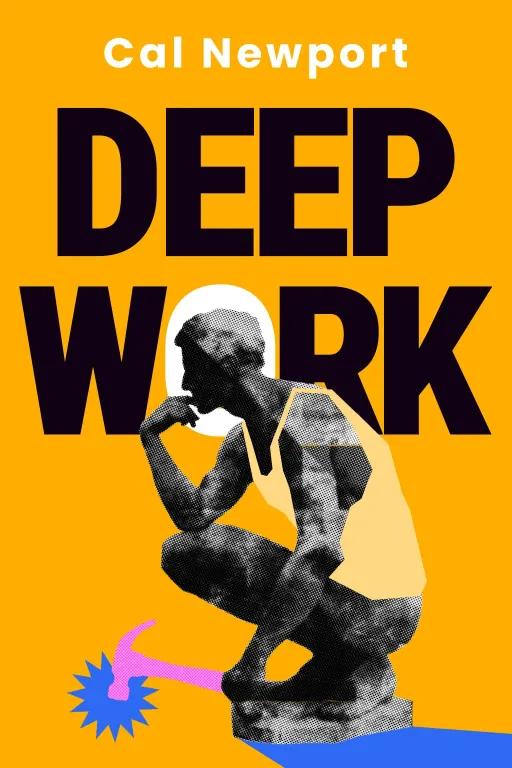
The 'Deep Work' Law: Rethinking Focus for Peak Performance.
Golden Hook & Introduction
SECTION
Nova: Okay, Atlas, 'Deep Work' by Cal Newport. Five words. Go.
Atlas: Focus. Mastery. Quiet. Essential. Hard.
Nova: Hard! Love that. And you know, 'hard' is probably the most honest word you could pick for this book. Today, we're diving into Cal Newport's seminal work, 'Deep Work: Rules for Focused Success in a Distracted World.' What's fascinating about Newport is that he's a highly successful computer science professor at Georgetown, a prolific author, yet he famously has no social media accounts. He practices what he preaches, offering a powerful, living example of thriving in academia and beyond without constant digital noise.
Atlas: Oh, I like that. It's almost like he's built his own digital fortress. But wait, in a world that seems to demand constant connectivity, constant availability, how has this ability to focus deeply become so rare? I mean, it feels like we're just wired for distraction now.
Nova: Exactly! That's the cold, hard truth he lays out. Our world is designed to pull our attention in a million different directions. What Newport argues is that deep work—the ability to focus without distraction on a cognitively demanding task—isn't just a nice-to-have anymore. It's a superpower.
Atlas: A superpower? That's a bold claim. But I can see it. For anyone who's trying to achieve significant results, whether it's mastering complex information or producing genuinely high-quality work, that sustained, uninterrupted concentration just feels... elusive.
The Scarcity and Value of Deep Work
SECTION
Nova: It absolutely is. Think about it: every advanced field, from software engineering to medical research, demands deep, sustained thought. But our modern work environments, with their open offices, constant Slack pings, and endless email notifications, actively conspire against it. We've optimized for communication and collaboration, sometimes at the expense of concentration.
Atlas: That makes me wonder, is this really just a perception, or is the actual capacity for deep focus genuinely eroding? For our listeners who are managing high-pressure teams, constantly juggling priorities, this concept might feel impossible to implement. Like, I can't just turn off my phone for four hours.
Nova: No, you can't be a monk, and Newport isn't suggesting that. He's saying that the for deep work is shrinking, and with it, the number of people who can actually it. This creates an enormous competitive advantage for those who can. Imagine a software developer, for instance, who can consistently carve out two to three hours of uninterrupted time each day to tackle a complex coding problem, free from alerts. They will consistently outperform someone who spends their day context-switching every ten minutes. The quality, the innovation, the sheer output will be dramatically different.
Atlas: Right, like the difference between meticulously crafting a delicate piece of machinery and trying to assemble IKEA furniture with a blindfold on and someone constantly tapping your shoulder.
Nova: Exactly! It's the difference between producing something truly exceptional and just churning out mediocre, reactive work. Newport even talks about what he calls the 'craftsman's mindset,' where you strive for excellence in what you produce, and deep work is the vehicle for that. It’s not just about speed, it’s about quality and profound impact.
Atlas: That gives me chills, honestly. Because I think a lot of us feel that pressure to be constantly "on," to respond immediately, to be seen as available. But if that's actually hindering our ability to produce our best work, then we're caught in this really counterproductive cycle. It's like we're sacrificing long-term mastery for short-term responsiveness.
Nova: Precisely. And that's why this skill is becoming so valuable. In what Newport calls the 'new economy,' characterized by rapid technological change and complex systems, the ability to quickly master hard things and produce at an elite level is paramount. Deep work is the engine for both.
Building a 'Mental Fortress': Habits and Environment for Deep Work
SECTION
Atlas: Okay, so if it's this valuable, this essential, how do we actually it? It sounds great in theory, but how do you build a 'mental fortress' when the world is constantly trying to breach it? For our listeners who are practical strategists, who need tangible steps, what's the first brick in that fortress?
Nova: That's where the insights from James Clear's 'Atomic Habits' beautifully intersect with Newport's philosophy. It's not about relying on sheer willpower, which is a finite resource. It's about designing your environment and building consistent routines. As James Clear teaches, small, consistent changes in your environment and routines can lead to remarkable results. Apply this to deep work by building consistent habits around focused effort.
Atlas: Like, I've heard of people who have a specific "deep work" space, or a ritual before they start. Does that really make a difference? It feels a bit... ceremonial for the modern world.
Nova: It's not ceremonial; it's strategic. Think of it like this: your brain is a creature of habit. If you always do deep work in the same environment, at the same time, with the same pre-work ritual—whether it's making a specific cup of tea, reviewing your goals, or putting on noise-canceling headphones—you're training your brain to enter that focused state more easily. One powerful technique is the "shutdown ritual." At the end of your workday, you review everything you've done and everything you still need to do, making a plan for tomorrow. Then, you literally say "shutdown complete" or something similar. This signals to your brain that it's okay to disengage from work thoughts, preventing that mental residue from spilling into your evening and making it easier to start fresh the next day.
Atlas: Wow, that's actually really inspiring. I can imagine that would free up a lot of mental bandwidth. It’s about building a mental fortress distraction, not just output, right? So it’s not just about what you during deep work, but what you outside of it.
Nova: Absolutely. It's about creating a clear boundary. My own take on this, and something I deeply believe, is that cultivating deep work isn't just about output; it's about building a mental fortress against distraction, leading to mastery and satisfaction. It's about taking control of your attention, which is your most valuable resource.
Atlas: So, for someone who's ready to take that first tiny step, what's the most impactful thing they can do tomorrow? Because I imagine a lot of our listeners are thinking, "This sounds amazing, but where do I even begin?"
Nova: The simplest, most powerful tiny step is this: Schedule a 60-minute block of 'deep work' into your calendar tomorrow, free from all distractions, and stick to it. Treat it like a non-negotiable meeting with your most important client: yourself. Turn off notifications, close unnecessary tabs, and tell those around you you're unavailable. Even an hour can be transformative. It’s about proving to yourself that it's possible.
Synthesis & Takeaways
SECTION
Nova: So, what we're really talking about here is an investment. It's an investment in your cognitive clarity, in the quality of your output, and ultimately, in your professional and personal satisfaction. Deep work isn't just a productivity hack; it's a philosophy for living a more intentional, impactful life in a chaotic world.
Atlas: This all sounds like a lot of effort, Nova. Is it really worth it? What's the ultimate payoff for someone who dedicates themselves to this, beyond just getting more done? For the 'Disciplined Achiever' who cares about tangible results and personal growth, what's the deeper reward?
Nova: The deeper reward, Atlas, is twofold. First, it's the sheer joy of craftsmanship. When you engage in deep work, you're not just completing tasks; you're creating, you're innovating, you're mastering. That sense of intellectual fulfillment, of truly pushing your capabilities, is incredibly satisfying. Second, it's a form of mental resilience. In a world that constantly bombards us with information and demands, the ability to choose focus, to filter out the noise, is a superpower that protects your mental well-being and allows you to truly thrive, not just survive. It's about building a life of meaning and impact, one focused hour at a time.
Atlas: That’s such a hopeful way to look at it. It’s not just about what you achieve, but who you become in the process. So, for everyone out there, schedule that hour. Give yourself the gift of focus.
Nova: Absolutely. It's a small step that can lead to profound changes. This is Aibrary. Congratulations on your growth!









