Stop Building Features, Start Building Habits: The Guide to Lasting User Engagement.
Golden Hook & Introduction
SECTION
Nova: You've poured your heart into building an incredible Agent system, a technical marvel. It's got features no one else can touch. But... why isn't anyone it consistently? Why isn't it becoming that indispensable tool you envisioned?
Atlas: Oh man, that hits home. As an architect, you spend countless hours on system design, scalability, robust features, only to see adoption rates lag. It's like building a supercar that just sits in the garage. All that potential, underutilized.
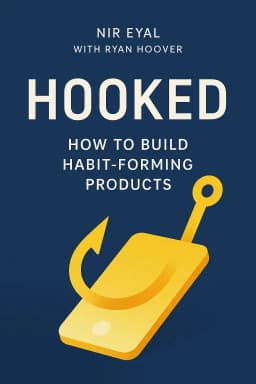
Nova: Exactly! It’s the cold, hard truth of product development. Many brilliant products with groundbreaking features ultimately fail because they don't seamlessly integrate into daily routines. Today, we're unpacking a fundamental truth that often escapes even the most brilliant engineers, drawing lessons from two colossal works: Nir Eyal's 'Hooked: How to Build Habit-Forming Products' and James Clear's 'Atomic Habits.' Eyal, a Stanford lecturer and consultant, has guided countless Silicon Valley companies in embedding behavioral science into their products, while Clear, a renowned habit expert, offers a science-backed framework for making tiny changes yield massive results. These aren't just books; they're blueprints for engineering engagement.
Atlas: So, we're talking about moving beyond just 'what' a product does, to 'how' it becomes a part of someone's life? That's a huge shift in perspective for anyone focused on pure functionality.
Nova: Precisely. It’s about understanding that users are busy. They need solutions that don't just solve a problem, but fit effortlessly into their existing lives. Creating habit-forming products is the key to long-term success, and it’s a strategic act of value creation.
The 'Hook Model': Engineering User Engagement
SECTION
Nova: And that brings us to our first deep dive: Nir Eyal's 'Hook Model.' He presents a four-phase cycle that successful products use to cultivate user habits. Think of it as a blueprint for making your product indispensable. The first phase is the Trigger.
Atlas: Okay, but let's break this down for an Agent architect. What does a 'trigger' even look like in that world? Is it just a notification? Because I can tell you, users get notification fatigue.
Nova: That's a great question, and it's where the nuance comes in. Triggers can be external—like a notification, an email, or an icon on your home screen. But the truly powerful ones are triggers. These are feelings, routines, or contexts that automatically prompt a user to engage with your product without conscious thought. For an Agent, an external trigger might be a prompt when a certain data anomaly is detected. An internal trigger could be the user feeling overwhelmed by a complex task, and instinctively turning to their Agent for help, because they associate it with problem-solving.
Atlas: So, it's about solving a pain point, and the Agent becomes the go-to solution for that specific internal itch. That makes sense. What's next after the trigger?
Nova: Next is the Action. This is the simplest behavior done in anticipation of a reward. For a product to be habit-forming, this action must be incredibly easy to perform. It’s not about complex onboarding or multiple steps; it’s about reducing friction to the absolute minimum.
Atlas: So, an 'action' is just... using the Agent? That sounds too simple. Where's the 'engineering' in that? What can a full-stack engineer to make an action easier beyond just good UI?
Nova: Ah, the engineering here is in the. Think about the number of clicks, the cognitive load, the clarity of the interface. If your Agent requires five steps to initiate a common task, that's friction. If it can anticipate user needs and offer a one-click solution, that's engineered ease. It’s about optimizing the user's motivation their ability. The easier the action, the more likely it is to become a habit. Now, for the magic ingredient: Variable Reward.
Atlas: Variable reward in an Agent? Is it just getting the right answer? Or is there something deeper, something an architect can design for? Because if every interaction just gives me the expected output, that's efficient, but not necessarily 'rewarding' in a habit-forming sense.
Nova: That’s the critical distinction. A variable reward isn't just a predictable outcome; it's an unpredictable, yet satisfying, outcome that keeps users coming back for more. Think about social media feeds—you never know exactly what you'll see next. For an Agent, this could manifest in many ways: an unexpected insight it provides, a novel solution it generates, a surprising efficiency gain, or even a personalized, delightful interaction that wasn't strictly necessary but added value. The is key; it stimulates the dopamine system and creates a craving.
Atlas: Okay, that’s powerful. So it's not just about the Agent doing its job, but doing it in a way that sometimes surprises and delights. That's a design challenge! And the final piece?
Nova: The final piece is Investment. This is when the user puts something into the product—time, data, effort, social capital, customization. This investment increases their commitment to the product, loading the next trigger and making it more likely they’ll return.
Atlas: Hmm. 'Investment' sounds like just... data entry. How does that make an Agent 'stickier'? Isn't that just friction we're trying to avoid?
Nova: It's friction with a purpose. When users invest, they store value in the product. Think about training an AI model with your specific preferences, customizing an Agent's parameters for your workflow, or even just curating specific datasets within the system. The more a user invests their time and effort into tailoring the Agent, the more valuable and indispensable it becomes to. It creates a sense of ownership, making it harder to leave and easier to re-engage. So, as architects, we're not just building the engine; we're designing the entire user journey, almost like a behavioral loop.
Atomic Habits for Product Design: Making Engagement Effortless
SECTION
Nova: Exactly, Atlas. And if Eyal gives us the 'what' and 'why' of the habit loop, James Clear in 'Atomic Habits' gives us the 'how' – the practical science of making those loops irresistible. Clear argues that sustainable change comes from focusing on systems, not just goals, and making tiny, atomic changes.
Atlas: Atomic Habits sounds like personal development. How does 'making your bed' translate to building an enterprise Agent solution? That feels like a leap.
Nova: It might seem like a leap, but Clear's four laws of behavior change are universally applicable, whether you're building a personal habit or designing a product interaction. He says: Make it Obvious, Make it Attractive, Make it Easy, and Make it Satisfying. These directly map to the Hook Model. Let’s look at 'Make it Obvious' first.
Atlas: Okay, 'Make it Obvious.' So, clear UI, intuitive design. That's standard good engineering practice, isn't it?
Nova: It goes deeper. 'Make it Obvious' is about designing clear cues and triggers that prompt the desired behavior. If your Agent has a critical function, is the trigger for that function immediately apparent within the user's workflow? Is it a context-aware prompt that appears exactly when they need it, or a subtle visual cue that guides them? It’s about reducing the search cost for the user. Then there's 'Make it Attractive.'
Atlas: For an Agent, 'attractive' usually means high performance, accuracy, and reliability. But Clear's talking about psychological attraction. An Agent isn't exactly a shiny new toy.
Nova: True, but attraction in this context can be about associating the desired action with a positive feeling or outcome. This could be through clear, compelling visualization of the Agent's impact, like a dashboard showing immediate efficiency gains, or even a simple, positive confirmation message after a successful complex task. It’s about highlighting the immediate benefit, making the user to engage. But the most powerful for product design is often 'Make it Easy.'
Atlas: For a full-stack engineer, 'making it easy' often means refactoring, optimizing code, reducing latency. But Clear's talking about ease. How do we design an Agent's interaction flow so it's almost impossible to use it for a critical task?
Nova: This is where Clear's insights truly shine for product design. 'Make it Easy' means reducing friction to the point where the desired action requires minimal effort. Think about the '2-minute rule': if a task takes less than two minutes, do it immediately. For an Agent, this could mean setting intelligent defaults that pre-fill information, offering highly relevant suggestions that save multiple steps, or integrating the Agent's capabilities directly into existing tools so users don't have to switch contexts. You're designing the path of least resistance towards the valuable outcome. It's not about adding more features; it's about removing obstacles.
Atlas: That's a profound shift. It's not about adding more buttons; it's about removing obstacles and designing the path of least resistance towards value creation. It's almost like psychological architecture. And 'Make it Satisfying' links back to the variable reward, right?
Nova: Absolutely. 'Make it Satisfying' is about ensuring an immediate, positive feeling or outcome after performing the desired action, reinforcing the behavior. This could be the fast, accurate answer from your Agent, a visualization of time saved, or the successful completion of a complex workflow. It closes the loop and makes the user want to repeat the action.
Synthesis & Takeaways
SECTION
Nova: So, bringing it all together: Eyal’s Hook Model gives us the strategic framework for the habit loop—Trigger, Action, Variable Reward, Investment—and Clear’s Atomic Habits gives us the atomic-level tactics for building those loops effectively, making them Obvious, Attractive, Easy, and Satisfying. It's a powerful combination.
Atlas: So for our listeners, the architects and value creators, this means thinking beyond the code. It's about designing an Agent system that not only performs brilliantly but brilliantly into a workflow, becoming indispensable. It’s about engineering human behavior within the digital ecosystem.
Nova: Exactly. It's about shifting your focus from merely building functionality to strategically engineering user behavior, creating products that don't just exist, but truly. And that’s our 'tiny step' for today: identify one core interaction in your Agent product and brainstorm how you could introduce a variable reward to make it more engaging for repeat use.
Atlas: What small, almost invisible habit are you asking your users to form with your next product, and how can you make that irresistible? Think about it.
Nova: It’s a challenge that can transform your product's impact.