

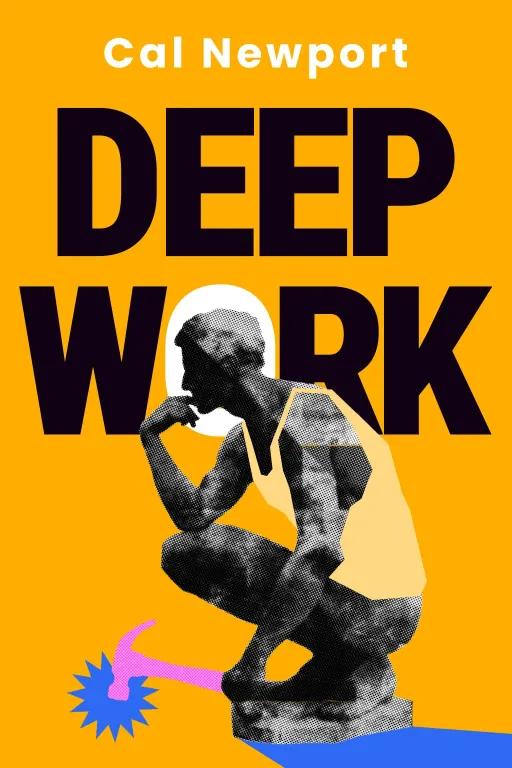
Mastering the Art of Deep Work for Focused Impact
Golden Hook & Introduction
SECTION
Nova: Atlas, if I told you that the secret to truly impactful work isn't about working, but about working, what would your immediate reaction be?
Atlas: Oh, man. My immediate reaction is probably a skeptical, "Tell that to my overflowing inbox and the hundred tabs open on my browser right now." It sounds appealing, but also... a bit like a unicorn.
Nova: Well, prepare to chase that unicorn with us today because we're diving into the transformative power of deep work, drawing heavily from Cal Newport's seminal work, "Deep Work." Newport, an associate professor of computer science at Georgetown, isn't just theorizing; he’s a practitioner who carved out an incredibly successful academic career while publishing multiple bestselling books, all without email or a social media presence. He's living proof this isn't just a nice idea.
Atlas: Wow, no email? No social media? That sounds less like a unicorn and more like a mythical creature from another dimension. How does one even function like that in our hyper-connected world?
Nova: Exactly, and that's the core of his argument. He posits that deep work – that focused, undistracted effort on cognitively demanding tasks – is becoming increasingly rare and, paradoxically, increasingly valuable. It’s the kind of work that truly moves the needle, creates new value, and hones your skills.
Atlas: So you're saying the endless stream of notifications, the constant context-switching, the "just checking in" emails... that's all? The stuff that feels productive but isn't actually creating anything meaningful?
Nova: Precisely. Newport distinguishes between 'deep work' and 'shallow work.' Shallow work is necessary to some extent – answering emails, scheduling meetings, administrative tasks. But it’s non-cognitively demanding, often logistical, and doesn't push your intellectual boundaries. The problem is, for many of us, it consumes the vast majority of our day.
Atlas: I can definitely relate to that. It feels like I'm constantly putting out small fires, and by the end of the day, I'm exhausted but can't point to one significant thing I truly accomplished. It’s a bit disheartening, actually.
Nova: It can be. And this isn't just about feeling good; it's about measurable impact. Deep work is where high-quality output and rapid mastery of complex information happen. It's where you build, you fix, you connect on a truly profound level, which I know is incredibly important to you and many of our listeners who are builders and innovators.
Atlas: I guess that makes sense. If you're constantly pulled in a dozen directions, how can you ever truly build something intricate or solve a complex problem? You need that sustained focus.
Nova: You absolutely do. And James Clear, in "Atomic Habits," provides the perfect complement here. He emphasizes that sustaining deep work isn't just about willpower; it's profoundly about environment design.
Atlas: Oh, I like that. So it's not just about to focus, but about to focus? That feels much more actionable.
Nova: Exactly. Clear illustrates how small, consistent changes in your environment can lead to remarkable results. He talks about making it easy to do the right thing and hard to do the wrong thing. For deep work, that means crafting conditions where focus is the default, not the exception.
Atlas: That resonates deeply. For someone who values real-world application and tangible impact, the idea of an environment rather than just for focus feels like a much more grounded approach. It’s about building the conditions for your best work to emerge.
Crafting Your Focus Sanctuary
SECTION
Nova: Think about it this way, Atlas. If you were building a magnificent structure, you wouldn't just throw tools and materials anywhere. You'd organize your workspace, ensure safety, and minimize distractions to maximize efficiency and quality. Your cognitive output deserves the same meticulous attention.
Atlas: That’s a great analogy. It’s like a master craftsman protecting their workshop. But how does one even begin to "craft" a sanctuary for focus when the world seems designed to pull us in a million different directions? What’s the tiny step from feeling overwhelmed to actually doing deep work?
Nova: The tiny step, the atomic habit for deep work, is surprisingly simple yet incredibly powerful: dedicate a specific 90-minute block each day for deep work on your most important task, free from all distractions.
Atlas: Ninety minutes. Okay. That sounds... achievable. But "free from all distractions" is where I hit a wall. My phone is practically glued to my hand, and my computer screen is a minefield of potential diversions.
Nova: That's where the environment design comes in. For that 90-minute block, your phone goes into another room, on silent. All unnecessary browser tabs are closed. Your email client stays shut. You inform others of your unavailability during this precise window. It's a non-negotiable appointment with your highest-value work.
Atlas: So it's not just about to focus, it's about physically of distraction. That's a subtle but crucial difference. It’s like putting candy out of reach if you're trying to cut down on sugar.
Nova: Exactly! Clear would applaud that analogy. He argues that willpower is finite, and relying solely on it is a losing battle. Instead, we need to design our environment to make the desired behavior – deep work – the path of least resistance. This is where the practical innovator in you can truly shine.
Atlas: That makes me wonder, though. For many of our listeners, especially those in high-stakes, collaborative environments, informing others of unavailability for 90 minutes might feel... unrealistic. Or even selfish. How do you navigate that?
Nova: That’s a valid concern, and it touches on the cultural impact of deep work. Newport himself has faced critiques that his methods, while effective, might inherently favor those in positions of more autonomy. However, the core principle still applies. It might mean finding unconventional times—early mornings, late evenings—or negotiating with your team for a specific "focus hour" where everyone respects each other's concentration.
Atlas: So, it's about setting boundaries, even if they're small ones to start. It’s not about being inaccessible, but about being intentionally inaccessible for a for. That feels more manageable.
Nova: Absolutely. And when you consistently produce high-quality output during those 90 minutes, the value becomes undeniable. You're not just doing tasks; you're mastering your craft, which is a core drive for you, Atlas, and many of our listeners. This isn't just about getting more done; it's about doing work.
Atlas: That’s a powerful distinction. It’s about quality over quantity, which ultimately leads to more significant impact. So, the deep question here is: how can you systematically eliminate distractions from your workspace and digital environment to protect your most valuable cognitive hours? And the answer starts with that tiny 90-minute step.
Nova: Indeed. It's about consciously building a firewall against the constant influx of shallow work and digital noise. It's about recognizing that your attention is your most valuable resource, and treating it as such.
Atlas: I’ve been thinking about this a lot. It’s not just about creating quiet, but about creating space for true intellectual engagement. It's about giving your mind the room to actually and, rather than just react.
Nova: That’s a beautiful way to put it, Atlas. It's about cultivating a mental landscape where complex ideas can take root and flourish. It's a deliberate act of intellectual gardening.
Atlas: Intellectual gardening. I love that. And for many of us who are driven by connection and enriching relationships, this might seem counterintuitive. But if you're constantly scattered, are you truly present even in those relationships?
Deeper Connections & Focused Impact
SECTION
Nova: That’s an insightful point, Atlas. This brings us to a deeper layer of impact. When you're constantly doing shallow work, not only is your professional output diluted, but your capacity for genuine connection can also suffer. You’re always half-present.
Atlas: Oh, I’ve definitely felt that. Trying to have a meaningful conversation while my phone is buzzing, or my mind is still racing from the last email. It's not fair to the other person, and it’s not fulfilling for me.
Nova: Exactly. Deep work isn't just about productivity; it cultivates a deeper presence. When you've dedicated focused time to your demanding tasks, you can then truly disengage and be fully present for your family, friends, or even for that quiet contemplation you value.
Atlas: So, mastering deep work actually for deeper connections and for personal reflection, rather than consuming all your time and energy. That’s a powerful reframe.
Nova: It absolutely is. Consider the impact on someone who truly builds and fixes. If you're constantly interrupted, the quality of your craft diminishes. But if you can carve out that deep work time, the solutions you devise, the connections you forge, and the problems you fix will be more robust, more elegant, more... deep.
Atlas: That gives me chills. It’s about building a legacy of quality, not just a mountain of busywork. It’s about creating something that truly lasts, whether it’s a physical structure, an innovation, or a relationship.
Nova: And that's where the resilience comes in. The ability to consistently engage in deep work, to protect those cognitive hours, builds a kind of mental fortitude. You learn to embrace the discomfort of sustained focus, and in doing so, you become more resilient to the constant barrage of modern life.
Atlas: Okay, so it's not just about getting more done, it's about becoming a more capable, more present, and more resilient individual. This isn't just a productivity hack; it's a way of living.
Nova: It’s a philosophy, really. A commitment to excellence and to protecting your most valuable resource: your attention. It’s about understanding that our brains thrive on focused challenges, not constant stimulation.
Atlas: That makes me wonder, what about those moments when deep work feels impossible? When the distractions are external and unavoidable, like a noisy environment or unexpected demands?
Nova: Newport addresses that. He’s not advocating for monastic isolation 24/7. It’s about deep work. If you know you have a noisy afternoon, schedule your deep work for the quiet morning. If an unexpected demand arises, gracefully reschedule your deep work block, but reschedule it. Don't let it simply vanish. The consistency is key.
Atlas: So it’s about being deliberate and intentional, even when things go off script. It’s about honoring that commitment to yourself and your most important work.
Nova: Precisely. And the cumulative effect of these small, consistent 90-minute blocks is profound. It’s the atomic habit of deep work, building remarkable results over time. You don't just become more productive; you become a master of your own attention.
Atlas: That’s actually really inspiring. It’s a reminder that we have more control than we think over how we spend our most valuable cognitive hours.
Synthesis & Takeaways
SECTION
Nova: So, Atlas, as we wrap up, what’s the single most profound takeaway from our dive into deep work for you?
Atlas: For me, it’s the realization that true impact doesn’t come from being constantly busy, but from being deeply focused. It's about designing my environment to make deep work the default, rather than fighting an uphill battle with willpower. That 90-minute dedicated block feels like a tangible first step towards crafting not just better work, but a more present and connected life.
Nova: That’s beautifully put. The core of our podcast today is really an exploration of how conscious control over our attention can transform not just our output, but our very state of being. It’s about recognizing that in a world constantly vying for our attention, the ability to concentrate deeply is not just a skill, but a superpower.
Atlas: A superpower that allows us to build, to connect, and to achieve at a level we might not have thought possible. It really makes you rethink how you approach every single day.
Nova: And it’s a superpower that's accessible to everyone, starting with those tiny, intentional changes to your environment and schedule. It’s about moving from a state of constant reaction to one of deliberate creation.
Atlas: That’s a powerful thought to leave our listeners with. Protect your focus, and you'll protect your impact.
Nova: Exactly. This is Aibrary. Congratulations on your growth!









