Engineering Immediate Action and Sustainable Behavioral Change
Golden Hook & Introduction
SECTION
Nova: Motivation is a myth. People treat it like a feeling that shows up when it’s convenient, but waiting for that surge of inspiration is the fastest way to stay exactly where you are.
Atlas: That is a brutal way to start the episode, but I suspect you’re right. We spend our lives waiting for the mood to strike, thinking we need to 'feel' like working out or 'feel' like writing that report before we start. And while we wait, the clock keeps ticking.
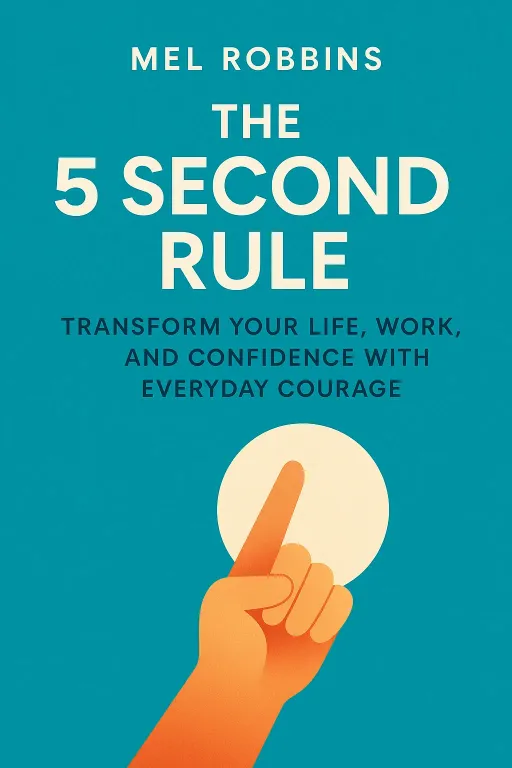
Nova: Exactly. And that gap between the idea and the action is where our potential goes to die. Today, we are looking at how to bridge that gap by combining two of the most powerful frameworks for human performance ever written. We are diving into The 5 Second Rule by Mel Robbins and Atomic Habits by James Clear.
Atlas: Mel Robbins and James Clear. That is a heavy-hitting combination. I have seen The 5 Second Rule everywhere, and Atomic Habits is basically the gold standard for anyone trying to stop self-sabotaging. But I’ve always wondered how these two fit together. Are they saying the same thing in different ways, or are they actually two halves of a larger machine?
Nova: They are two halves of the same engine. Mel Robbins provides the ignition, and James Clear provides the fuel and the steering. Mel Robbins, who famously developed her rule during a time of significant personal and financial struggle, discovered a way to hack the brain’s hesitation loop. James Clear, on the other hand, spent years studying the biology and psychology of how we actually form—and break—patterns.
Atlas: So, Robbins is the 'get moving' expert, and Clear is the 'keep going' architect.
Nova: Precisely. And if you have ever felt that sickening pit in your stomach when you know you need to do something, but your brain is screaming at you to stay on the couch, this conversation is for you.
The Friction Problem & The 5-Second Solution
SECTION
Atlas: Let’s start with that "pit in your stomach." That feeling of hesitation. We have all been there. It’s 6:00 AM, the alarm goes off, and your brain immediately starts negotiating. "Five more minutes won’t hurt." "I’ll do it later." It’s a physical sensation of resistance.
Nova: That is exactly what Mel Robbins calls the hesitation loop. It is a biological survival mechanism. Your brain is wired to protect you, and whenever you face something that feels difficult, scary, or uncertain, your brain perceives it as a threat. It tries to pull you back into the comfort zone.
Atlas: So, the brain is effectively trying to keep us safe by keeping us stagnant.
Nova: Correct. And here is where the 5 Second Rule comes in. It is a form of cognitive decoupling. When you have an impulse to act on a goal, you must physically move within five seconds, or your brain will kill the idea. You count down—5, 4, 3, 2, 1—and then you move.
Atlas: Okay, I have to play devil's advocate here. Counting down from five sounds like a party trick. It sounds like something you’d do to launch a model rocket, not something that changes your life. How does counting backwards actually change the chemistry in your brain?
Nova: It is not about the numbers; it is about the interruption. When you count, you are engaging your prefrontal cortex. That is the part of the brain responsible for higher-level thinking, planning, and executive function. You are essentially taking the wheel away from your emotional, reactive brain—the one that wants to keep you safe and comfortable—and handing it over to the analytical, intentional part of your brain.
Atlas: So, by forcing yourself to count, you are physically shifting your brain’s activity from the limbic system, which deals with emotions and fight-or-flight, to the prefrontal cortex. You are literally hijacking your own panic button.
Nova: Exactly. And the five-second window is crucial because that is how long you have before your brain starts rationalizing the hesitation. Once you hit "1," you have to act. You don't have time to think about why it’s hard, why you’re tired, or why you’d rather be doing something else. You just go.
Atlas: I can see how that works for immediate, high-friction moments. Like getting out of bed, or picking up the phone to make a sales call you’ve been dreading. But what happens after the five seconds? Does the rule work for long-term goals? Or is it just for these short, sharp bursts of action?
Nova: That is the perfect question. Mel Robbins’ rule is the spark, but it is not the whole system. If you use the 5 Second Rule to get to the gym, that is a win. But if you get to the gym and you have no idea what to do, or you feel overwhelmed by the workout, you are going to burn out. That is where James Clear enters the picture.
The Sustainability Problem & Atomic Habits
SECTION
Atlas: Right. Because once the initial adrenaline of the countdown fades, you are back to reality. You are still the same person with the same habits.
Nova: And that is the brilliance of James Clear’s approach. In Atomic Habits, he argues that we focus too much on the outcome—losing ten pounds, writing a book, building a business—and not enough on the system. He talks about the 1% improvement rule. If you get 1% better every day, you are 37 times better by the end of the year.
Atlas: It’s the compounding interest of personal growth. But for our listeners who are juggling careers, families, and a million responsibilities, 1% feels small, almost insignificant. How do you make that stick when you feel like you are barely keeping your head above water?
Nova: Clear’s framework is built on the Four Laws of Behavior Change. He says that if you want to build a habit, you must make it obvious, make it attractive, make it easy, and make it satisfying.
Atlas: Let’s break that down, because I think that’s where most people fail. We try to make things 'hard' because we think that’s what discipline looks like. We think if it’s not painful, it’s not working.
Nova: That is the biggest misconception in self-improvement. Clear suggests that the key to sustainability is actually making the habit so easy you can’t say no. He uses the example of the Two-Minute Rule. If you want to start running, don’t aim for a 5K. Aim to put on your running shoes. That’s it.
Atlas: That sounds almost too simple to be effective. But I suppose if you are in the middle of that 5-second countdown, thinking about putting on shoes is a lot less intimidating than thinking about running three miles.
Nova: Exactly! See how they connect? The 5 Second Rule gets you to the starting line. Atomic Habits keeps you in the race. If you use the countdown to put on your shoes, you have already won the first battle of the day.
Atlas: I see the synergy now. The countdown bypasses the brain’s resistance to starting, and the habit design removes the friction from continuing. But let’s look at the "Make it Obvious" part of Clear’s law. I imagine a lot of our listeners are wondering how to apply that to a cluttered life.
Nova: It is about environmental design. If you want to read more, don’t keep your book in a drawer. Put it on your pillow. If you want to eat healthier, put the fruit bowl on the counter and hide the junk food in the cupboard. You are essentially setting up your environment so that the good choice is the path of least resistance.
Atlas: It’s funny, we talk about willpower as if it’s a finite resource—which it is—but we rarely talk about just changing the room we are standing in. It’s like, why rely on willpower when you can rely on geography?
Nova: That is a profound way to put it. Willpower is the backup plan. Your environment should be the primary strategy. And this is where the cultural impact of these books really shines. Both Robbins and Clear have moved the needle on how we view productivity. It is no longer about "grinding" through the pain. It is about engineering your life so that the right behavior happens automatically.
Atlas: There is a lot of criticism out there, though, that these kinds of systems are just "hacks" for a high-pressure, capitalist society that expects us to be productive machines 24/7. How do we make sure we aren’t just optimizing ourselves for burnout?
Nova: That is a valid concern. The danger is using these tools to do more of what you hate. But the beauty of the identity-level change Clear talks about is that you get to choose the habits. It’s not just about doing more; it’s about becoming the person who does the things that matter to you.
Atlas: So, it’s about alignment, not just efficiency.
Nova: Precisely. If you use the 5 Second Rule to force yourself into a career path you despise, that is a recipe for disaster. But if you use it to start a creative project that fulfills you, or to start a health routine that gives you energy, then you are using these tools to build a life you actually want to live.
Synthesis & Takeaways
SECTION
Atlas: I love that distinction. We are using these systems as a scalpel, not a sledgehammer. So, let’s synthesize this for the listener who is feeling stuck. They have a goal, they have the desire, but they are paralyzed by the gap between where they are and where they want to be. What is the step-by-step reality of using these together?
Nova: Here is the blueprint. First, identify the one habit that would move the needle most for you right now. Don't pick five. Pick one.
Atlas: And keep it small. Like, ridiculously small.
Nova: Exactly. If it’s writing, the goal is one paragraph. If it’s exercise, it’s ten minutes of movement. Now, apply the 5 Second Rule. When you feel that hesitation to start—and you will feel it—count down 5-4-3-2-1. Do not give your brain the time to negotiate.
Atlas: And then, you immediately execute the "easy" version of the habit. You don't aim for the marathon; you aim for the shoes.
Nova: Right. And you repeat that sequence. The countdown is the trigger. The small, easy action is the habit. And as you do this, you start to rewrite your internal narrative. You stop being the person who "wants to run" and you start being the person who "runs." That is the identity shift Clear emphasizes.
Atlas: It’s a powerful cycle. The countdown breaks the inertia, and the habit design builds the momentum. I think the most important takeaway here is that you don’t need to be a different person to change your life. You just need a different system.
Nova: That is the core of it. We often think that we need a personality transplant to be productive or successful. We think we need to be naturally disciplined, or naturally motivated. But the reality is that the most successful people aren't the ones with the most willpower. They are the ones who have built systems that make willpower unnecessary.
Atlas: It makes me think of the concept of the compounding effect again. If you can just get that 5-second window to work for you, and then you layer a 1% improvement on top of it, the results aren't linear. They are exponential.
Nova: And that is where the magic happens. It’s not about the one big moment of transformation. It’s about the thousands of tiny, 5-second decisions you make every single day.
Atlas: I think that’s a perfect place to land. It’s not about the marathon; it’s about the shoes. It’s not about the grand gesture; it’s about the countdown.
Nova: And it’s about showing up for yourself, one small, intentional move at a time. If you are listening to this and you have been waiting for a sign to start, this is it. 5-4-3-2-1. Go.
Atlas: I love that. Let’s encourage everyone listening to pick one thing—just one—and apply this starting today. Don’t wait for the feeling. Don’t wait for the perfect moment. Just count down and move.
Nova: And remember, your future self is built on the habits you choose today. Make them count. Thank you for joining us on this journey to deconstruct the systems that truly work.
Atlas: We hope this helps you reclaim your time and focus on what actually matters.
Nova: This is Aibrary. Congratulations on your growth!