

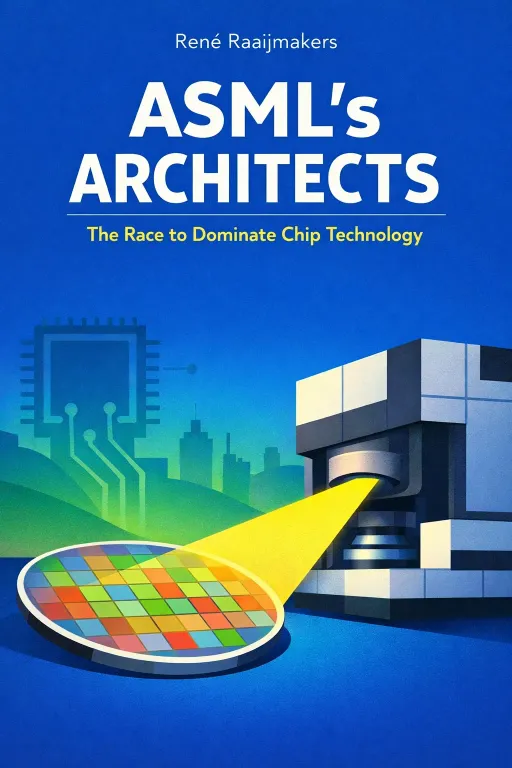
ASML: Architects of a Monopoly
Content
Content
Narrator: Introduction
In the early 1970s, engineers at the Philips Research Laboratory in the Netherlands built a machine that promised to be a license to print money. They believed they had created an invention that would secure their dominance in the burgeoning world of microchips. They were wrong. They didn't realize they had created a monster, a machine that would do nothing but devour money for twenty long years. How does a company born from such a financially draining project, a tiny offshoot from an unassuming Dutch town, grow to become a global monopoly that dictates the pace of all modern technology? René Raaijmakers’ book, "ASML's Architects," unravels this improbable story, revealing that the secret to building the world’s most complex and crucial machines lies not just in technology, but in the people, the culture, and the audacious ambition to conquer the world.
Key Insights
Key Insight 1: The Underdog's Audacious Goal
The story of ASML is, at its core, a classic underdog tale. In the early 1990s, the author, then a young technology journalist, attended a conference in Silicon Valley. He was surprised and delighted to find a Dutch company, ASML, competing against the established Japanese giants, Canon and Nikon. What struck him most was their raw ambition. These engineers from a small town weren't just there to participate; they were there to win. As they told him with fiery enthusiasm, whatever else happened, they were going to crush their Asian competitors. This wasn't just corporate bravado. The book reveals this "all or nothing" quest for market dominance was baked into the company's DNA from its earliest days. While the rest of the world saw an impossible fight, ASML saw an opportunity. This mindset explains how a company that started as a tiny, underfunded joint venture could eventually leave its rivals in the dust, capturing over 70 percent of the market and becoming the sole provider of the extreme ultraviolet (EUV) lithography machines that power the next generation of technology.
Key Insight 2: The Architect of Culture
A central question the book investigates is a claim made by an early employee: "ASML as it is today—it was planned that way from the start." This included its frank communication style, its relentless drive, and its revolutionary strategy of outsourcing everything possible. The author was initially skeptical. How could a culture be engineered so perfectly in a company born from what he calls a "shambles"? The investigation leads to a pivotal figure: Gjalt Smit, ASML's first CEO and its "chief architect." Smit was not a saint. He was described as being "full of himself" and had notorious arguments with key partners. He was, in the end, "spat out by many" at the company. Yet, everyone agrees that in his first few years, he performed a miracle. He took a "burned-out jumble" of Philips employees and forged them into an impassioned, aggressive team with a completely different culture. He instilled a sense of urgency and a belief that they could take on the world. Within just three years of his leadership, The New York Times was already mentioning ASML in the same breath as Canon and Nikon. The culture wasn't meticulously planned on paper, but it was forcefully architected by a difficult but visionary leader.
Key Insight 3: Innovation Born from Frustration
ASML's technological roots stretch back to the 1960s at Philips' legendary research lab, Natlab. The book introduces Frits Klostermann, a brilliant young engineer tasked with a monumental challenge: build a microchip. The problem was, Natlab didn't have the right equipment. When Klostermann first saw an American-made chip under a microscope, he described it as a "strange insect, glittering in all the colors of the rainbow." His boss simply told him, "If they did it, we can do it, too." Initially, Klostermann was forced to work with a purchased American machine, a David Mann photorepeater. He was not impressed. He meticulously analyzed the machine, finding its performance lacking and its design flawed. This period of frustration was crucial. It gave him the deep knowledge and motivation to build something better. When Philips' manufacturing division, Elcoma, grew desperate for more precise machines, Klostermann was finally given the green light. He collaborated with the master instrument maker Ad Bouwer, and through intense, often argumentative discussions, they built a photorepeater that was vastly superior to the American competitor, laying the technological groundwork for what would one day become ASML's core business.
Key Insight 4: The Realization That Drove the Revolution
By the 1970s, Philips had world-class technology for making photomasks, the stencils used to create chip patterns. But two engineers, Herman van Heek and Gijs Bouwhuis, discovered a shocking truth. As Van Heek put it, "The chipmaking process turns out to be extremely, enormously wasteful." The method used at the time, contact printing, involved pressing the mask directly onto the silicon wafer. This process damaged the delicate masks so quickly that for every wafer produced, a mask was thrown in the trash. The yield was abysmal, with sometimes only one in fifty chips on a wafer actually working. Van Heek's conclusion was simple and powerful: "There has to be a better way." He and Bouwhuis realized that contact printing was a dead end. The only solution was to project the chip patterns in miniature directly onto the silicon, without any contact. This was the pivotal realization that led to the development of the wafer stepper, the machine that would become ASML's signature product. It was a revolutionary idea born not from a flash of genius, but from the practical observation of profound inefficiency.
Key Insight 5: The Human Cost of a Merciless Culture
While ASML's demanding culture was a key ingredient in its success, the book does not shy away from its human cost. The relentless drive for perfection and market dominance created an environment that was both exhilarating and exhausting. The author captures this duality perfectly through a story about an ex-employee he interviewed. This man had become a millionaire from his ASML shares and left the company years before retirement age. The author asked him why he would leave such a fantastic company. The man's answer was a powerful metaphor. He said, "Look, eighteen-wheelers are built to do sixty miles an hour. You can make them do ninety, but then you wear them out faster. At ASML, I spent seventeen years doing ninety." This single anecdote reveals the immense personal sacrifice that was often required. The merciless work culture that propelled ASML to the top also burned out some of its most talented people, a critical and often overlooked aspect of its legendary success story.
Conclusion
The ultimate takeaway from "ASML's Architects" is that world-changing innovation is not simply the product of brilliant technology. ASML's rise was a rare and complex alchemy of factors: a fiercely competitive culture forged by a difficult visionary, a foundation of technical excellence born from decades of solving practical frustrations, and a relentless ambition that bordered on irrational. The technology was a prerequisite, but it was the people—their arguments, their sacrifices, and their shared will to conquer—that turned a small Dutch upstart into a global superpower.
As Gjalt Smit, the company's first CEO, himself reflected, "I strongly doubt that given the same parameters today the same company would emerge again—if, indeed, any company at all." It leaves one to wonder what unique, unrepeatable combination of human elements is truly necessary to achieve the impossible, and whether our modern, more structured world still has room for such chaotic, brilliant, and world-altering creation.