

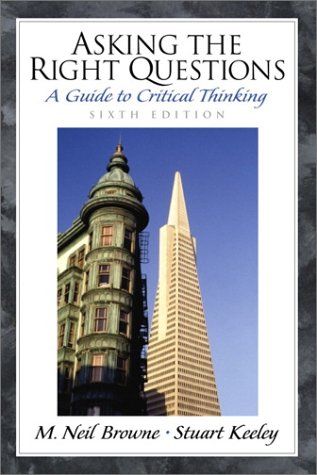
Asking the right questions
Introduction: Stop Soaking, Start Digging
Introduction: Stop Soaking, Start Digging
Nova: Welcome to the show! Today, we’re diving into a book that promises to fundamentally rewire how you process information: M. Neil Browne and Stuart M. Keeley’s classic, "Asking the Right Questions: A Guide to Critical Thinking."
Nova: : That title sounds deceptively simple, Nova. Everyone thinks they ask the right questions. What makes Browne and Keeley’s approach so special that it’s been a staple textbook for decades?
Nova: That’s the million-dollar question, and the answer lies in their opening metaphor. They don't just tell you to think critically; they show you to stop thinking like a sponge and start thinking like a gold prospector.
Nova: : A sponge? I like that. I usually think of myself as a highly absorbent professional. Tell me more about this sponge.
Nova: The Sponge Method is passive. You soak up everything—every fact, every claim, every statistic—without challenging its source or structure. It’s great for memorizing dates, but terrible for making life decisions. Browne and Keeley argue that in our current information deluge, being a sponge is dangerous.
Nova: : So, what’s the alternative? The gold prospector, the Panning for Gold approach. That sounds like work.
Nova: It is work! Panning for Gold is active. It means you approach every piece of information—a news article, a political speech, an advertisement—with a mental sieve, ready to shake out the dirt and find the valuable nuggets. You aren't just absorbing; you are with the material.
Nova: : I see. So, this book isn't about to think, but to approach the thinking process itself. It’s a toolkit for intellectual self-defense.
Nova: Exactly. They claim these habits are transferable to everything from consumer choices to complex ethical dilemmas. And to give us that toolkit, they distill critical thinking down to a manageable set of inquiries. We’re talking about a framework that moves you from passive acceptance to active analysis. Ready to look at the first set of tools?
Nova: : Absolutely. Let’s get our panning equipment ready. What’s the first thing we need to look for when we start sifting through an argument?
Nova: We start with the absolute basics: identifying the target. Let’s break down the anatomy of any claim in our next chapter.
Key Insight 1: Finding the Target
The Foundation: Identifying the Issue and Conclusion
Nova: The first step in Panning for Gold is knowing what you’re panning. Browne and Keeley insist that before you can evaluate an argument, you must clearly identify two things: the Issue and the Conclusion.
Nova: : The Issue is usually the topic, right? What the discussion is about?
Nova: Precisely. It’s the question that the author is trying to answer. But the Conclusion is the tricky part. It’s the main point the author wants you to believe or do. It’s the destination, and often, authors try to hide it in a sea of supporting details.
Nova: : I feel like I see this all the time in clickbait headlines. They state a vague problem, but the actual conclusion—the thing they want you to buy or agree with—is buried three paragraphs down.
Nova: That’s the perfect example of an argument designed to bypass critical thinking. The authors stress that if you can’t identify the conclusion, you can’t evaluate the argument. They suggest asking: What is the author trying to convince me to believe or do?
Nova: : And once we have the conclusion, we need the scaffolding that holds it up. That’s the Reasons, correct?
Nova: Yes. Reasons are the evidence, the logic, the justifications offered to support that conclusion. A strong argument has clear, relevant reasons. A weak one has vague, irrelevant, or missing reasons. Think of it like a table: the conclusion is the tabletop, and the reasons are the legs. If the legs are wobbly, the table collapses.
Nova: : So, the first set of questions boils down to: What is the main point, and what evidence is being used to support that specific point? It sounds almost too simple.
Nova: That’s the genius of it! They make you slow down. They found that most people skip this step entirely. They react emotionally to the conclusion before they’ve even checked if the reasons are sound. For instance, if a politician says, 'We must lower taxes because it stimulates the economy,' the Issue is tax policy, the Conclusion is lower taxes, and the Reason is economic stimulation.
Nova: : Okay, I’ve got the structure. But what if the author uses loaded language or vague terms? Does that fall under this initial deconstruction?
Nova: That leads us perfectly into the next layer of analysis, which is about the of the language used to present those reasons and conclusions. We need to look for hidden assumptions next, because that’s where the real intellectual traps are laid.
Key Insight 2: Questioning What’s Taken for Granted
Unmasking the Hidden: Assumptions and Ambiguity
Nova: This is where the Panning for Gold gets really active. We move from identifying what’s to uncovering what’s. Assumptions are the unstated beliefs that must be true for the reasons to support the conclusion.
Nova: : Assumptions are the bedrock, aren't they? If the bedrock is cracked, the whole structure is unsound.
Nova: Exactly. And they are often the most powerful, yet invisible, part of an argument. For example, if the conclusion is 'We should invest heavily in solar power,' and the reason is 'Solar power is clean,' the hidden assumption might be 'Clean energy sources are inherently superior to all other energy sources, regardless of cost or scalability.'
Nova: : That’s a huge leap! The author assumes we agree with that value judgment without ever having to defend it.
Nova: Precisely. The book pushes us to ask: What must the author believe for these reasons to logically lead to that conclusion? If you can challenge the assumption, you can often dismantle the entire argument without even touching the stated evidence.
Nova: : That’s powerful. It shifts the focus from arguing about the facts to arguing about the underlying beliefs. What about ambiguity? I imagine vague words are the assumption-hider’s best friend.
Nova: You hit the nail on the head. Ambiguity is the fog that obscures the argument. Browne and Keeley dedicate significant attention to identifying vague or emotionally charged words. They want you to ask: Are there any terms used in a way that might mean something different to me than it does to the author?
Nova: : Like the word 'freedom,' for instance. Everyone claims to support freedom, but what of freedom are we talking about? Economic freedom? Personal autonomy? Freedom from want?
Nova: Perfect analogy. If an author uses 'freedom' without defining it, they are leveraging its positive emotional charge while allowing you to fill in the definition that best suits pre-existing beliefs. The critical thinker demands clarification: What exactly do you mean by that term in this context?
Nova: : So, we’ve identified the conclusion, checked the reasons, and now we’re digging out the unstated assumptions and clarifying the fuzzy language. This feels like we’re building a very robust mental framework.
Nova: We are. And once we’ve established the argument’s structure and clarified its terms, we finally get to the meat of the evidence itself. Are the reasons actually true? That’s Chapter Three’s focus.
Key Insight 3: Scrutinizing the Facts and Values
Evaluating Evidence and Applying the Ethical Lens
Nova: We’ve established the argument’s skeleton and checked the foundation for cracks. Now, we look at the materials used—the evidence. This is where we ask: Are the reasons supported by credible, relevant evidence?
Nova: : This is where the sponge mentality really fails, right? A sponge just accepts 'Studies show...' as proof.
Nova: It does. The book forces us to interrogate the evidence itself. Is the source credible? Is the evidence statistical, anecdotal, or expert testimony? And crucially, is the evidence sufficient? One anecdote is not proof of a trend.
Nova: : I remember reading about how often statistics are misused. Do they give specific guidance on statistical reasoning?
Nova: They do. They emphasize understanding averages, percentages, and the difference between correlation and causation. A classic trap is seeing two things happen together and assuming one caused the other. The critical question here is: Is there any other plausible explanation for this evidence?
Nova: : That’s a fantastic check. Now, I know from my earlier search that this framework is often adapted for ethical decision-making, bringing in concepts like Rights and Responsibilities. How does that fit into evaluating evidence?
Nova: That’s the advanced application. When you move from factual claims to value claims—which are common in politics, advertising, and ethics—you have to question the underlying being promoted. The JMU adaptation of the 8KQ highlights this: What rights apply? What responsibilities are being ignored? How would I act if I truly cared about everyone involved—that’s the Empathy check.
Nova: : So, if a company argues for a cost-cutting measure, the factual evidence might show it saves money, but the ethical questions force us to look at the trade-off: Does this decision violate a responsibility to employee safety, or infringe on a customer's right to privacy?
Nova: Exactly. You are using the same critical structure—Issue, Conclusion, Reasons—but applying a different set of questions to the themselves. You’re not just asking 'Is this fact true?' but 'Is this value judgment justifiable?' It’s a comprehensive system for navigating complexity.
Nova: : It sounds like the book is less about winning arguments and more about achieving intellectual honesty, regardless of the topic.
Nova: That’s the ultimate goal. It’s about autonomy. When you master these questions, you are less susceptible to manipulation, whether it’s from a salesperson, a pundit, or even your own internal biases. It’s about owning your beliefs because you’ve actively tested them.
Conclusion: The Lifelong Practice of Inquiry
Conclusion: The Lifelong Practice of Inquiry
Nova: We’ve covered a lot of ground today, moving from the passive Sponge to the active Panning for Gold approach. We learned that true critical thinking starts with clearly defining the Issue and Conclusion.
Nova: : And then we dug deeper, uncovering the hidden assumptions that prop up weak arguments, and demanding clarity on any ambiguous language used by the speaker.
Nova: Finally, we looked at scrutinizing the evidence itself—checking for sufficiency, relevance, and the crucial distinction between correlation and causation. And we saw how this framework extends beautifully into ethical reasoning by questioning underlying values like Rights and Responsibilities.
Nova: : If I had to take away one thing, it’s that critical thinking isn't a destination; it’s a continuous process of inquiry. Browne and Keeley give us the map for that journey.
Nova: They do. The takeaway is simple: Don't just accept information. Interrogate it. Make the author defend their position against your well-formed, structured questions. That’s how you build beliefs that can withstand scrutiny.
Nova: : It’s a challenging but incredibly rewarding shift in perspective. It makes the world a much more interesting, albeit sometimes frustrating, place to navigate.
Nova: Indeed. So, the next time you read a headline or hear a strong claim, remember your gold pan. Shake it out, look closely, and ask those right questions. This is Aibrary. Congratulations on your growth!