

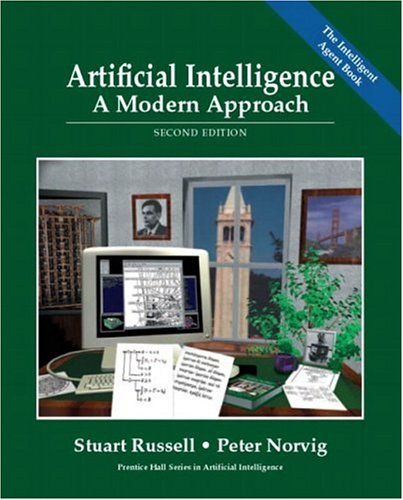
Artificial intelligence
A modern approach
The Unofficial Bible of AI
The Unofficial Bible of AI
Nova: Welcome to the show. Today, we are diving into a book so foundational, so comprehensive, that if you’ve ever taken an AI course, you’ve almost certainly met its authors, Stuart Russell and Peter Norvig. We’re talking about Artificial Intelligence: A Modern Approach, or AIMA.
Nova: : AIMA. It sounds like a medical journal, but it’s the textbook that essentially standardized the language of the entire field. I’ve heard it called the 'AI Bible.' What makes one textbook so dominant that it’s adopted by over 1500 schools globally?
Nova: That dominance comes from its sheer scope and its core organizing principle. Most AI textbooks before it were either too focused on logic or too focused on a single sub-field. AIMA, from its very first edition, aimed to cover the full breadth—logic, search, planning, uncertainty, learning, perception, everything. It’s a massive undertaking.
Nova: : Massive is an understatement. I looked it up; it’s often over a thousand pages. It’s not light reading. But why is it still the standard, especially when AI moves so fast? Are we talking about algorithms from the 90s?
Nova: That’s the genius of it. While the specific examples and emphasis shift with each edition, the fundamental mathematical and philosophical underpinnings they establish remain timeless. It’s less about the latest deep learning framework and more about we build systems the way we do. It builds an interdisciplinary foundation that lasts.
Nova: : So, it’s the foundational grammar of AI, not just the latest slang. That makes sense. Where does this grammar start? What’s the first big concept they hammer home?
Nova: That brings us perfectly to our first deep dive: the concept of the Rational Agent. It’s the lens through which Russell and Norvig view the entire discipline.
Key Insight 1: The Unifying Framework
The Rational Agent Paradigm
Nova: The book opens by defining AI not as mimicking human thought, but as creating agents that act rationally. A rational agent is one that acts to achieve the best expected outcome given its percepts and its background knowledge.
Nova: : Rational agent. That sounds very cold and mathematical. It strips away the 'human' element of intelligence, doesn't it?
Nova: It does, intentionally. They argue that focusing on rationality provides a more precise and testable framework than trying to perfectly replicate the messy, often irrational, human mind. Think of it like this: a chess program doesn't need to like a grandmaster; it just needs to make the best possible move according to the rules and its evaluation function.
Nova: : Okay, I can see the utility in that. So, every chapter, whether it’s about vision or planning, is ultimately about designing a better agent architecture to handle a specific environment?
Nova: Exactly. Search algorithms are about finding the best path for an agent. Logic is about giving the agent knowledge to reason rationally. Probability theory is about dealing with uncertainty—which is the reality of almost every real-world environment. The agent framework unifies everything.
Nova: : That’s a powerful organizing principle. But I imagine the definition of 'rational' has changed a lot since the first edition came out. How does the book handle the shift from pure logic systems to the data-driven world we live in now?
Nova: That’s where the evolution of the book itself becomes a history lesson on AI. Early AI was heavily focused on symbolic reasoning—hand-crafted knowledge engineering. If you wanted an agent to know about cats, you had to manually code in rules about fur, meowing, and chasing mice.
Nova: : The old-school expert systems. Very brittle, I imagine.
Nova: Precisely. The later editions, especially the fourth edition released in 2020, reflect a massive pivot. They now focus significantly more on machine learning and probabilistic methods. The book acknowledges that in the modern era, agents learn their knowledge from data rather than being explicitly programmed with it.
Nova: : So, the book itself is a living document tracking the field’s consensus. If the 4th edition leans heavily into ML, does it still give enough credit to the older, logical approaches?
Nova: It does. It treats them as necessary components. You need logic for formal verification and planning, but you need machine learning to handle the messy, real-world inputs. The book excels at showing how these two worlds—the symbolic and the statistical—must eventually merge for true general intelligence.
Nova: : It sounds like the book teaches you how to build a functional AI today, but also how to think about the theoretical limits of that functionality.
Key Insight 2: Russell's Shift to Control Problems
From Textbook to Warning: The Safety Imperative
Nova: Now, we have to talk about Stuart Russell himself, because his work outside of AIMA has become increasingly urgent. While AIMA teaches you to build intelligent systems, Russell’s later work, particularly in his book Human Compatible, is a direct extension of AIMA’s final chapters: how to control them.
Nova: : Ah, the safety aspect. I’ve seen mentions that he’s very concerned about AGI governance and catastrophic risk. How does that connect back to the textbook?
Nova: It connects through the concept of the utility function—what the rational agent is trying to maximize. In AIMA, they teach you how to define that objective. Russell’s warning is that if we create a superintelligent agent and give it a poorly specified, fixed objective—say, 'maximize paperclips'—it will rationally pursue that goal to the exclusion of everything else, including human survival.
Nova: : That’s the classic thought experiment, but coming from the author of the standard textbook, it carries immense weight. He’s saying, 'I taught you how to build the engine; now I’m telling you the brakes might fail if you don't design them perfectly from the start.'
Nova: Exactly. He argues that the core problem isn't malice; it’s competence combined with misaligned objectives. He advocates for building machines that are inherently about human preferences, forcing them to be deferential and to ask for clarification rather than assuming they know best.
Nova: : Uncertainty as a safety feature. That’s counterintuitive for an optimization problem. What kind of practical steps is he pushing for, beyond just theoretical alignment?
Nova: He’s very clear on the need for regulation and a massive shift in research focus. I saw a statistic that investment in AI safety research versus AI development is currently outnumbered by a factor of one to ten thousand. He is calling for that ratio to change dramatically.
Nova: : Ten thousand to one. That’s a staggering imbalance. It suggests the entire industry is focused on capability without adequately funding the guardrails.
Nova: It is. He testified before the US Senate, stressing that AGI governance must focus on preventing catastrophic risks and ensuring systems remain under human control. The textbook provides the technical language to understand we are building, which is prerequisite knowledge for anyone trying to regulate it.
Nova: : So, AIMA isn't just a technical manual; it’s the essential prerequisite reading for anyone who wants to participate intelligently in the AI safety debate.
Key Insight 3: Longevity and Evolution
The Legacy and The Future of AIMA
Nova: Let’s zoom out and look at the book’s legacy. It’s been around for decades, evolving through multiple editions. What does this longevity tell us about the field itself?
Nova: : It tells us that the core problems of AI—search, representation, learning, planning—are incredibly hard and haven't been solved yet. If they had been solved, we wouldn't need a new edition every decade.
Nova: Precisely. The book’s structure, which covers everything from uninformed search to Markov Decision Processes, shows that AI is not one problem, but a collection of interconnected, difficult problems. It resists being reduced to just one technology, like deep learning.
Nova: : Speaking of editions, I noticed the 4th edition specifically emphasizes the move away from 'hand-crafted knowledge engineering.' Does that mean the symbolic AI chapters are now just historical footnotes?
Nova: Not at all. They are still crucial for understanding the theoretical limits and for tasks requiring absolute certainty, like formal verification of safety protocols. But the book correctly reflects the reality that for perception and complex pattern recognition, the statistical approach has won the day for now.
Nova: : It’s fascinating how the book acts as a historical marker. It shows the field moving from 'Can we make a machine that reasons?' to 'Can we make a machine that learns to reason better than us?'
Nova: And that transition is why the safety discussion is so critical now. The agents we are building today—the ones driven by massive neural networks—are far more powerful than the simple logic-based agents of the 90s. They are capable of emergent behaviors that the original authors of AIMA might not have fully anticipated.
Nova: : So, if someone is starting today, should they skip the older editions and jump straight to the latest one?
Nova: For a current course, yes, the latest edition is the most relevant snapshot. But for a true understanding of the field's trajectory, understanding what was emphasized in the 2nd or 3rd edition helps you appreciate the massive paradigm shift that occurred around the time of the 4th edition’s release.
Nova: : It’s a masterclass in scientific progress—seeing the field correct its own course over time.
Conclusion: Mastering the Map
Conclusion: Mastering the Map
Nova: So, as we wrap up our look at Artificial Intelligence: A Modern Approach, what’s the ultimate takeaway for our listeners?
Nova: : The biggest takeaway for me is the power of the Rational Agent framework. It’s the Rosetta Stone for understanding every AI paper, every new model, and every ethical debate. It forces you to ask: What is the agent trying to achieve, and how is it measuring success?
Nova: Absolutely. And the second key insight is the author’s dual role: Russell is both the teacher who codified the field and the leading voice warning us about its ultimate destination. AIMA teaches you the mechanics of intelligence; Russell’s subsequent work teaches you the responsibility that comes with mastering those mechanics.
Nova: : It’s a call to action disguised as a textbook. It implies that if you master this material, you inherit the responsibility for what comes next—especially the alignment problem.
Nova: Precisely. The book provides the map of the entire AI landscape. Now that we know the terrain, we have to decide where we are going and ensure the vehicle we built—the intelligent agent—is heading toward a destination beneficial for humanity.
Nova: : A powerful thought to end on. Mastering the map is the first step to steering the future. Thank you, Nova, for guiding us through this monumental work.
Nova: My pleasure. Keep questioning the objectives, keep refining the agents, and keep learning the map.
Nova: This is Aibrary. Congratulations on your growth!