

Personalized Podcast
Golden Hook & Introduction
SECTION
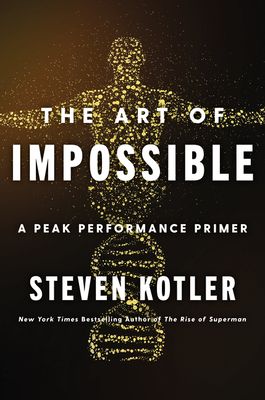
Nova: What if the word impossible isn't a definition of what is actually achievable, but simply a challenge of engineering? In manufacturing, we know that complex, high-performing systems are built piece by piece, feedback loop by feedback loop. Today, we are looking at the ultimate complex system: the human brain. Welcome to the show! I am Nova, and today we are diving deep into Steven Kotler's masterwork,. And I am absolutely thrilled to have entrepreneur and analytical thinker Peris Karanga with us today. Peris, welcome!
Peris Karanga: Thanks, Nova. It is great to be here. You know, when I look at Kotler's work, I don't just see a book about psychology or self-help. I see a schematic. It is a blueprint for optimizing human capital, and as someone who loves breaking down complex systems, I find the science of peak performance absolutely fascinating.
Nova: Oh, I love that! A schematic. That is the perfect way to frame this. Because Kotler really does treat peak performance as a sequence, right? It is not some mystical gift that only a few people are born with. It is a formula. Today, we are going to tackle this book from two major perspectives. First, we will explore the Motivation Stack and how to build a foundation of high-grit learning. And then, we will focus on Flow State Engineering—how to trigger and sustain peak cognitive performance in our daily work.
Peris Karanga: Exactly. And what is beautiful about this formula is that it is highly systematic. If you understand the inputs, you can reliably predict the outputs. For entrepreneurs, especially in demanding fields like engineering or manufacturing, this isn't just academic theory. It is operational efficiency for the mind.
Nova: Yes! So let's start with those inputs. Let's look at the foundation of the entire system, which Kotler calls the Motivation Stack.
Deep Dive into Core Topic 1
SECTION
Nova: Now, when most of us think of motivation, we think of it as a single feeling. Like, oh, I feel motivated today, or I don't. But Kotler argues that true, sustainable motivation is actually a stack of five distinct intrinsic drivers that need to be aligned in a very specific order. It starts with curiosity, which feeds into passion, which then connects to purpose. Once you have purpose, you need autonomy to pursue it, and finally, the drive for mastery to get better at it.
Peris Karanga: That sequence is highly logical. Think about it like designing a power grid. You can't just jump straight to mastery or even purpose without a fuel source. Curiosity is that raw fuel. But curiosity on its own is volatile; it sparks and dies out. To make it sustainable, you have to connect multiple curiosities together until they crystallize into passion. And then, you take that passion and point it outward at a massive problem in the world, which gives you purpose.
Nova: That is such a great analogy, Peris! A power grid. And Kotler actually shares this incredible history of extreme sports athletes in the 1990s to illustrate this. These athletes were doing things on skis, snowboards, and surfboards that scientists literally thought were physically impossible. They didn't have massive corporate sponsorships back then, and they didn't have advanced training facilities. What they did have was this exact stack. They had intense curiosity, absolute passion, a shared purpose of pushing the boundaries, total autonomy over their sports, and a relentless drive for mastery. Because these drivers were perfectly aligned, their brains were constantly flooded with dopamine and norepinephrine, which naturally led to massive breakthroughs.
Peris Karanga: What strikes me about that story is that these athletes weren't necessarily stronger or more talented than the generation before them. They just had a better cognitive setup. In entrepreneurship, we often face what seems like impossible hurdles—supply chain disruptions, technical design failures, or market shifts. If you are relying purely on extrinsic motivation, like money or status, your system is going to crash under that kind of stress. Extrinsic rewards just don't have the chemical bandwidth to sustain long-term grit.
Nova: Right! Kotler talks about how extrinsic rewards actually narrow our focus and can crush creativity if they are the primary driver. But when you stack curiosity, passion, and purpose, you get this self-sustaining loop. But let's talk about the transition from motivation to grit. Because Kotler says motivation gets us into the game, but grit keeps us there. He actually identifies six different types of grit we need to cultivate.
Peris Karanga: Yes, and that distinction is crucial. It is not just about raw perseverance, like a blunt instrument. He talks about the grit to control your thoughts, the grit to face fear, the grit to recover, and even the grit to be at your best when you are feeling your worst. From an engineering perspective, this is about building redundancy into your system. If one type of grit fails, you have other protocols to keep the machine running.
Nova: Oh, redundancy! I love that. So, how do you see this playing out in your own journey as an entrepreneur? How do you keep your motivation stack aligned when things get tough?
Peris Karanga: Well, for me, it always goes back to curiosity and learning. In manufacturing, you are constantly dealing with variables. If a machine breaks down or a process isn't yielding the right efficiency, my immediate reaction has to be curiosity, not frustration. I have to ask, what is this system trying to tell me? By framing the problem as a learning puzzle, I am instantly tapping into dopamine. That dopamine keeps my focus sharp and prevents burnout. If I looked at it purely as a financial loss or a personal failure, the stress hormones would take over, and my creative problem-solving would go out the window.
Nova: That is incredibly profound, Peris. You are literally using curiosity as a cognitive shield against stress. And that brings us to the next layer of Kotler's book, which is how we actually acquire the knowledge to solve these complex puzzles. He talks about high-grit learning. He says we don't need to know everything, but we do need to learn how to learn, especially in a world where information is expanding exponentially.
Peris Karanga: Absolutely. In engineering and manufacturing, technology changes so fast that your degree is practically obsolete a few years after you graduate. You have to become a professional learner. Kotler's approach to learning is very systematic. He suggests starting by reading popular books on a subject to get the narrative arc, then moving to more technical textbooks, and finally reading actual research papers. You are building a mental model from the macro to the micro.
Nova: Yes! He calls it the five steps of learning. You start with your curiosity, gather vocabulary, play in the sandbox of the ideas, and only then do you try to master the details. It is so much more encouraging than just staring at a dense textbook and trying to memorize facts, isn't it?
Peris Karanga: It is, because it respects how the brain actually processes information. You need that high-level context first. It is like looking at the blueprint of a factory before you start inspecting the individual gears on a single machine. Once you have the big picture, the details actually make sense and stick.
Deep Dive into Core Topic 2
SECTION
Nova: That transition from building a solid foundation of motivation and learning naturally leads us to the second key idea we need to talk about, which often acts as the ultimate accelerator for peak performance: Flow State Engineering. Now, flow is that state of optimal consciousness where we feel our best and perform our best. You might know it as being in the zone. But Kotler does something amazing here—he demystifies it. He explains that flow is not a spiritual accident. It is a biological state with very specific triggers.
Peris Karanga: This is where the book really shines for me. As an analytical thinker, I love when things are broken down into actionable variables. Kotler lists twenty-two flow triggers. These are environmental, psychological, social, and creative conditions that release the specific neurochemicals required to drive us into flow. And the most important one, the one that serves as the golden rule of flow, is the Challenge-Skills Balance.
Nova: Ah, yes! The Challenge-Skills Balance. Tell us more about how you view that.
Peris Karanga: Well, think of it as a tuning dial. If a task is too easy, if your skills far exceed the challenge, you get bored. Your mind wanders, and you drop out of focus. On the other hand, if the challenge is way too high, if it completely overwhelms your current skills, you experience anxiety. Your brain floods with cortisol, which shuts down your creative centers. Flow exists in this incredibly narrow corridor right between boredom and anxiety. Kotler actually quantifies it. He says the challenge should exceed your skills by about four percent.
Nova: Four percent! That is so precise, isn't it? It is just enough to stretch you, but not enough to snap you. It is like that gentle nudge that keeps you fully engaged.
Peris Karanga: Exactly. It is the sweet spot of cognitive load. In manufacturing, we talk about tolerances. If a part is machined with too much tolerance, it rattles and breaks. If it is too tight, it won't fit. The four percent rule is the optimal tolerance for human attention. It forces deep focus because the brain has to marshal all its resources to meet the challenge, but it doesn't trigger the panic button.
Nova: And the science behind this is just mind-blowing. When we are in flow, our brain waves shift from the fast beta waves of normal waking consciousness down to the slower alpha and theta waves, which are associated with daydreaming and deep meditation. At the same time, the brain releases a massive cocktail of five of the most potent neurochemicals: dopamine, norepinephrine, endorphins, anandamide, and serotonin. This combination doesn't just make us feel amazing; it actually amplifies our lateral thinking and pattern recognition. Kotler mentions a study by McKinsey showing that executives in flow are five hundred percent more productive than their peers.
Peris Karanga: Five hundred percent! Just think about the implications of that for a business. If you can systematically trigger flow in your daily work, you could theoretically accomplish in one day what normally takes a week. But to do that, you have to understand that flow is a cycle, not a permanent state. Kotler outlines four phases: struggle, release, flow, and recovery.
Nova: Oh, yes! The flow cycle is so important because so many people give up during the first phase, don't they? They experience the struggle and think, oh, this isn't working, I am not in flow. But the struggle is actually a mandatory step!
Peris Karanga: Right. The struggle phase is when you are loading your brain with information. You are trying to solve the problem, and it feels frustrating. Your brain is releasing cortisol and norepinephrine. This is the engineering phase where you are gathering data and hitting walls. But you have to push through that. The next phase is release, where you actually take your mind off the problem. You go for a walk, do the dishes, or do something completely unrelated. This allows your brain to transition from local processing to global processing.
Nova: Yes! It is like letting the computer run the program in the background while you go grab a cup of coffee. And then, boom! You enter the flow state. The ideas connect, the writing flows, or the code just works. But then, what about that fourth phase? Recovery. That is one that high-achievers often ignore, isn't it?
Peris Karanga: It is the most neglected phase, and it is the reason so many entrepreneurs burn out. You cannot stay in flow forever. The neurochemicals that fuel flow are expensive for the body to produce. Once they are depleted, you have to recover. If you try to force yourself back into struggle without proper recovery, you are running on empty, and your performance will plummet. For me, recovery is an active process. It is about deep sleep, proper nutrition, and completely disconnecting from work. It is like scheduled maintenance on a factory floor. If you don't shut down the machines for maintenance, they will eventually shut themselves down, usually at the worst possible time.
Nova: That is such a vital point, Peris. Scheduled maintenance. We wouldn't expect a high-precision machine to run twenty-four-seven without service, yet we expect our brains to do exactly that. It is a recipe for disaster. Kotler's work really shows us that rest is not the opposite of performance; it is a prerequisite for it.
Peris Karanga: Absolutely. And when you look at the whole system—the Motivation Stack, high-grit learning, and the Flow Cycle—you realize that peak performance is about managing your energy, not just your time. It is about creating an environment where these flow triggers can naturally occur.
Nova: Yes! And speaking of triggers, Kotler talks about environmental triggers like rich environments, novelty, complexity, and unpredictability. These are things that naturally grab our attention. For someone in engineering or manufacturing, your work environment is often filled with complexity and novelty. How do you leverage those environmental triggers without getting overwhelmed by them?
Peris Karanga: It is all about structuring the chaos. Novelty and complexity are great for triggering flow, but only if you have clear goals and immediate feedback, which are two of the psychological triggers Kotler highlights. In my work, we use agile frameworks. We break down massive, complex engineering projects into tiny, manageable sprints with very clear definitions of success. This gives us that immediate feedback loop. We know instantly if a design works or if a part fits. That feedback keeps us locked into the present moment, which is exactly where flow happens.
Nova: That is brilliant! You are essentially using project management systems as cognitive scaffolding to trigger flow. You are taking the complexity of the engineering environment and filtering it through clear goals and immediate feedback to hit that four percent challenge-skills sweet spot.
Peris Karanga: Exactly. It is about designing the container so that flow can happen. You can't force flow, but you can build the conditions that make it highly probable.
Synthesis & Takeaways
SECTION
Nova: This has been such an incredibly rich conversation, Peris. We have covered so much ground, from the neurobiology of extreme athletes to the precise engineering of our daily work environments. As we start to wrap up, let's synthesize this for our listeners. If you had to summarize the core message of for someone who is trying to scale their own life or business, what would it be?
Peris Karanga: I think the ultimate takeaway is that the impossible is actually a sequence. If you want to achieve high-level, audacious goals, you can't just wish your way there. You have to build the system. You start by aligning your intrinsic motivators—your curiosity, passion, and purpose. You use that alignment to fuel high-grit learning. Then, you use that learning to push yourself into the four percent stretch zone, triggering flow states. And finally, you respect the recovery process so you can do it all over again tomorrow. It is a repeatable, scalable loop.
Nova: A repeatable, scalable loop. That is beautiful. It takes the intimidation out of big goals and turns them into a daily practice. And for our listeners today, we want to leave you with a practical challenge. Think about your current workload. Where can you find your four percent stretch zone today? What is one task that you can make just a little bit more challenging, or a little more focused, to trigger that flow state?
Peris Karanga: And remember, don't fear the struggle phase. When you feel that initial frustration, don't walk away. Recognize it as the necessary first step of the flow cycle. Your brain is just loading the data. Push through, take a brief release break, and let the system do its work.
Nova: I love that. Embrace the struggle! Peris, thank you so much for sharing your incredible insights and your analytical perspective with us today. This has been an absolute joy.
Peris Karanga: Thank you, Nova. It was a pleasure.
Nova: And to all our listeners out there, thank you for tuning in. Go engineer your own impossible today, and we will see you next time!