

The Math Behind Breakthroughs: From Abstract Concepts to Applied Solutions
Golden Hook & Introduction
SECTION
Nova: Alright, Atlas, rapid-fire word association for you. Ready?
Atlas: Oh, I'm always ready, Nova. Hit me.
Nova: Math.
Atlas: Oh, man. Math…. And also, from high school algebra, but mostly unlocked potential now!
Nova: Ha! I love that! And that’s exactly what we’re diving into today on Aibrary, because for too many of us, math feels like this impenetrable fortress, right? But what if I told you it's actually your secret weapon for understanding and shaping the world?
Atlas: Oh, I like that. A secret weapon. Because honestly, for a lot of people, the word "math" conjures up images of dusty textbooks and equations that make your brain hurt. But you’re saying it’s actually a superpower.
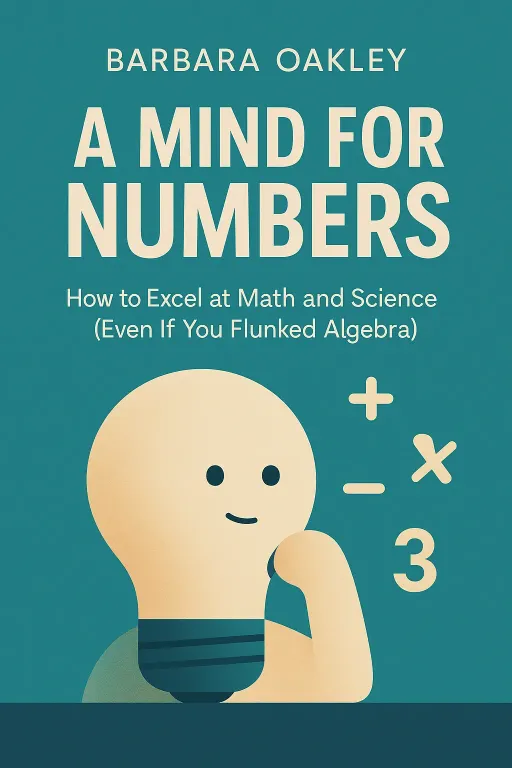
Nova: Absolutely. And to decode this superpower, we’re drawing insights from a collection of incredible books, including the foundational "A Mind for Numbers" by Barbara Oakley, "How Not to Be Wrong" by Jordan Ellenberg, and "Applied Mathematics" by J. David Logan. What’s particularly fascinating is Barbara Oakley’s own journey. She actually started her career as a Russian language expert in the U. S. Army before deciding to completely retool herself and become an engineering professor!
Atlas: Whoa, really? From language to advanced engineering? That’s quite the pivot. It makes me immediately wonder, how does someone who admittedly struggled with math earlier in life, become such an authority on mastering it? What's her secret, and can we steal it?
Nova: Well, Atlas, that’s precisely where we’re going to start: by unlocking your mathematical brain, moving from that feeling of overwhelm to cultivating genuine intuition.
Unlocking Your Mathematical Brain: From Overwhelm to Intuition
SECTION
Nova: Oakley’s core insight, and it’s brilliant, revolves around two distinct modes of thinking: focused and diffuse. Think of focused mode like a super-bright flashlight beam. It’s what you use when you're laser-focused on a specific problem, following a step-by-step solution, or memorizing a formula. It’s powerful, but it can also get you stuck if you’re staring too hard at the wrong thing.
Atlas: So, when I’m trying to debug a piece of code or balance my budget, that’s focused mode. I’m zeroed in. But hold on, for many of us, math feels like a foreign language, not something you just "learn to speak." How do these modes actually help us bridge that gap, especially if we're not naturally 'math people'?
Nova: That’s where diffuse mode comes in. If focused mode is the flashlight, diffuse mode is the floodlight. It’s your brain working on a problem in the background, making connections subconsciously, often when you’re doing something else entirely – walking, showering, even sleeping. This is where creativity sparks, and those "aha!" moments often happen. Oakley argues that mastering complex subjects, especially math and science, requires actively toggling between these two modes.
Atlas: That makes sense. So, it's not just about grinding away, but also about stepping back and letting your brain wander. But can you give an example? Like, what does actively toggling between these look like for someone trying to learn a new, complex skill, say, a new programming language, or even just a difficult concept in their field?
Nova: Absolutely. Imagine you're trying to learn a new, complex algorithm for optimizing logistics, which feels like a foreign language on first read. In focused mode, you'd sit down, read the documentation, try to understand each line of code, and attempt to trace its execution with a small dataset. You're pushing, trying to force the understanding. You might get stuck, feel frustrated, hit a wall.
Atlas: Oh, I’ve been there. Many times. That feeling of hitting a wall is exactly what makes people give up.
Nova: Exactly. But instead of banging your head against that wall, you then deliberately switch to diffuse mode. You might go for a run, listen to music, or even just work on a completely different, unrelated task for 20 minutes. What happens in the background is your brain, freed from the intense scrutiny of focused mode, starts making broader connections, seeing patterns you missed, and consolidating the information. Then, when you come back to the algorithm, suddenly a piece clicks into place, or you see a different approach.
Atlas: Wow, so it’s almost like your brain needs a bit of a break to process the information, to let it marinate. So, when we're trying to model something like our daily commute, as the book suggests, or even just optimizing our weekly schedule, is that where we're supposed to be in focused mode, or diffuse?
Nova: Both! You'd use focused mode to gather the data—how long each leg of the commute takes, common delays, different route options. Then, you step back. Maybe you sketch it out roughly on a napkin while waiting for coffee. That's diffuse mode helping you see the bigger picture, identify bottlenecks, or even come up with a completely novel route that combines elements you hadn't considered when you were just focused on the individual parts. It's about building that intuitive feel for the problem, making math less about calculation and more about understanding the underlying structure.
Atlas: That’s actually really inspiring. It reframes "being good at math" not as an inherent talent, but as a skill you can cultivate by understanding how your own brain works.
Math as Your Everyday Superpower: Navigating the World with Logic and Data
SECTION
Nova: And once you start speaking that language, once you start building that intuition, you realize math isn't just about learning; it's about seeing the world differently, about navigating its complexities with clarity. That’s where books like Jordan Ellenberg’s "How Not to Be Wrong" truly shine. Ellenberg illustrates how mathematical thinking can illuminate everyday life, helping us avoid common pitfalls in reasoning.
Atlas: Okay, "How Not to Be Wrong"—that sounds like a bold claim. Can you give me an example of how mathematical thinking helps us avoid being wrong in a way that feels practical, not just theoretical, for someone trying to make sense of, say, market trends or complex project data?
Nova: Absolutely. Ellenberg famously discusses the "tyranny of averages." We often hear statistics like "the average American has X number of children" or "the average income is Y." Our intuition tells us this average is representative. But mathematically, an average can be incredibly misleading. For example, if Bill Gates walks into a bar, the net worth of everyone in that bar skyrockets, but it doesn't mean anyone else suddenly got rich.
Atlas: Oh, I see! So, relying solely on an average without understanding the distribution or the outliers can lead to completely flawed conclusions. Like, a company might boast "average employee satisfaction is high," but if half their employees are ecstatic and the other half are miserable, that average hides a huge problem.
Nova: Precisely! Mathematical thinking forces you to look beyond the surface, to question how data is presented, and to understand the underlying distributions and probabilities. It helps you see that sometimes, what appears to be a simple truth is actually a statistical illusion. And then, J. David Logan’s "Applied Mathematics" takes this a step further, showing how these principles are formalized into models to solve problems in fields from engineering to environmental science.
Atlas: That's fascinating. So, whether it's understanding the true risk of a new product launch, optimizing a supply chain, or even just interpreting the news, we're essentially talking about using math to build a clearer, more accurate picture of reality. But for our aspiring innovators and leaders, how do we move from understanding these concepts to them to build solutions? What's the practical bridge?
Nova: The practical bridge is in learning to model. Even a rough mathematical model forces you to define your assumptions, identify the variables, and articulate the relationships between them. It’s not about getting a perfect answer immediately, but about clarifying your thinking. For instance, if you're an innovator trying to optimize a new delivery route, you might start with a simple graph theory model, even if it's just sketched on a whiteboard. That act of formalizing it, however crudely, immediately reveals constraints and opportunities that purely intuitive thinking might miss.
Atlas: So, it’s not just about calculation; it’s about framing the problem in a way that reveals its logical structure. That directly links to our listener’s "next destination" of logical reasoning and critical thinking. It transforms those abstract skills into a tangible process for creating solutions.
Nova: Exactly. It's about moving from passively observing the world to actively understanding and shaping it.
Synthesis & Takeaways
SECTION
Nova: So, by combining the learning strategies from "A Mind for Numbers" with the critical thinking from "How Not to Be Wrong" and the modeling principles from "Applied Mathematics," we gain a powerful toolkit. We learn to demystify complex subjects, cultivate a genuine mathematical intuition, and then apply that thinking to dissect problems and build innovative solutions. Math really is more than calculation; it's a language for understanding and shaping the world.
Atlas: That’s such a profound way to put it, Nova. For our listeners who are aspiring innovators, focused learners, and inspiring leaders, it sounds like embracing mathematical thinking isn't just about crunching numbers. It’s about cultivating a mindset that allows them to truly dissect complex problems, build robust solutions, and lead with unparalleled clarity. It’s about transforming their logical reasoning and critical thinking into creative problem-solving.
Nova: It truly is. Remember, as you embark on this journey, every step is progress. Your potential is limitless. Don't be afraid to start small.
Atlas: So, take that tiny step. Choose a real-world problem you face today—optimizing your commute, refining your budget, or even just planning your next project—and try to model it mathematically, even if roughly. Just observing it through that lens changes everything. It’s the ultimate practice for building that momentum.
Nova: And for those of you who want to dive deeper, we encourage you to explore these books and start applying these principles in your daily life. The insights you'll gain will transform your approach to any challenge.
Atlas: What a powerful episode. Thanks, Nova.
Nova: Thank you, Atlas.
Atlas: This is Aibrary. Congratulations on your growth!