Strategic Resilience in Global Crises
Golden Hook & Introduction
SECTION
Nova: You know, we spend our entire lives trying to predict the future, yet when a global shock hits, we act like we have never seen a challenge before. We treat crises like freak accidents, but the reality is that systemic shocks are actually features of our interconnected world, not bugs.
Atlas: That is a brutal way to start, but I cannot argue with it. It feels like every time we get comfortable, the ground shifts. We are either dealing with a sudden biological event or a slow-burning climate crisis. It makes you wonder if our internal operating system is even equipped to handle this level of volatility.
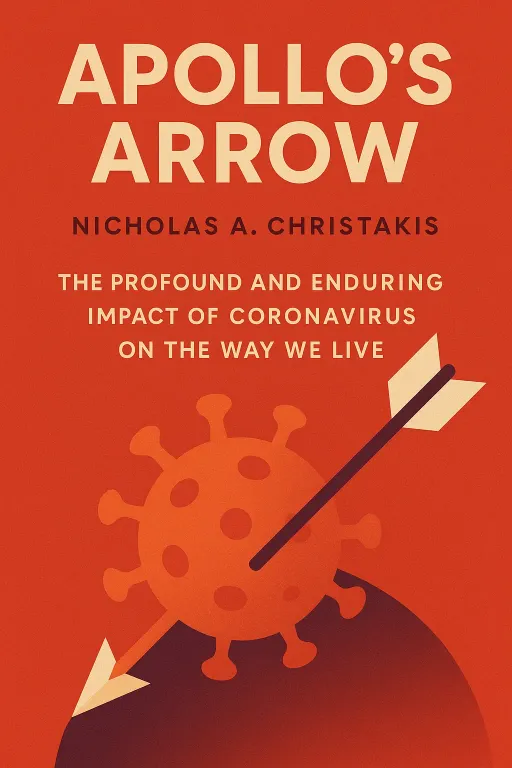
Nova: That is precisely the question we are tackling today. We are looking at two essential books that, when read together, provide a masterclass in navigating chaos. First, we have Apollo's Arrow by Nicholas A. Christakis. He is a sociologist and physician, and he breaks down the biological and social impacts of the pandemic with surgical precision. Then, we are pairing that with The Future We Choose by Christiana Figueres and Tom Rivett-Carnac. These two were the architects of the Paris Agreement, and they offer a completely different, yet complementary, framework for how we survive and thrive.
Atlas: I like that pairing. You have the analytical, almost clinical look at how humans react to sudden trauma, and then you have the visionary, strategic look at how we build our way out of it. It feels like the difference between understanding why the ship is sinking and actually learning how to build a better boat.
Nova: Exactly. Christakis gives us the diagnosis of our social immune system, and Figueres and Rivett-Carnac give us the prescription for how to move forward. If you are someone who wants to build sustainable systems in your own life or business, this is the blueprint for the resilient operator.
The Anatomy of a Shock
SECTION
Atlas: Let’s start with the shock itself. I have always been fascinated by how people behave when everything goes sideways. Christakis makes a point in Apollo's Arrow that really caught my attention. He talks about how we are not just individuals, but nodes in a massive network. What does that actually mean for someone trying to lead a team or run a household during a crisis?
Nova: It changes everything. We have this myth of the rugged individual who saves the day, but Christakis shows us that our greatest strength and our greatest vulnerability is our social nature. When a crisis hits, like the pandemic he analyzes, the first thing that happens is a breakdown in our ability to trust the signals coming from our network. We panic because the network panics.
Atlas: That makes sense. It is like a contagion of fear. But is there a way to override that? Because the moment someone starts hoarding supplies or retreating into their own silo, the whole system starts to fray.
Nova: That is the core of the problem. Christakis argues that we have a biological imperative to cooperate, but it is easily hijacked by fear. In his research, he highlights that during these systemic threats, the most resilient groups are the ones that maintain high levels of social trust, even when the environment is hostile. It is not about being tough; it is about being connected.
Atlas: I am curious, though. How do you maintain trust when the environment is hostile? That sounds like a tall order. If I am in a high-pressure situation, my instinct is to protect my own, not to open up and trust the network.
Nova: That is the counterintuitive part. When you retreat, you actually become more fragile. Christakis illustrates this through the way different societies responded to the pandemic. The ones that fared better were not just the ones with the best medical tech; they were the ones that maintained social cohesion. They communicated clearly, they shared resources, and they didn't let the fear of the other fracture the collective. Think of it like a bridge. If the bridge is rigid, it snaps under the wind. If it is designed to flex and distribute the load across all its cables, it holds.
Atlas: That is a great analogy. The bridge has to be flexible. But let me push back a little. If I am a leader in a company, and we are facing a massive disruption, how do I apply this? I cannot just tell my team to trust each other and hope for the best.
Nova: You have to build the architecture of trust before the crisis arrives. You cannot manufacture it in the middle of a storm. Christakis points out that these networks are built on consistent, reliable interactions. If you have spent years building a culture of transparency and mutual support, that network becomes your shock absorber. If you have spent years building a culture of competition and silos, that network becomes a brittle glass structure that shatters the moment pressure is applied.
Atlas: That hits home. It means resilience isn't a reaction; it’s a form of maintenance. It is like servicing your car before you go on a long road trip. You don't wait for the engine to smoke to check the oil.
Nova: Precisely. And that leads us to the second piece of the puzzle. If Christakis shows us how we act when the shock hits, Figueres and Rivett-Carnac show us how we decide where we go after the dust settles.
Stubborn Optimism and the Architecture of the Future
SECTION
Atlas: I have heard the term stubborn optimism thrown around a lot, but it usually sounds like fluff. It sounds like just being happy in the face of disaster. I am assuming these authors have a more rigorous definition than that?
Nova: You are right to be skeptical. In The Future We Choose, Figueres and Rivett-Carnac are very clear that this is not about ignoring the facts. They are the people who negotiated the Paris Agreement, so they are steeped in the harsh realities of climate change. For them, stubborn optimism is a strategic choice. It is the belief that because we have the agency to shape the future, we have a responsibility to act as if success is possible.
Atlas: So it is not a feeling, it is a methodology.
Nova: Exactly. It is a framework for decision-making. They argue that we are constantly choosing between two futures. One is the future we inherit if we remain passive, which they describe as a world of scarcity and fragmentation. The other is the future we choose, which requires massive, coordinated action.
Atlas: I find that compelling because it shifts the locus of control. Instead of being a victim of the changing environment, you become a participant in the design of the next one. But how does that translate into actual, day-to-day work? If I am a listener trying to apply this, I am not negotiating international climate treaties. I am trying to get through my own week.
Nova: You apply it by asking what the future looks like if you continue your current patterns, and then asking what you need to change to reach the future you actually want. Figueres and Rivett-Carnac suggest that we need to drop the idea that we can just fix things incrementally. We need to think in terms of systemic shifts. They talk about turning our gaze toward the horizon.
Atlas: I like that. It is the difference between fixing a leak in the roof and deciding to build a house that doesn't leak in the first place.
Nova: Exactly. And the power of their approach is how they dismantle the paralysis that comes with big problems. When you look at the entirety of a global crisis, it is paralyzing. You feel small. You feel like your actions don't matter. They argue that the antidote to that paralysis is agency. You pick one area where you can have influence, and you focus your stubborn optimism there.
Atlas: That makes me wonder about the intersection with the first idea we discussed. If Christakis says we need to be connected to survive the shock, and Figueres and Rivett-Carnac say we need to be forward-looking to shape the future, then the resilient operator is someone who maintains deep connections while keeping their eyes on a long-term goal.
Nova: That is the winning combination. If you are connected but have no vision, you just suffer together. If you have a vision but no connection, you are a lone wolf who will eventually burn out or be crushed by the system.
The Resilient Operator
SECTION
Atlas: Let’s get practical then. We have these two powerful frameworks. We have the need for social cohesion and the need for stubborn, strategic optimism. How does the resilient operator actually show up in the world? What does their day look like?
Nova: It starts with how they process information. Most people consume news and crises as a stream of threats. The resilient operator processes them as data. They look at the shock—the pandemic, the market crash, the internal team failure—and they ask, what does this reveal about my network? Where are the brittle points? Where is the trust lacking?
Atlas: That is a diagnostic step. You are not just reacting; you are auditing your environment.
Nova: Right. And then, they pivot to the Figueres and Rivett-Carnac mindset. They don't just patch the leak. They ask, what does this crisis make possible? They use the disruption to accelerate the changes they wanted to make anyway. They treat the crisis as a forcing function for progress.
Atlas: I can see how that would be powerful. It turns the narrative from "Why is this happening to me?" to "What is this teaching me about how to build a better version of my work?" It changes the emotional state from victimhood to agency.
Nova: It is the ultimate shift in perspective. And this is where the "stubborn" part of stubborn optimism comes in. It is not about being naive. It is about acknowledging the difficulty—the very real, tangible difficulty—and saying, "I am going to work toward the best possible outcome anyway." It is a refusal to let the current shock dictate the future potential.
Atlas: That sounds exhausting, though. How do you keep that up without losing your mind?
Nova: You keep it up by remembering the network. You don't do it alone. This is where Christakis’s point about social cohesion is critical. You share the burden. You build a team, a family, or a community that shares that vision. You are not the only one carrying the optimism; you are part of a network that sustains it.
Atlas: That is a beautiful way to frame it. The optimism isn't a solo act. It is a collective energy.
Nova: And that is how you scale your impact without losing your soul. You are not trying to change the world by yourself. You are trying to be a node in a network that is collectively moving toward a better future.
Atlas: I have to say, this changes how I look at my own challenges. I usually try to solve problems by tightening my grip, by working harder, by closing the doors. You are suggesting I should be doing the opposite. I should be looking at who I am connected to and what future I am trying to build.
Nova: Precisely. Open the doors, strengthen the bonds, and define the destination.
Synthesis & Takeaways
SECTION
Atlas: If I had to distill this into something I can carry with me, it feels like the takeaway is that resilience is not a static trait. You don't just have it or not have it. It is a dynamic state of being.
Nova: That is a perfect summary. It is a muscle that you train. The Christakis side of the equation is about the health of your connections—your social immune system. The Figueres and Rivett-Carnac side is about the clarity of your intent—your stubborn optimism. If you have both, you can handle almost anything the world throws at you.
Atlas: It makes me think that the biggest risk isn't the crisis itself. The biggest risk is losing our connection to each other and losing our belief that we can shape the outcome. If we lose those, we are vulnerable to every shock that comes our way.
Nova: That is the most profound insight of all. We often think that the crisis is the danger, but the real danger is the loss of our ability to respond adaptively. When we stop trusting each other and when we stop believing in our agency, that is when we are truly in trouble.
Atlas: I think I am going to walk away from this conversation with a much lighter load. It is not about bearing the weight of the world; it is about being part of a system that can lift it.
Nova: And that is the definition of a resilient operator. You are building systems that can withstand the arrow, and you are choosing a future that is worth the effort to build.
Atlas: I love that. To our listeners, I would challenge you to look at the next disruption in your life not as a threat, but as a test of your network and a chance to pivot toward that future you are trying to build. Don't just survive the shock; use it to clarify your direction.
Nova: Well said. This has been a deep dive into the architecture of resilience. Remember, the future isn't something that happens to you; it is something you build, one connection and one choice at a time.
Atlas: Thanks for walking through this with me. It gave me a lot to think about for my own path forward.
Nova: It was a pleasure to explore it with you. This is Aibrary. Congratulations on your growth!