The 'Antifragile' Advantage: How to Build Agent Systems That Get Stronger with Stress.
8 minGolden Hook & Introduction
SECTION
Nova: What if I told you that building something to be "resilient" is actually a design flaw? That focusing on robustness might be your biggest blind spot when it comes to true innovation?
Atlas: Wait, a design flaw? Nova, isn't resilience the ultimate goal? We spend so much time trying to make systems unbreakable, to bounce back from anything. Are you saying that's… wrong?
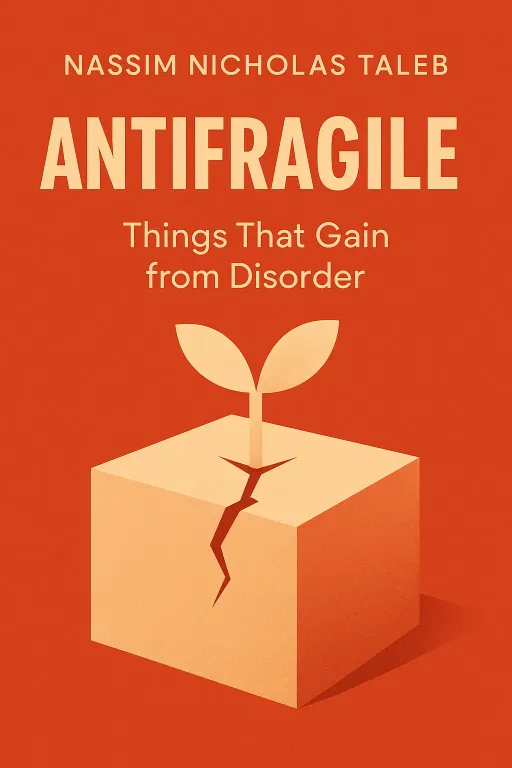
Nova: Not wrong, Atlas, but incomplete. We're talking about a paradigm shift, a concept introduced by the brilliant Nassim Nicholas Taleb in his groundbreaking book,. Taleb, a former options trader and statistician, brings this incredible street-smart perspective to risk and uncertainty. He’s seen firsthand how theoretical models fail in the face of real-world volatility, which gives his philosophical insights immense practical weight. He argues that there's a hidden blind spot in our quest for stability. We often aim for systems that can withstand shocks, but we miss the opportunity to create systems that actually when stressed.
Atlas: Okay, that immediately makes me think about my own agent systems. We’re always patching, recovering, trying to get back to "normal" after an incident. But the idea of actively getting from the chaos? That’s… different.
Antifragility vs. Resilience: The Paradigm Shift
SECTION
Nova: Exactly. Let's unpack it. Most people understand 'robustness' – something that's difficult to break, like a rock. Then there's 'resilience' – something that can absorb shocks and return to its original state, like a spring. But Taleb introduces 'antifragility.' Think of it like this: if you ship a package, you want it to be robust so it doesn't break, or resilient so it bounces back. But an antifragile package would actually from rough handling. It would arrive at its destination somehow better, stronger, more valuable because of the journey.
Atlas: So it's not just surviving a punch, it's actively improving from it? That sounds almost… counter-intuitive, especially in engineering. What does that even look like outside of philosophy? Give me a real-world example where something disorder.
Nova: Absolutely. The most visceral example is our own biology. Our muscles, for instance. When you lift weights, you're intentionally stressing them, causing micro-tears. If you just rested, they wouldn't get stronger. It's the recovery adaptation to that stress that leads to growth, to becoming more capable. Your immune system is another perfect example; exposure to pathogens strengthens it, making it more robust against future threats. Evolution itself is antifragile – species adapt and improve over generations because of environmental pressures and stressors.
Atlas: That makes sense. We intentionally stress our bodies to make them stronger. So, we've been designing our technical systems for "no breakage" when we should be designing for "better breakage," or at least for "learning from breakage"? It’s a complete flip of perspective.
Nova: It is. And this isn't just a philosophical fancy. While Taleb's style can be polarizing for some readers, the core message behind has been widely acclaimed for challenging conventional wisdom and offering a profoundly different lens through which to view uncertainty and risk. It's a call to embrace volatility as a feature, not a bug. For future architects, this means shifting from a defensive posture to an offensive one.
Atlas: I can definitely see how that's a blind spot. My gut reaction is always to shield and protect. But if the goal is growth, then maybe a little controlled chaos is exactly what we need.
Architecting Antifragile Agents: Practical Design Principles
SECTION
Nova: Exactly, Atlas. And that naturally leads us to the engineering challenge: how do we build agent systems that embrace this philosophy? Not just resilient, but truly antifragile. The goal is to design for continuous, stress-driven improvement.
Atlas: Okay, great. But how? What does that look like for an actual agent system? My current agent system just crashes when it gets unexpected input. It doesn't get from that. It just breaks.
Nova: That's where we move from theory to practical design principles. First, think about It's not just about having backups. It’s about diverse, independent components that can fail gracefully and, crucially, from those failures. Imagine a microservices architecture where individual services can be updated or even fail without bringing down the entire system. Over time, the system learns optimal routing, recovery strategies, and even anticipates failure modes from these small, contained incidents.
Atlas: So, it's not just having a spare tire, it's having a fleet of small, different vehicles that can each learn from their own flat tires. I like that. What else?
Nova: Next, we have This is where you intentionally introduce volatility. Think of 'chaos engineering,' a concept famously pioneered by Netflix. Their 'Chaos Monkey' randomly disables services in a production environment. The goal isn't to break things, but to find weaknesses they become catastrophic failures, and in doing so, the system learns to become more robust and adaptable. For an agent system, this could mean A/B testing with deliberately varied, slightly challenging inputs, or even introducing simulated adversarial attacks to see how the agent adapts its decision-making heuristics.
Atlas: That's fascinating. So, essentially, you're stress-testing your agent in a controlled environment, forcing it to adapt, almost like an athlete training for a competition. It’s about building in the capacity to at a fundamental level, not just recover from it. It's almost like giving the system a 'growth mindset'!
Nova: Precisely! And that brings us to the third principle: Your agent systems need to be designed with strong self-correction capabilities. When an unexpected input leads to an undesirable outcome or a failure, the system needs to log that event, analyze the failure mode, update its internal models or decision-making algorithms, and then test new strategies. This is the essence of reinforcement learning, where agents get "punished" for bad decisions and learn to avoid them, becoming more optimal and intelligent over time.
Atlas: That directly answers the deep question then: if an agent system component faces unexpected input, it improves by logging the event, analyzing the, updating its internal logic or models, and then testing those new strategies. It turns every stumble into a step forward.
Nova: Exactly. The unexpected input isn't just an error; it's a valuable data point, a learning opportunity that refines the agent's understanding of its environment and its own capabilities. It transforms from a fragile system that breaks, to a resilient one that recovers, to an antifragile one that actively gets smarter and more capable because of the stress.
Synthesis & Takeaways
SECTION
Nova: Ultimately, antifragility for agent systems isn't about avoiding error, Atlas. It's about designing error into the learning process. It's about proactive evolution through stress and volatility.
Atlas: That's a profound shift in mindset. It means embracing the 'unknown unknowns' not as threats to be eliminated, but as rich data points for growth. It resonates with the idea of 'embracing the mess' to find innovation.
Nova: Precisely. It challenges architects to break free from the traditional boundaries of 'stability' and 'prevention' and instead, see disorder as a catalyst. Your full-stack background is a huge advantage here, Atlas, because you see the whole system, not just individual components.
Atlas: So, the takeaway for our listeners, especially those future architects, isn't just to build systems that the next black swan event, but to build ones that from it. To turn every unexpected input into a learning opportunity that makes their agent systems more intelligent, more adaptable, and ultimately, more valuable.
Nova: Exactly right. It's about asking yourself: how can I design my next agent component not just to gracefully recover, but to actually get smarter when it stumbles? How would that change your approach to architecture?
Atlas: That's a powerful question to end on. It's about seeing the future not just as something to prepare for, but as something to actively leverage for continuous growth.
Nova: This is Aibrary. Congratulations on your growth!