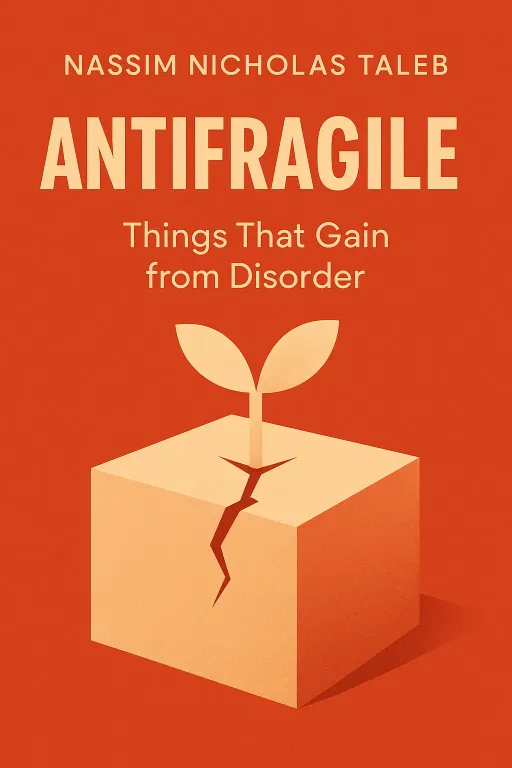
The 'Antifragile' Advantage: How to Build Agent Systems That Get Stronger with Stress.
8 minGolden Hook & Introduction
SECTION
Nova: Most people think strength means resisting damage. Like a rock, unyielding. But what if real strength, the kind that creates breakthroughs, actually comes from chaos and getting better with every jolt? What if the goal isn't to prevent all failures, but to design in a way that them to evolve?
Atlas: Oh, I love that. So, we’re not just talking about bouncing back after a hit, but actually using the hit to become stronger, faster, smarter? That’s almost counter-intuitive to how we typically approach building robust systems.
Nova: Absolutely, Atlas. Today, we're tearing down that assumption by diving into the revolutionary ideas of Nassim Nicholas Taleb, specifically his groundbreaking work,. Taleb, a former options trader turned philosophical essayist, brings a truly unique perspective to risk and uncertainty. His work is acclaimed for challenging conventional thinking, often sparking intense debate, but always forcing us to rethink our relationship with the unpredictable. He flips our conventional understanding of robustness on its head.
Atlas: So, we're talking about going beyond just surviving the storm, right? Like, the storm actually makes you a better sailor?
Nova: Exactly, Atlas. It's about designing systems, and in our case, agent systems, that don't just recover, but actually when faced with unexpected inputs or failures. It challenges that deep-seated human desire for predictability.
Understanding Antifragility: Beyond Resilience
SECTION
Atlas: That makes me wonder, what precisely is the difference? Because for an architect building complex systems, resilience is often the holy grail. We spend countless hours trying to make things resilient. What's the 'blind spot' you mentioned?
Nova: The blind spot, Atlas, is thinking resilience is the ultimate state. Let's imagine three types of packages in transit. A 'fragile' package breaks easily. A 'robust' package can withstand a good deal of shock—think of it as being well-padded, it resists damage. A 'resilient' package might get squashed but springs back to its original shape. It recovers. But the 'antifragile' package? That's the one that, every time it gets dropped or bumped, actually grows stronger, perhaps develops a thicker skin, or optimizes its internal structure to handle the next impact even better.
Atlas: Whoa. So, it's not just about enduring, it’s about from the hit? That sounds almost mythical. Can you give an example that isn't a magical package?
Nova: Think of the human immune system. It's a classic example of antifragility. When exposed to a pathogen, it doesn't just resist or recover. It learns, develops antibodies, and becomes against future encounters with that specific pathogen. Or consider an innovative startup that thrives on market volatility and disruption, using each challenge to pivot, refine its product, and capture new opportunities. Many established companies, aiming for stability, are fragile to such shocks, while the nimble startup gains.
Atlas: That’s a great analogy. It’s like, instead of just patching up the wound, the body grows new, better tissue in response. So, in our world of agent systems, we're often building for that "resilient" state—we account for edge cases, we build fail-safes, we try to recover gracefully. But you're saying that's not enough? That recovery is just the baseline?
Nova: Precisely. Recovery is good, but it's not growth. Taleb argues that by obsessing over prediction and prevention, we often make systems fragile to the truly unpredictable, the "black swans." Antifragility accepts that the unexpected happen and designs systems that are positioned to benefit from it. It's a profound shift in mindset.
Atlas: I see. So, the blind spot isn't a lack of effort in resilience, but a lack of imagination about what's resilience. It's the thought that the best we can do is just survive. But what does this look like in practice for, say, an AI agent system? How do you engineer an immune system for code?
Designing Antifragile Agent Systems: From Theory to Practice
SECTION
Nova: That’s the million-dollar question, Atlas, and it moves us into the 'how.' Designing antifragile agent systems requires a few key principles. First,. This means having many small, low-risk experiments or components, where failure of one doesn't bring down the whole, but provides valuable data. Think of it as placing many small bets.
Atlas: So, instead of one monolithic, perfectly engineered agent that might spectacularly fail, you build a swarm of smaller, adaptable agents? And if one goes rogue or produces a bad output, the others learn from it?
Nova: Exactly. That leads to the second principle:. Not just identical backups, but diverse components that can handle different types of stressors. And crucially, a feedback loop that unexpected inputs or failures as learning opportunities, not just errors to be logged and ignored.
Atlas: Can you give an example of an agent system gaining from failure? Because often, a failure is just a failure, right? We see a bug, we fix it. We don't usually say, "Great, this bug made our system stronger."
Nova: Consider a multi-agent recommendation system. If a single agent or a small cluster of agents occasionally makes a "bad" recommendation—one that the user quickly rejects or provides negative feedback on—an antifragile design wouldn't just discard that agent's output. It would analyze it failed. Perhaps it discovered a niche preference, or exposed a flaw in the overall model's understanding of a certain user segment. The system could then use that "failed" recommendation data, not just to avoid similar failures, but to refine its understanding of user behavior, leading to more nuanced and effective recommendations overall. The unexpected input—the user rejection—becomes a catalyst for growth for the entire system, making it more robustly intelligent.
Atlas: That’s fascinating! So the failure isn't just a signal to repair, but a signal to the core logic. It requires a mindset shift from trying to predict every possible scenario to building systems that are designed to learn from the unpredictable. For our "architects of the future" listening, what’s the biggest challenge in adopting this?
Nova: The biggest challenge is often our own human bias towards control and predictability. We want to eliminate risk, but Taleb argues that by doing so, we often eliminate the very volatility that could make us stronger. It means designing for decentralization, for rapid iteration, for embracing small, contained errors as information, rather than trying to create impenetrable fortresses. It’s about building systems with built-in optionality and the capacity for self-correction and improvement, rather than just protection.
Synthesis & Takeaways
SECTION
Atlas: This is profoundly different from how many of us have been trained to think about system design. It’s not just tweaking parameters; it’s a whole new philosophy. So, for the pragmatist in me, what’s the one thing I should take away from this conversation?
Nova: The core takeaway is this: the true 'Antifragile Advantage' for agent systems isn't about avoiding chaos, it's about strategically inviting it in small, manageable doses. It's about designing architectures that inherently possess the ability to extract knowledge and strength from disorder, making them not just resilient, but. When we apply this, our agent systems won't just survive the next unexpected input; they'll use it as fuel to become more intelligent, more adaptable, and ultimately, more valuable.
Atlas: That’s actually really inspiring. It means our toughest challenges aren’t roadblocks, but potential launchpads for something even better. It shifts the entire perspective on what a 'failure' truly is. What if we started seeing every unexpected input, every system failure, not as a problem to be fixed, but as a prompt for growth?
Nova: Exactly. It's about harnessing the power of the unknown, rather than fearing it.
Atlas: This is Aibrary. Congratulations on your growth!