The 'Antifragile' Advantage: How to Build Agent Systems That Get Stronger with Stress.
8 minGolden Hook & Introduction
SECTION
Nova: What if everything you've been told about building robust systems is actually holding you back? What if the very thing you fear – chaos, failure, unexpected inputs – is precisely what your agent systems need to not just survive, but to truly thrive?
Atlas: Wait, are you saying we've been doing it wrong all along? Because my entire career has been about making things,, bulletproof from the unexpected.
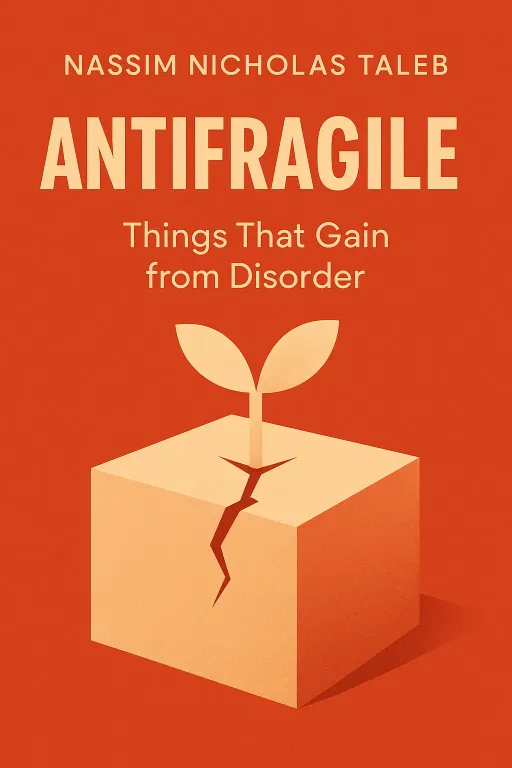
Nova: Exactly, Atlas! And that's the blind spot we want to expose today. We're diving into a concept that flips that traditional thinking on its head, from the brilliant mind of Nassim Nicholas Taleb, in his groundbreaking book,.
Atlas: Oh, I love that title. Taleb, right? The former options trader who basically wrote the book on "black swans" and risk?
Nova: The one and only. His background as a quantitative analyst and options trader gives him such a unique, street-smart perspective on uncertainty, far removed from the ivory tower. He’s seen firsthand how the world really works, and that informs his radical ideas.
Atlas: That makes sense. You need someone who's lived through market crashes and volatility to truly understand how to build systems that don't just endure, but actually get stronger from it. So, what's this big distinction we're missing in agent system design?
The Blind Spot: Why Resilience Isn't Enough for Agent Systems
SECTION
Nova: Well, it starts with understanding the crucial difference between three states: robust, resilient, and antifragile. Most of us aim for robust, or at best, resilient. A robust system is like a solid rock; it resists damage, but it doesn't change. A resilient system is like a rubber ball; it can absorb a shock, deform, and then spring back to its original shape. It recovers.
Atlas: I see. So, a resilient system just goes back to baseline. It’s a good goal, right? We want our agent systems to recover quickly from errors, adapt to new data, and keep performing.
Nova: Absolutely, resilience is good, but it's not the ultimate state. It's a defensive posture. Taleb argues that there's a third category: antifragile. Think of it like this: a muscle doesn't just recover after heavy lifting; it gets stronger. A forest, after a wildfire, often regenerates with greater biodiversity. These aren't just recovering; they're because of the stress.
Atlas: So, an antifragile one actually and? Can you give me a more concrete example in the context of agent systems? How does resilience fall short there?
Nova: Picture an agent system designed for, let's say, medical diagnosis. It's been meticulously trained on vast datasets and is highly resilient to common data noise or minor input variations. It can filter out known anomalies. But then, a truly novel, never-before-seen disease pattern emerges – a "black swan" in medical data.
Atlas: Okay, so the system encounters something entirely outside its training data.
Nova: Precisely. A merely resilient system might just flag it as an unknown, or worse, misclassify it based on the closest familiar pattern, leading to potentially harmful outcomes. It recovers to its operational state, but it hasn't from this novel stressor. It hasn't improved its of disease. It just hit its resilience limit.
Atlas: Huh. That sounds rough, but it also sounds like a perfect description of many current AI systems. They're good at what they're trained for, but new unknowns break them, or at least they don't know how to integrate that new knowledge.
Nova: Exactly. The inherent danger of aiming for resilience is that it creates an invisible ceiling on innovation and adaptive capacity. By focusing purely on returning to a previous state, we miss the opportunity for the system to that state. We're essentially saying, "Don't change, just survive," when the real world demands, "Change, and get better."
Atlas: That's a powerful distinction. It means we're not just protecting our systems; we're inadvertently limiting their potential for growth.
The Antifragile Shift: Designing Agent Systems That Thrive on Disorder
SECTION
Nova: And that naturally leads us to the real game-changer: how do we actually for this antifragility in our agent systems? It’s about a fundamental shift in our philosophical approach. We need to embrace stressors, not just avoid them.
Atlas: Okay, so how do we do that? 'Embrace stressors' sounds great on a motivational poster, but how do you actually build it into code, into an agent's decision-making framework? Give me some concrete mechanisms.
Nova: Taleb offers several principles that we can translate directly. First, instead of trying to prevent all errors, design systems that can experience small, localized failures, and from them. Think of a decentralized network where individual nodes might fail, but the overall system not only continues but uses the failure data to optimize routing or resource allocation, making the system smarter and more robust for future stresses.
Atlas: So basically you’re saying, instead of trying to bulletproof the system, we should build in mechanisms for it to and? Like a child learning to walk by falling, but at a system level?
Nova: Exactly! Another key is building in redundancy and optionality. Don't just have one way for an agent to achieve a goal. Give it multiple pathways, multiple algorithms, even multiple internal models. When one approach fails or encounters an unexpected input, the system has the optionality to switch, adapt, or even combine elements from different strategies. The stress of failure on one path then highlights the utility of others, strengthening the overall decision-making process.
Atlas: I’ve been thinking about this with multi-modal agent systems. If one modality, say vision, gets unreliable input, the system shouldn't just freeze. It should lean harder on language or auditory cues, and then use that new context to its future visual processing.
Nova: Precisely! And the third principle is active exposure to variability. Don't just train agents on perfectly curated, clean data. Actively expose them to diverse, even chaotic, environments during training and operation. Let them encounter messy, contradictory inputs. The stress of reconciling these inconsistencies forces the system to develop more nuanced, robust, and generalizable internal representations.
Atlas: That’s actually really inspiring. It’s about turning 'exception handling' into 'exception learning and growth.' It sounds like it requires a fundamental shift in how we think about risk and control. Instead of minimizing exposure, we're almost maximizing exposure to benefit.
Nova: That’s the heart of it. It's a proactive, almost evolutionary approach to system design, one that acknowledges the inherent unpredictability of complex environments and turns it into an advantage.
Synthesis & Takeaways
SECTION
Nova: So, antifragility isn't just about surviving; it's about a mindset and design philosophy that sees disorder as information and a catalyst for evolution. It’s about building agent systems with an internal engine for self-improvement through stress, making them not just resilient, but truly adaptive and innovative.
Atlas: So, for the architects of the future listening, the takeaway isn't just to build stronger walls, but to build systems that can the incoming 'wrecking balls' into building blocks for something even better. What's one crucial mindset shift that listeners should adopt today?
Nova: I'd say it's this: view every unexpected challenge, every system failure, every anomalous input not as a threat to be mitigated or merely recovered from, but as an invaluable opportunity for the system to reveal its next evolutionary step. It's a chance for true learning and growth.
Atlas: That’s a powerful call to action. It forces us to rethink our definition of 'success' in system design. It's not just about uptime, it's about.
Nova: Absolutely. And it’s about aligning with the true nature of complex systems, which are always in flux, always adapting. Embrace the chaos, and design for growth.
Atlas: This is Aibrary. Congratulations on your growth!