

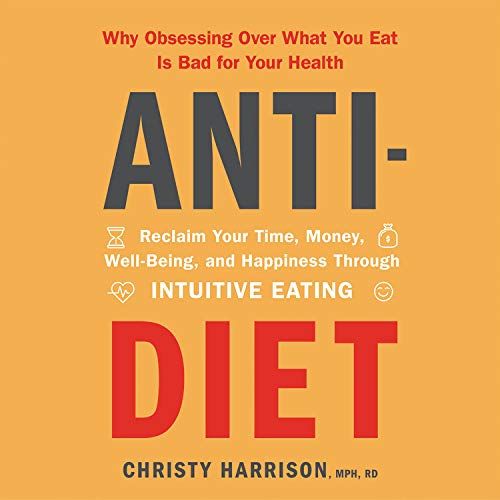
Anti-Diet
Introduction: Escaping the Wellness Trap
Introduction: Escaping the Wellness Trap
Nova: Welcome to the show. Imagine this: You spend thousands of dollars a year, countless hours agonizing over food labels, and every single New Year’s resolution is about shrinking your body. Now, what if I told you that entire system—the diet industry, the relentless pursuit of 'wellness'—is actually designed to keep you trapped, broke, and unwell?
Nova: Exactly. Christy Harrison, who is an anti-diet Registered Dietitian and host of the popular Food Psych podcast, doesn't just offer a new set of rules. She offers a total paradigm shift. Her core argument is that dieting—and its modern cousin, 'wellness'—is a form of systemic oppression that profits off our insecurity.
Nova: She wants us to see that the problem isn't us, our willpower, or our genetics. The problem is the framework itself. She traces the history of modern diet culture, showing how it’s been expertly repackaged as self-care. It’s a radical reframing that demands we look at our relationship with food and our bodies through a completely new lens. Get ready to question everything you thought you knew about health.
Key Insight 1: Diet Culture as Systemic Oppression
Defining the Enemy: Diet Culture vs. Wellness Culture
Nova: Let’s start with the term itself: Diet Culture. Harrison defines it as a system of beliefs that values thinness above all else, equating it to health and moral virtue. It’s the air we breathe in our society.
Nova: Precisely. She argues it’s a form of oppression, much like racism or sexism, because it targets specific bodies—primarily fat bodies—and dictates worth based on weight. She points out that the diet industry is a massive enterprise, often cited as being worth over $70 billion globally. That scale means it has a vested interest in keeping you perpetually dissatisfied.
Nova: That’s Chapter One’s big reveal. Wellness culture is diet culture in camouflage. It swaps out explicit weight loss goals for vague terms like 'clean eating,' 'biohacking,' or 'optimizing your gut health.' Harrison notes that these trends often require the same restrictive, obsessive behaviors as traditional dieting, just under a more palatable, self-care banner.
Nova: They do. Harrison emphasizes that when health behaviors are driven by the of being unhealthy or the to look a certain way, rather than genuine care for your body, you’re operating within diet culture. She cites research showing that the pursuit of these 'perfect' habits often leads to increased anxiety and disordered eating patterns, even if the person never formally 'dieted.'
Nova: She tackles that head-on by exposing the flaws in weight-centric research. She looks at the long-term data, which overwhelmingly shows that intentional weight loss is unsustainable for the vast majority of people. She brings up weight cycling—the yo-yo effect—and how that constant fluctuation is far more detrimental to health markers than simply maintaining a stable, higher weight.
Nova: Exactly. The priority shifts from weight management to holistic well-being, which brings us perfectly to the solutions she proposes: the twin pillars of the Anti-Diet movement.
Key Insight 2: Reclaiming Internal Wisdom
The Pillars of Freedom: Intuitive Eating and HAES
Nova: Intuitive Eating is a framework of ten principles designed to heal your relationship with food. It’s about rejecting the diet mentality entirely and learning to trust your body’s internal wisdom. Harrison, as an IE counselor, stresses that it’s not a free-for-all; it’s about giving yourself unconditional permission to eat, which paradoxically calms the food obsession.
Nova: She addresses it by explaining the concept of 'food neutrality' and the psychological reality of restriction. When you restrict a food, your brain signals scarcity, making that food hyper-desirable. Harrison explains that once you truly internalize that you can have the ice cream tomorrow, the intense, urgent craving often dissipates. It’s about breaking the binge-restrict cycle by removing the moral judgment from food choices.
Nova: Yes, Health at Every Size is the crucial companion. Harrison dedicates significant space to defending HAES against common misconceptions. The core principle is weight inclusivity: respecting the inherent diversity of body shapes and sizes. It rejects the idea that there is one ideal, healthy body weight.
Nova: She uses her journalistic background to meticulously cite research. She argues that focusing solely on weight as a proxy for health is flawed because health behaviors—like eating nourishing food, moving joyfully, and managing stress—are independent of weight. She points to studies showing that people in larger bodies who engage in healthy behaviors often have better health outcomes than thin people who engage in unhealthy behaviors.
Nova: Exactly. And the other key HAES principles she champions are self-regulation—which links back to Intuitive Eating—and respect for the diversity of bodies. She emphasizes that weight stigma itself is a major driver of poor health outcomes, causing stress, shame, and avoidance of medical care. By rejecting weight stigma, HAES is actually a public health intervention.
Nova: It is. And the liberation isn't just about food. It’s about what you gain when you stop fighting your body and stop chasing an ever-receding goalpost. That brings us to the tangible benefits Harrison outlines in the book’s subtitle.
Key Insight 3: The Hidden Costs of Dieting
Reclaiming Life: Time, Money, and Mental Health
Nova: Harrison’s subtitle is a powerful promise: Reclaim Your Time, Money, Well-Being, and Happiness. This is where the abstract philosophy hits the listener’s real life. Let’s talk about time first. How much time do we collectively waste on dieting?
Nova: Harrison frames it perfectly. She points out that the mental load of constantly policing intake and body size steals cognitive energy that could be used for career development, hobbies, relationships, or actual rest. She suggests that leaving diet culture frees up hours every week that you can reinvest in things that actually bring you joy and fulfillment.
Nova: It’s a financial drain disguised as an investment in health. Harrison details how the constant cycle of starting and failing diets means you’re perpetually buying the next solution. By embracing Intuitive Eating, you return to eating regular food, prepared in regular ways, which is often significantly cheaper and less stressful than maintaining a highly specialized, restrictive diet.
Nova: It’s immense. She connects diet culture directly to anxiety, depression, body shame, and low self-esteem. When your worth is tied to a number on the scale or the size of your jeans, any fluctuation feels like a moral failure. This creates a constant state of internal conflict.
Nova: She emphasizes focusing on body respect rather than body love, which can feel too big a leap initially. Body respect means acknowledging your body’s functionality—it allows you to walk, breathe, think, and experience the world—regardless of its appearance. She encourages listeners to identify their core values—things like creativity, kindness, curiosity—and actively pursue those, intentionally decoupling them from physical appearance.
Nova: Exactly. She also addresses the concept of 'fat liberation' within this context. For many, especially those in larger bodies, reclaiming time and money means reclaiming the right to exist in public spaces without fear of harassment or judgment, which is a direct result of diet culture’s rigid standards.
Nova: It is the ultimate pivot. When you stop fighting your body, you gain the energy to fight for the things that truly matter. It’s a profound call to action to redirect all that energy we spend on dieting back into our actual lives.
Conclusion: The Ongoing Practice of Anti-Dieting
Conclusion: The Ongoing Practice of Anti-Dieting
Nova: Absolutely. The key synthesis is this: Diet Culture is the problem, and Intuitive Eating paired with Health at Every Size is the solution. It’s a commitment to weight neutrality, self-trust, and recognizing that your body’s worth is inherent, not conditional on size or adherence to arbitrary rules.
Nova: Harrison suggests starting small by identifying one area where diet culture has a hold on you—maybe it’s a specific food you label 'bad,' or a piece of exercise you feel obligated to do. Then, practice one small act of rebellion against that rule. Give yourself unconditional permission for that one thing, and observe the mental space that frees up.
Nova: And remember her background—she’s a journalist and an RDN. She backs up every claim with science. This isn't just feel-good theory; it’s evidence-based practice for mental and physical well-being that prioritizes stability over the temporary, stressful pursuit of weight loss.
Nova: It’s a call to reclaim our time, our money, and our peace of mind. It’s about choosing liberation over restriction, every single day. Thank you for exploring this vital topic with me.
Nova: This is Aibrary. Congratulations on your growth!