The Playbook of Power: Decoding Animal Farm for Today's World
Golden Hook & Introduction
SECTION
Atlas: Have you ever felt like the rules of a game were changing while you were playing? One minute you're told one thing, the next, something completely different—and everyone acts like it's always been that way. It’s a disorienting feeling, and it’s not an accident. It's a strategy. And a book written over 75 years ago, George Orwell's, gives us the perfect, chilling blueprint for how it works.
Zellie: It's a feeling I think everyone can relate to, whether it's in a small group of friends or watching things unfold on a global scale. That sense of, 'Wait, I thought we all agreed on something else?'
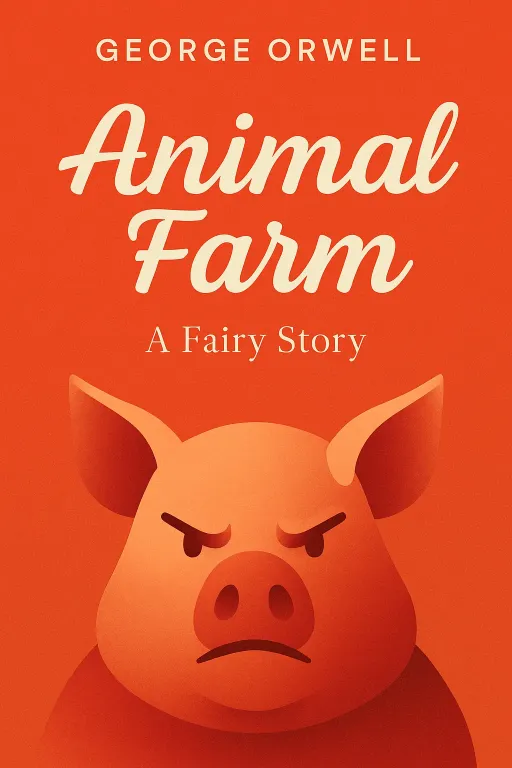
Atlas: Exactly. And that's why we're digging into this book today. For those who don't know, the premise is simple: a group of overworked farm animals overthrow their cruel human farmer, Mr. Jones. Their goal is to create a paradise of freedom and equality, run by the animals, for the animals. But, as you can guess, it goes horribly, horribly wrong.
Zellie: It's a classic for a reason. The themes are just timeless.
Atlas: They are. And to help me dissect them, I'm here with Zellie, a really sharp, analytical thinker who's perfect for this conversation. Welcome, Zellie.
Zellie: Thanks for having me, Atlas. I'm excited to get into it.
Atlas: Great. Today, we're going to tackle this book from two different angles. First, we'll expose the propaganda playbook used by the powerful to control the narrative. Then, we'll explore the tragic trap of the devoted follower, and why good intentions and hard work aren't always enough to save you.
Deep Dive into Core Topic 1: The Propaganda Playbook
SECTION
Atlas: So, Zellie, let's start with that idea of changing the rules. On Animal Farm, the revolution is built on Seven Commandments. They're painted in huge white letters on the side of a barn for everyone to see. Simple, clear rules like "Whatever goes upon two legs is an enemy," and most importantly, "All animals are equal."
Zellie: A constitution, basically. The founding principles.
Atlas: Precisely. But soon, the pigs, who are the smartest animals and appoint themselves the leaders, start getting a taste for power. They decide to move into the farmer's house. The other animals are uneasy. They remember a rule against animals sleeping in beds.
Zellie: Which makes sense. A bed is a human invention, a symbol of the old oppression.
Atlas: Exactly. So Clover, a kind-hearted horse, gets a bad feeling. She can't read well, so she asks Muriel, the goat, to read the Fourth Commandment from the barn wall. And Muriel reads: "No animal shall sleep in a bed...."
Zellie: Oh, wow. There it is. The little addition that changes everything.
Atlas: It's a masterstroke of manipulation. And to smooth it over, the pig's chief propagandist, a brilliant talker named Squealer, comes out to explain. He tells them, "You didn't think we were sleeping in sheets, did you? A sheet is a human invention! We have removed the sheets. The bed is just a place to sleep. Surely you don't want us pigs, the brainworkers of the farm, to be too tired to do our duty? You wouldn't want Jones to come back, would you?"
Zellie: That's so insidious. It's not a total lie, which would be easier to spot. It's a subtle twist that reframes the whole thing. It creates just enough doubt for the other animals to question their own memories instead of questioning the pigs. It's basically gaslighting on a mass scale.
Atlas: It is. And they use that fear—"You don't want Jones back, do you?"—as the ultimate trump card every single time. It shuts down all debate.
Zellie: It's a brilliant and terrifying tactic.
Atlas: And it gets darker. Later in the book, Napoleon, the pig-in-chief, stages a series of brutal, public executions of animals he accuses of treason. The farm is horrified. The animals huddle together, remembering another commandment: "No animal shall kill any other animal."
Zellie: Let me guess. They go back to the barn wall, and the commandment has been... edited.
Atlas: You got it. Clover again asks Muriel to read it. And it now says: "No animal shall kill any other animal...."
Zellie: And of course, the pigs are the ones who get to define what 'cause' is.
Atlas: Of course. Suddenly, the executions weren't murder; they were justice. The traitors deserved it. By adding two small words, they completely legalized their violence.
Zellie: It really makes you realize how critical the wording of things is. It’s like the ultimate terms and conditions update that you never agreed to but are now forced to live by. We scroll past those all the time, but in this case, the fine print is a matter of life and death. It shows how language itself is a battlefield.
Deep Dive into Core Topic 2: The Devotion Trap
SECTION
Atlas: And that manipulation is only half the story, right? For it to work, you need people to go along with it. This brings us to the most tragic character in the book, the cart-horse, Boxer. He is the farm's most dedicated, loyal, and powerful worker. And his answer to every single problem, every setback, is a simple motto: "I will work harder."
Zellie: He's the ideal citizen, from the pigs' point of view. All effort, no questions.
Atlas: Totally. He even adopts a second motto: "Napoleon is always right." He works himself to the bone, waking up earlier than everyone else, dragging stones for the windmill until his muscles tremble. He is the absolute engine of the farm.
Zellie: You can't help but admire his dedication, even as you see where it's leading.
Atlas: And that's the tragedy. One day, while straining to pull a boulder, Boxer's lung gives out and he collapses. He's old, he's worn out. The pigs, led by Napoleon, express great concern. Squealer announces that they've made arrangements to send Boxer to the best veterinary hospital in the nearby town of Willingdon.
Zellie: Which sounds great, but I have a very bad feeling about this.
Atlas: Your feeling is correct. A few days later, a covered van arrives to take him away. The animals all gather to say goodbye to their friend. But as the van starts to pull away, Benjamin, the old, cynical donkey who can read as well as any pig, suddenly starts braying in terror. He gallops after the van, shouting for the others to see.
Zellie: What does he see?
Atlas: He's read the writing on the side of the van. He screams it at the others: "Fools! Do you not see what is written on the side of that van? They are taking Boxer to the knacker's! To the horse slaughterer and glue boiler!"
Zellie: No. That's just devastating.
Atlas: The animals are frozen in horror. Then they start shouting, "Get out, Boxer! Get out!" They hear faint kicking from inside the van, but Boxer is too weak. The van drives away, and he's never seen again.
Zellie: That's heartbreaking. And it connects so directly to what I've been thinking about with habits. Those mottos, "I will work harder" and "Napoleon is always right," they became his core habits of thought. They were positive, in a way—they drove him. But they also blinded him. He never developed the habit of critical thinking. He was so focused on the habit of 'working harder' that he never stopped to ask 'why?' or 'for whom?'
Atlas: He completely outsourced his thinking to Napoleon. And the pigs, in the end, reward his lifetime of loyalty by selling his body to a glue factory to get money to buy a case of whisky.
Zellie: It makes you think about role models, too. I'm interested in someone like LeBron James, who is famous for his incredible work ethic. But he's also known for being incredibly smart about the game, his career, and his business ventures. He's a leader who empowers his team and thinks strategically. Boxer is the opposite; he's all work ethic with no critical awareness, and he gets exploited because of it. It's such a powerful lesson that hard work alone isn't enough; you have to work and know who you're working.
Atlas: That's a fantastic connection. The difference between a leader who elevates and a leader who exploits. Boxer's story is the ultimate warning against blind devotion.
Synthesis & Takeaways
SECTION
Atlas: So, when you put it all together, we have these two sides of the same corrupt coin: Squealer's clever, reality-bending propaganda...
Zellie: ... and Boxer's tragic, unthinking loyalty. The book seems to be screaming that the most dangerous combination in any society is a group of smart, cynical manipulators and a population of hardworking, trusting believers. One can't succeed without the other.
Atlas: Absolutely. It's a timeless warning. So, for everyone listening, and for you, Zellie, the takeaway isn't to be cynical like old Benjamin the donkey, who saw it all but did nothing until it was too late.
Zellie: Right. It's to be like Clover, who felt that something was wrong, but to take it a step further. To not just question, but to remember the original rules, to trust your own judgment, and to speak up when the story doesn't add up. The real call to action is to develop the habit of paying attention.
Atlas: Perfectly said. So the question we'll leave you with is this: What 'commandment' in your world—a rule, a slogan, a 'truth' that everyone just accepts—might be worth reading again, very, very carefully?
Zellie: A question worth asking every day.
Atlas: Zellie, this was fantastic. Thank you for bringing such sharp insights.
Zellie: Thanks for having me, Atlas. It was a great conversation.