

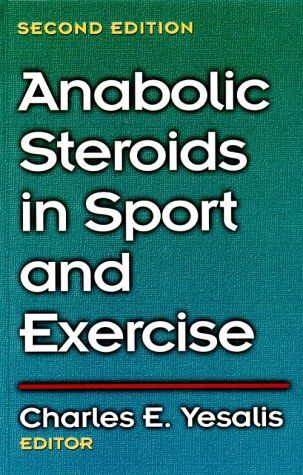
Anabolic Steroids in Sport and Exercise
Introduction
Nova: September 24, 1988. The Men's 100-meter final at the Seoul Olympics. The entire world is watching. The gun fires, and in 9.79 seconds—a time so fast it seems almost inhuman—Ben Johnson crosses the finish line. He's the fastest man on earth. And then, just 48 hours later, the dream collapses. Stanozolol, an anabolic steroid, is detected in his urine. Gold medal stripped. Record erased. That moment changed everything about how we think about sports, drugs, and the human body. Today, we're taking a deep dive into the book that became the definitive reference on this entire subject: Anabolic Steroids in Sport and Exercise, edited by Dr. Charles E. Yesalis.
Nova: : And I have to say, Nova, before we jump in—I've heard the name Ben Johnson my whole life, but I never realized that was the moment that really exploded the steroid conversation into the mainstream. What makes this particular book so important?
Nova: Great question. This book, first published in 1993 and then released in a substantially expanded second edition in the year 2000, is not some sensationalist exposé. It is a rigorous, multi-author academic reference text—15 experts contributing chapters on everything from the biochemistry of testosterone to the politics of drug testing to the psychological dependence issues among adolescents. Yesalis himself is a professor at Penn State who spent over three decades researching the non-medical use of these substances. He's testified before Congress three times, consulted for the DEA, the FDA, the NFL Players Association, the US Olympic Committee, and the NCAA. This is the book that doctors, researchers, coaches, and policymakers turn to.
Nova: : So we're talking about the encyclopedia of steroids in sports. But here's what I wonder—this book came out in 2000, the second edition. A lot has happened since then. Does it still hold up?
Nova: That's exactly the right question. And what's fascinating is that Yesalis himself, in interviews years later, would say that the fundamental dynamics haven't changed at all. In fact, he argues they've gotten worse. The money's bigger, the drugs are more sophisticated, and the testing—well, let's just say he's earned his skepticism over thirty years. Today we're going to walk through what this book actually teaches us: where steroids came from, what they do to the body and mind, why drug testing keeps failing, and the crisis happening not in professional locker rooms but in high school weight rooms.
Nova: : I'm hooked. Let's get into it.
The Birth of Anabolic Steroids
From Laboratory Curiosity to Olympic Weapon
Nova: Let's start at the very beginning, and the book opens exactly there—with a chapter co-authored by Charles Kochakian, who is literally one of the scientists who helped discover how these compounds work. Picture this: it's the 1930s. Scientists in Germany, including Adolf Butenandt—who would later win a Nobel Prize—successfully isolated testosterone. They were trying to treat medical conditions like hypogonadism, where men don't produce enough testosterone naturally.
Nova: : So the origin story of anabolic steroids is actually medicine, not sports cheating?
Nova: Exactly. The word "anabolic" comes from the Greek word "anabole," meaning to build up. These are compounds structurally related to testosterone that promote tissue building, particularly muscle. "Androgenic" refers to the development of male characteristics. The book's first chapter carefully defines these terms because they matter—not all steroids are anabolic steroids. Cortisone, for example, which is commonly used in sports medicine, is a completely different class. As Yesalis once put it in an interview, saying cortisone and anabolic steroids are similar because they're both steroids is like saying gasoline and orange juice are the same because they're both liquids.
Nova: : That's a great analogy. So when did these compounds go from treating medical conditions to becoming performance enhancers?
Nova: The pivotal moment came in 1954. That year, at the World Weightlifting Championships in Vienna, the Soviet Union absolutely dominated. A Soviet team doctor allegedly told the American team physician, Dr. John Ziegler, that his athletes were receiving testosterone injections. Ziegler was alarmed but also intrigued. He went back to the United States and collaborated with Ciba Pharmaceuticals to create a compound that would have the muscle-building benefits of testosterone but with fewer androgenic side effects—things like prostate enlargement. In 1958, they released it under the brand name Dianabol.
Nova: : And Dianabol just exploded?
Nova: Oh, it more than exploded. It transformed entire sports. The book documents how, within a few years, Dianabol spread from weightlifting into football, track and field, bodybuilding—essentially any sport where strength and muscle mass mattered. By the 1960s, Sports Illustrated was already running exposés about the widespread use of performance-enhancing drugs. One team doctor, Robert Kerlan of the Los Angeles Dodgers, warned in 1969 that the excessive and secretive use of drugs was likely to become a major athletic scandal.
Nova: : He was basically a prophet. But here's what strikes me—the book was published in 2000. It's covering material that goes back to the 1930s. How comprehensive is the historical picture it paints?
Nova: Remarkably so. Yesalis and his co-authors trace a clear arc. The 1960s and 70s saw state-sponsored doping programs emerge—most notoriously in East Germany, where thousands of athletes, some as young as 12, were systematically given steroids without their knowledge or consent. By the 1980s, steroid use had spilled out of elite athletics and into the general population. The book notes that before 1980, anabolic steroids were primarily an elite athlete phenomenon. After 1980, you start seeing use among recreational bodybuilders, then high school athletes, then people who just wanted to look more muscular.
Nova: : So the genie was out of the bottle.
Nova: And as Yesalis would say, putting it back in has proven essentially impossible.
Efficacy, Health, and Psychology
What Steroids Actually Do—and Don't Do
Nova: This brings us to the heart of the book—Part Two, which dives into what steroids actually do to the human body and mind. And this is where the research gets really nuanced. Chapter five, by Dr. John Lombardo, tackles the efficacy question head-on. Do anabolic steroids actually work? The answer is yes—but perhaps not in the way most people think.
Nova: : Okay, I'll bite. Don't they just make you huge?
Nova: They increase muscle mass and strength—that's well established. But what fascinated me is the mechanism. Steroids don't just magically build muscle. What they primarily do is enhance recovery. They allow an athlete to train harder, more frequently, with less downtime between workouts. Yesalis explained this beautifully in an interview. He said, imagine two baseball players with identical hand-eye coordination. One adds 20 pounds of muscle through steroid-assisted training. Who hits the ball farther? The answer is obvious. But here's the crucial point he always makes: there has never been a study showing steroids help you catch a baseball or hit a baseball better. They amplify the physical toolkit—they don't create the skill.
Nova: : So they're a force multiplier, not a magic pill. What about the health effects? That's what everyone really worries about.
Nova: The book devotes multiple chapters to this, and the picture is surprisingly complex. Karl Friedl's chapter on physical health effects documents a range of adverse outcomes—liver damage, cardiovascular issues including elevated blood pressure and changes in cholesterol profiles, tendon injuries, and endocrine disruption. But here's where it gets controversial. Yesalis himself, in his public commentary over the years, has been remarkably measured. He's stated plainly that anabolic steroids are not what he calls a "major killer drug." As an epidemiologist, he would never put them in the same category as tobacco, cocaine, amphetamines, or heroin in terms of mortality risk.
Nova: : Wait, really? That's surprising. I think most people assume steroids are extremely deadly.
Nova: And that's exactly the kind of disconnect the book explores. Yesalis's point is not that steroids are safe—he emphasizes that if you take high doses for protracted periods, adverse effects will almost certainly occur. You can't fool Mother Nature. But the public perception has been shaped more by tragic high-profile cases—like NFL player Lyle Alzado, who died of brain cancer in 1992 and blamed his steroid use—than by epidemiological evidence. Scientific research has never established a link between steroids and brain cancer. The book tries to separate what we actually know from what we assume.
Nova: : What about the psychological side? I've heard of "roid rage."
Nova: Michael Bahrke's chapter on psychological effects is one of the book's most fascinating contributions. The research shows that anabolic steroids can produce psychological effects including increased aggressiveness, mood swings, and in some cases, manic episodes or severe depression during withdrawal. The book also features Kirk Brower's groundbreaking work on physical and psychological dependence—the idea that steroid use can become a genuine addiction pattern, complete with withdrawal symptoms and compulsive use despite negative consequences.
Nova: : So you can literally get addicted to steroids?
Nova: According to the research presented, absolutely. And this is particularly significant because, as Yesalis would later write about extensively in his 1998 book The Steroids Game, the fastest-growing population of users wasn't Olympic athletes or professional football players. It was adolescents. We'll get to that shortly. But first, let's talk about one of the book's most damning sections—the one on drug testing.
Why Drug Testing Keeps Failing
The Testing Mirage
Nova: Jim Ferstle's chapter, "Evolution and Politics of Drug Testing," is essentially an autopsy of a failed system. He traces how drug testing evolved from the 1976 Montreal Olympics—the first Games with steroid testing—through decades of political maneuvering, scientific limitations, and what Yesalis would later call outright hypocrisy.
Nova: : When you say "failed system," how bad are we talking?
Nova: Let me give you the timeline. The IOC banned anabolic steroids in 1975. Testing began in 1976. By 1988, Ben Johnson was caught. By the 1990s, we had the Anabolic Steroids Control Act making steroids a Schedule III controlled substance. WADA was formed in 1999. On paper, it looks like a steady escalation of enforcement. But Yesalis's perspective, both in the book and in his later interviews, is withering. He points out that after fifty years of drug testing, not one major sport has ever been proven clean.
Nova: : But don't they catch people? There are positive tests all the time.
Nova: They catch some people—usually the ones who aren't careful enough, or who don't have access to the best consultants. Here's the dynamic: every time testing gets more sophisticated, the drug regimens get more sophisticated too. Yesalis described it as taking two steps up the ladder in drug testing and four steps down. The athletes with resources—and there are enormous amounts of money at stake—hire consultants to navigate around the tests. Meanwhile, the sports organizations use testing to maintain what he called a "facade" for "low-information fans" who want to believe they're watching a clean sport.
Nova: : That's a pretty brutal assessment. Is he alone in that?
Nova: He's the most vocal, but the book itself—which is an academic text, not a polemic—paints a picture that supports his skepticism. R. Craig Kammerer's chapter on the actual science of drug testing acknowledges the enormous technical challenges. The testing technology is always playing catch-up. When they finally developed a reliable test for EPO—a blood-boosting agent—athletes simply shifted to blood doping with their own red blood cells, which was undetectable. When they tested for certain steroids, athletes moved to designer steroids like THG, the famous "Clear" from the BALCO scandal, which was specifically engineered to evade detection.
Nova: : So it's an arms race that the testers are always losing.
Nova: Exactly. And the book asks a provocative question in its final chapters: if testing doesn't really work, what are the alternatives? This is where Yesalis and his co-authors get into truly uncomfortable territory. Some medical professionals have proposed a "controlled use" model—essentially medically supervised steroid regimens. But Yesalis shoots this down too, pointing to what he calls the "innate human instinct to gain an edge." If you set a limit, athletes will just double the dose to regain their advantage. The book doesn't offer easy answers because, in this field, there aren't any.
Nova: : It sounds almost nihilistic.
Nova: It's certainly deeply pessimistic. But that pessimism is grounded in decades of evidence. And where it becomes most urgent—where the book's message hits hardest—is not in the professional ranks. It's in the chapter on adolescents.
Adolescent Steroid Use and What We're Not Doing About It
The Kids Are Not Alright
Nova: Chapter four of the book, by William Buckley, examines steroid use at the secondary school level. And then chapter ten, by Yesalis himself, looks at psychological dependence among adolescents. The numbers are sobering. Research from that era showed that between four and twelve percent of male adolescents had used anabolic steroids, and between half a percent and two percent of female adolescents.
Nova: : That's way higher than I would have guessed. And this was in the 1990s?
Nova: Yes, and more recent surveys haven't shown dramatic improvement. National survey data have consistently shown around 1.6 percent of 12th graders reporting lifetime use of anabolic steroids—and that's just the ones willing to admit it in a survey. The book raises an even more troubling question: why are these kids using steroids? It's not to win Olympic gold. Buckley's research showed that many adolescent users weren't even competitive athletes. They were using steroids primarily to improve their appearance—to look more muscular, more masculine.
Nova: : So it's body image, not athletic competition?
Nova: That's a major driver. Yesalis would later develop this theme extensively in The Steroids Game, co-authored with Virginia Cowart. The book pointed out that we were so fixated on the Ben Johnsons and the Mark McGwires that we completely missed the quiet epidemic happening in high school weight rooms across America. And these adolescents are especially vulnerable because their bodies are still developing—the endocrine disruption from anabolic steroids can have permanent consequences during puberty.
Nova: : What kind of consequences?
Nova: The book documents premature closure of growth plates, meaning some adolescent users permanently stunt their own height. Severe acne, early male-pattern baldness, gynecomastia—that's the development of breast tissue in males—and long-term damage to the body's natural testosterone production. For female adolescents, the effects include deepening of the voice, clitoral enlargement, disrupted menstrual cycles—some of these changes are irreversible. And then there's the psychological dimension. Brower's chapters detail how adolescents can develop genuine addiction patterns, with withdrawal symptoms including severe depression that can lead to suicidal ideation.
Nova: : That's terrifying. And what does the book say about prevention?
Nova: This is where things get uncomfortable again. The book acknowledges that traditional prevention programs—essentially telling kids "steroids are bad, don't do them"—have shown very limited effectiveness. Yesalis argues that the culture itself is the problem. Kids grow up seeing extraordinarily muscular bodies celebrated everywhere—sports, movies, action figures, video games. They're told that winning matters above all. And then we're surprised when they seek out the most effective tool available to achieve those outcomes. The book's final chapter on societal alternatives suggests that real prevention would require fundamentally changing our cultural relationship with competition, body image, and masculinity.
Nova: : That seems like a much bigger ask than just running a drug testing program.
Nova: It is. And that's exactly the book's most challenging insight. We keep reaching for technical solutions—better tests, harsher penalties, longer bans—when the problem is fundamentally cultural and economic. As long as there are billions of dollars in professional sports, and as long as our culture worships hyper-muscular bodies, the incentive to use performance-enhancing drugs will remain enormous. The book doesn't pretend to have a solution. What it offers instead is clarity—a clear-eyed, evidence-based understanding of the problem so that we can at least stop fooling ourselves.
Nova: : And that's the value of a reference text like this. It doesn't give you easy answers—it gives you the facts you need to ask better questions.
Conclusion
Nova: So where does that leave us? After walking through nearly 500 pages of research from fifteen experts, what does Anabolic Steroids in Sport and Exercise actually teach? I think there are three big takeaways.
Nova: : Let's hear them.
Nova: First, anabolic steroids are effective—that's why people use them, and that's why they'll keep using them. They increase muscle mass and strength, primarily by enhancing recovery and training capacity. The book is unambiguous about this: these drugs work. Second, the health risks are real but often misunderstood. Steroids aren't instant killers like heroin or cocaine, but prolonged high-dose use carries genuine cardiovascular, hepatic, endocrine, and psychological risks—and those risks are magnified in adolescents whose bodies are still developing. And third, our primary policy response—drug testing—has been, in Yesalis's assessment, a decades-long failure. The arms race between testers and users consistently favors the users because the financial incentives are simply too powerful.
Nova: : So what do we do with this information?
Nova: I think the book's deepest contribution is that it strips away the moral panic and replaces it with evidence. It's not a book that screams at you about the evils of steroids. It's a book that says: here is what we actually know, here is what we don't know, and here is where the data gets complicated. Yesalis himself, in that interview years after the book was published, was asked if his skepticism represented a consensus in the field. And he laughed and said, "That's your job, not mine." But the book makes it clear—any honest engagement with this topic has to start from the recognition that we're dealing with a problem that can't be solved with more testing, harsher penalties, or simple moralizing.
Nova: : It seems like the book is almost arguing for a kind of radical honesty—acknowledging that we've created a sports and body culture that practically demands enhancement, and then we act shocked when people enhance.
Nova: That's exactly it. Anabolic Steroids in Sport and Exercise is not a comfortable read. It doesn't offer reassurance. What it offers is the truth, as best as two dozen researchers and thirty years of data could tell it. And that truth is that the steroid problem isn't really a drug problem. It's a mirror reflecting back our own values—our obsession with winning, with size, with pushing the limits of human performance. Until we're willing to look in that mirror honestly, the testing will keep failing, the athletes will keep using, and the kids in the high school weight room will keep believing that bigger is always better.
Nova: : A sobering place to land, but I think that's the point. Nova, thank you for walking us through this.
Nova: Thanks for the great questions. And to our listeners—this is Aibrary. Congratulations on your growth!