

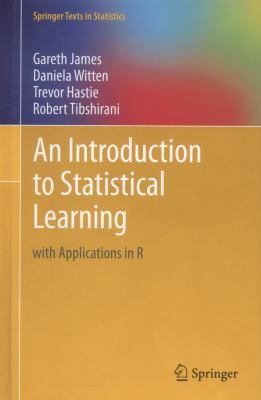
An Introduction To Statistical Learning With Applications In R
Introduction
Nova: Welcome back to Aibrary, the podcast where we crack open the books that shaped how we think about data, code, and the world. I'm Nova.
Nova: : And I'm Sol. Nova, I want to start with a question. What book has over 30,000 academic citations, millions of dollars in sales, and is used in university classrooms all over the world, yet has been available for free as a PDF since day one?
Nova: That's a great question, and the answer is a book that started with a professor trying to convince MBA students to take an 8 a. m. statistics elective. Today, we're diving into An Introduction to Statistical Learning with Applications in R, or as everyone calls it, ISLR, by Gareth James, Daniela Witten, Trevor Hastie, and Robert Tibshirani.
Nova: : Wait, an 8 a. m. statistics class for MBA students? That sounds like a recipe for an empty room.
Nova: That's what Gareth James's colleagues told him in 2006. They said he was crazy. They even scheduled it at 8 a. m. to make sure nobody would come. But James had a secret weapon. He gave the course a provocative name: Advanced Modern Statistical Methods. Fifty MBA students signed up. Several of them later told him they got internships and jobs partly because their employers were stunned that in 2006, an MBA even knew terms like boosting or random forests.
Nova: : That's an incredible origin story. And the book came directly out of that class?
Nova: Exactly. James turned his course notes into what would become one of the most beloved textbooks in all of data science. The first edition dropped in 2013, the expanded second edition came out in 2021, and in 2023, we even got a Python version. But here's the most remarkable thing: despite being a commercial success, the authors have always made the PDF freely available on their website.
Nova: : That's the kind of academic generosity that builds a generation of practitioners. So today we're going to explore what makes ISLR so special, why it's the book everyone recommends, and how it's changed the landscape of statistical education. Let's get into it.
The Core Philosophy Behind ISLR
What Exactly Is Statistical Learning
Nova: Before we go deeper into the book itself, let's define what ISLR means by statistical learning. The book describes it as a vast set of tools for understanding data. It's the intersection of statistics and what we now call machine learning. And here's the key philosophical move the authors make: they don't get bogged down in the statistics versus machine learning debate.
Nova: : That debate can get pretty tribal, right? Some people insist they're totally different fields.
Nova: Absolutely. And ISLR essentially shrugs and says, look, these are tools for making sense of complex datasets. Whether you call it statistics or machine learning doesn't matter when you're trying to predict customer behavior or classify images. The book covers linear regression, classification, resampling methods, tree-based methods, support vector machines, and clustering, all under the same umbrella of statistical learning.
Nova: : So it's deliberately broad and inclusive in how it frames the discipline?
Nova: Exactly. And the authors are remarkably clear about the book's central organizing question. For every method, they ask two things. First, how well does this predict? That's the prediction side. Second, can we understand the relationship between the inputs and the outputs? That's the inference side. Some methods are great at prediction but terrible at interpretation, like neural networks. Others, like linear regression, give you beautiful interpretability but may not capture complex patterns.
Nova: : That's such a useful framing. Instead of just throwing algorithms at you, ISLR teaches you to think about what you actually want from your analysis.
Nova: And here's a fascinating detail from the book that really stuck with me. They introduce the concept of irreducible error right at the beginning. No matter how good your model is, there's always some variability in the data that you simply cannot predict. Maybe it's unmeasured variables or inherent randomness. The book is honest about the limits of what statistical learning can do.
Nova: : That's humbling. A textbook that starts by telling you what it can't do. I like that.
Nova: It sets the tone for the entire book. This isn't a book that promises magic. It's a book that promises understanding.
Why ISLR Became the Go-To First Book
The Gentle On-Ramp to Machine Learning
Nova: So why has ISLR become the book that everyone recommends? The answer lies in a very deliberate design decision the authors made. The book assumes almost no mathematical background beyond an introductory statistics course. There's no matrix algebra. No vector notation. No calculus beyond the basics.
Nova: : Wait, seriously? No matrix algebra? How do you even teach regression without matrices?
Nova: You'd be surprised. They manage it by focusing on intuition and visualization. Every concept is accompanied by a plot, a graph, or a color-coded figure. The book is famous for its visual explanations. When they introduce the bias-variance tradeoff, for example, they don't just give you an equation. They show you plots with different model complexities and let you see the sweet spot where test error is minimized.
Nova: : That sounds like a completely different approach from most statistics textbooks, which tend to be equation-heavy from page one.
Nova: Exactly. And this is where the relationship with a more famous book comes in. Some of the same authors, Hastie and Tibshirani, also wrote The Elements of Statistical Learning, or ESL, with Jerome Friedman. ESL is the graduate-level, mathematically rigorous version. It's for PhD students and researchers. ISLR is the accessible companion. Same intellectual DNA, completely different entry point.
Nova: : So ISLR is almost like a translation of ESL into plain English?
Nova: That's a great way to put it. Larry Wasserman, a renowned statistician at Carnegie Mellon, called ISLR the how-to manual for statistical learning, while ESL is more of a reference work. And Dan Kopf, a data journalist at Quartz, once wrote that when people ask him the best way to learn statistics, he always gives the same answer: read ISLR first. If you finish that and want more, then read ESL.
Nova: : That's a powerful endorsement. But here's what I'm wondering. If the book is so accessible, does it sacrifice depth?
Nova: That's the brilliant balance. It doesn't sacrifice depth. It sacrifices formalism. You still learn why Lasso regression shrinks coefficients to exactly zero while Ridge regression doesn't. You still understand the mechanics of a random forest. You just learn it through intuition, examples, and carefully chosen visuals rather than dense mathematical proofs.
Nova: : And then at the end of every chapter, there's an R lab, right?
Nova: Yes! This is the other secret weapon. Each chapter includes a fully worked R tutorial where you implement everything you just learned. They walk you through every line of code. They explain what each function does. You're not just reading about statistical learning. You're doing it.
From Linear Regression to Deep Learning
Inside the Chapters
Nova: Let's walk through the actual structure of the book, because the way it builds knowledge is really elegant. The first edition from 2013 had ten chapters. It started with a gentle introduction to statistical learning concepts, notation, and the bias-variance tradeoff. Then it moved into linear regression, which most readers already have some exposure to.
Nova: : That makes sense. Start with familiar territory and then gradually expand outward.
Nova: Right. From linear regression, they move into classification, covering logistic regression, linear discriminant analysis, and K-nearest neighbors. Then resampling methods: cross-validation and the bootstrap. These are absolutely essential tools that every practitioner needs. Then they introduce linear model selection and regularization, things like subset selection, Ridge regression, and the Lasso.
Nova: : I've heard the Lasso described with almost religious reverence among statisticians. Does ISLR do it justice?
Nova: It does. The Lasso chapter is one of the book's highlights. They explain why it performs variable selection automatically by shrinking some coefficients to exactly zero. It's a wonderfully elegant tool and they make the intuition crystal clear.
Nova: : And then they go beyond linearity, right?
Nova: Yes, chapter seven covers moving beyond linearity with polynomial regression, step functions, regression splines, and generalized additive models. Then tree-based methods: bagging, random forests, and boosting. This is where the book really starts tackling the methods that dominate modern machine learning competitions. Then support vector machines, one of the most powerful classification techniques. And finally, unsupervised learning: principal components analysis, K-means clustering, and hierarchical clustering.
Nova: : That's already a comprehensive tour. But you mentioned the second edition added more.
Nova: The 2021 second edition is substantially expanded. It adds three entirely new chapters. Chapter 10 covers deep learning, which is a bold move for a statistics-focused book. Chapter 11 introduces survival analysis, which is crucial for medical research and time-to-event data. And there's a new chapter on multiple testing, which addresses the problem of false discoveries when you run lots of statistical tests simultaneously. They also expanded existing material on naive Bayes, generalized linear models, Bayesian additive regression trees, and matrix completion.
Nova: : Deep learning in an introductory statistics book? That seems like a big jump.
Nova: It might seem that way, but they approach deep learning the same way they approach everything else. They focus on intuition, they use simple examples, and they connect it back to the statistical principles they've been building throughout the book. They don't try to cover every neural network architecture. They teach you what a neural network fundamentally is and why it works.
Nova: : That consistency of approach across such diverse topics is impressive.
How ISLR Changed Data Science Education
The Real-World Impact
Nova: One of my favorite aspects of ISLR is the datasets. The book grounds every method in real data. They use the Wage dataset to explore labor market trends. They use the Default dataset to predict credit card defaults. They use the Smarket dataset with stock market returns. These aren't toy examples. They're datasets that feel tangible and relevant.
Nova: : That's so important for learning. You need to see how these methods answer actual questions.
Nova: And the impact has been extraordinary. The book has been translated into Chinese, Italian, Japanese, Korean, Mongolian, Russian, and Vietnamese. Stanford offers an official course based on the book on edX, and the authors recorded a 15-hour YouTube playlist of video lectures. There are entire Reddit communities dedicated to working through the book together, chapter by chapter.
Nova: : I've seen that. There's even a book club on the R for Data Science community that goes through ISLR systematically. It's almost like a shared rite of passage for people entering the field.
Nova: Exactly. And the book's influence extends into industry. One reviewer on Towards Data Science wrote about how she used ISLR to prepare for data science job interviews. She said she wanted to start doing Kaggle competitions but felt intimidated by all the available techniques. ISLR gave her the structured foundation she needed. She finished the book in about ten weeks, spending roughly five to six hours per week, and emerged feeling confident enough to compete.
Nova: : Ten weeks, five to six hours a week. That's a very manageable commitment.
Nova: And here's something fascinating. Even though the original book uses R, it's become incredibly popular among Python users too. Many readers take on the challenge of porting the R labs to Python on their own. They have to dig into scikit-learn documentation, figure out the equivalent functions, and truly understand what the code is doing rather than just copying it.
Nova: : That's almost a better learning experience, honestly. The friction forces deeper understanding.
Nova: And in 2023, the authors responded to the Python demand directly. They published An Introduction to Statistical Learning with Applications in Python, or ISLP, co-authored with Jonathan Taylor. So now the same gentle on-ramp exists in both languages.
Nova: : That seems like it seals the book's legacy. It's now accessible to essentially the entire data science community regardless of language preference.
What ISLR Doesn't Do
Critiques and Limitations
Nova: Now, no book is perfect, and it's worth discussing where ISLR has its limitations. Because the book avoids matrix algebra and vector notation, some readers find they hit a ceiling. If you want to truly understand the mathematical foundations, you will eventually need to graduate to The Elements of Statistical Learning.
Nova: : So ISLR is a starting point, not a destination?
Nova: Precisely. And the authors are completely upfront about this. They designed ISLR as a gateway. It's the book that gets you comfortable enough with the concepts that you can then tackle the harder material. Some readers on forums like Stack Exchange and Reddit have noted that they felt they needed additional mathematical background before some chapters really clicked.
Nova: : I've also heard some people say the R code in the first edition has aged a bit. The tidyverse has become the dominant paradigm in R, but ISLR uses base R syntax.
Nova: That's a fair observation. The second edition updated the R code for compatibility, but the book still primarily uses base R rather than the tidyverse. Some readers find that jarring if they learned R through the tidyverse approach first. On the other hand, some argue that base R gives you a better understanding of what's happening under the hood.
Nova: : What about the balance between theory and application? Does it lean too far in either direction?
Nova: I think the consensus is that the balance is very good for beginners, but practitioners who want a pure recipe book might find the theoretical sections frustrating. ISLR genuinely wants you to understand why a method works, not just how to call a function. If you're looking for a cookbook that just says import sklearn and call fit, ISLR is going to feel too slow and careful.
Nova: : But that's also exactly why people love it, right?
Nova: Yes. It respects the reader's intelligence. It assumes you want to understand. That's a rare quality in technical books.
Conclusion
Nova: So what have we learned about An Introduction to Statistical Learning? First, it's a book born from a professor's unlikely bet that business students would show up at 8 a. m. to learn about random forests, and that bet paid off spectacularly. Second, its genius lies in accessibility without condescension. It respects that you're intelligent but doesn't assume you have a PhD in mathematics. Third, it's a book that teaches you to think, not just to code.
Nova: : I love that framing. And the free PDF decision is genuinely inspiring. The authors could have kept it behind a paywall. Instead, they made sure anyone with an internet connection could learn statistical learning from world-class teachers.
Nova: Over 30,000 citations and millions in sales later, the strategy clearly didn't hurt them. It built an audience of grateful readers who then bought the physical book, took the Stanford course, and recommended it to everyone they knew.
Nova: : If you're listening and wondering whether ISLR is right for you, here's my takeaway. If you want to understand the core ideas behind machine learning and statistical modeling, if you want a book that explains the bias-variance tradeoff with a plot you'll never forget, if you want to know when to use Lasso versus Ridge or why random forests work, this is your book. It's the on-ramp the data science community has agreed upon.
Nova: And when you finish it, if you find yourself hungry for the deeper mathematics, The Elements of Statistical Learning will be waiting for you. But start here. Start with the 8 a. m. MBA class that changed everything.
Nova: : Beautifully put. This is Aibrary. Congratulations on your growth.
Nova: We'll see you next time.