

Sedated by Spectacle
Introduction
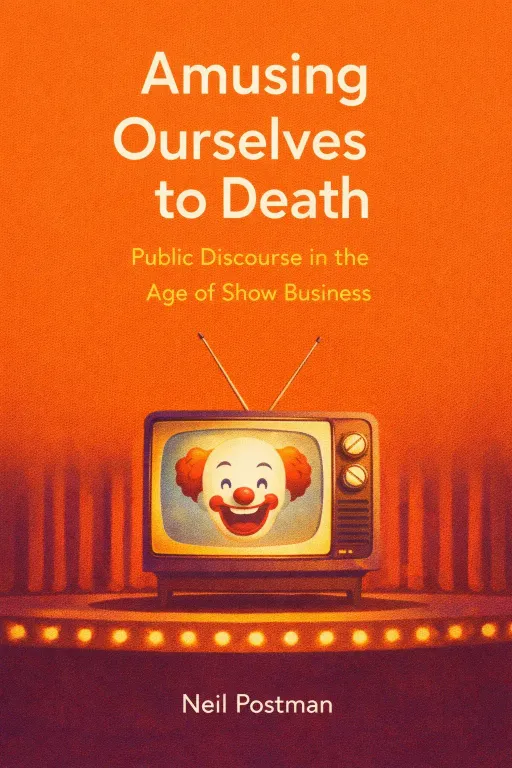
Narrator: What if the greatest threat to freedom isn't a boot stamping on a human face, but a society so captivated by amusement that it no longer cares about freedom at all? What if we are not being oppressed by what we hate, but are willingly sedated by what we love? This is the chilling proposition at the heart of Neil Postman's prophetic 1985 book, Amusing Ourselves to Death: Public Discourse in the Age of Show Business. Postman argues that while society was bracing for the tyranny George Orwell predicted in 1984, it failed to notice the more subtle, pleasure-based dystopia described by Aldous Huxley in Brave New World taking root. He contends that a single technology, television, was fundamentally rewiring our culture, transforming every serious aspect of public life—from politics to religion to education—into a trivial form of entertainment.
The Medium is the Metaphor
Key Insight 1
Narrator: Postman’s central argument begins with a powerful idea: the form of our communication dictates the content of our culture. A medium is not just a neutral pipe for information; it is a metaphor that quietly shapes how we think and what we can think about. Different media, he explains, have different biases. For example, an ancient culture that relies on smoke signals for long-distance communication could never develop complex philosophy. The medium itself, with its limited capacity for nuance, excludes that kind of content. You simply cannot use smoke to debate the nature of existence.
In the same way, a society built around the printed word will develop a "typographic mind," one that values logic, sequence, and complex argumentation. But a society built around the visual, fast-paced medium of television will value something else entirely. Postman argues that as America shifted from a print-based culture to a television-based one, it wasn't just changing its tools; it was changing its mind. He proposes that the defining metaphor for modern America is the city of Las Vegas—a place entirely devoted to the idea of entertainment. Just as in Vegas, all of our public discourse, from news to religion, is increasingly being recast as a form of show business, and we are, as Postman warns, on the verge of amusing ourselves to death.
The Typographic Mind: A Lost World of Reason
Key Insight 2
Narrator: To understand what has been lost, Postman first paints a vivid picture of what he calls "Typographic America." From its colonial beginnings through the nineteenth century, America was a culture uniquely dominated by the printed word. Literacy rates were exceptionally high, and public discourse was characterized by a seriousness and complexity that seems almost alien today.
The most striking example of this is the famous Lincoln-Douglas debates of 1858. These were not soundbite-driven spectacles. In one debate, Stephen Douglas spoke for three hours, after which Abraham Lincoln took the stage to deliver his own three-hour response. The audience, composed of everyday citizens, stood for hours, listening intently to intricate, legalistic, and grammatically complex arguments. They had the capacity for sustained attention and a familiarity with reasoned discourse because their minds had been shaped by a print-based culture. Even their religion was rooted in rational theology, with preachers like Jonathan Edwards delivering dense, logically structured sermons that demanded intellectual engagement. This "Empire of Reason," Postman argues, was a direct product of a world where the printed word was the primary mode of public conversation.
The Peek-a-Boo World: The Birth of Irrelevance
Key Insight 3
Narrator: The typographic mind did not vanish overnight. Postman identifies two nineteenth-century technologies that began its decline: the telegraph and the photograph. Together, they created what he calls the "Peek-a-Boo World," where information appears and disappears in a flash, devoid of context or meaning.
The telegraph was the first technology to separate communication from transportation. Suddenly, information could travel faster than a human being. This created a new kind of news—news from nowhere, addressed to no one in particular. As Henry David Thoreau presciently warned, the first news to travel from Maine to Texas might simply be that "Princess Adelaide has the whooping cough." The telegraph flooded the world with information that was novel and interesting, but largely irrelevant to people's lives. It created an "information glut" that altered the information-action ratio; people knew about many things but could do nothing about them, leading to a sense of impotence.
Photography complemented this by providing a concrete image for this decontextualized information. However, a photograph shows a moment in time, a particularity, but it cannot present an idea, a concept, or an argument. It offers a world of facts without context, meaning, or narrative. This combination of irrelevant information from the telegraph and context-free images from photography set the stage for television, which would perfect this new, fragmented way of knowing.
The Age of Show Business: When Everything Becomes Entertainment
Key Insight 4
Narrator: Television, Postman argues, took the biases of the telegraph and photograph and raised them to a "dangerous perfection." It did not just continue the attack on literate culture; it made entertainment the "supra-ideology" of all discourse. On television, the overarching assumption is that everything—no matter how serious—is there for our amusement.
Postman illustrates this with a powerful case study: a serious ABC News discussion that followed the broadcast of the nuclear holocaust film The Day After. The panel included intellectual heavyweights like Henry Kissinger, Carl Sagan, and Elie Wiesel. The network took pains to signal seriousness—there were no commercials and no theme music. Yet, the format itself betrayed the content. Each panelist was given only about five minutes to speak, with no real debate or follow-up. They were not there to argue, but to perform. They were giving an impression of themselves, not a reasoned analysis. Thinking, Postman notes, does not "play well on television" because it is not visually interesting. The medium's demand for dynamic images and a brisk pace forces even the most serious topics to be packaged as a performance. This logic extends everywhere, turning politics, religion, law, and education into branches of show business.
"Now... This": The Logic of Disinformation
Key Insight 5
Narrator: The signature phrase of television news, "Now... this," perfectly encapsulates the medium's epistemology. It is a phrase that announces that what you have just seen has no connection to what you are about to see. A report on a tragic famine can be immediately followed by a perky commercial for a fast-food chain, and then a story about a celebrity divorce. The newscaster maintains the same cheerful, authoritative demeanor throughout, creating a world where everything is presented with the same level of triviality.
This constant stream of fragmented, context-free information does not lead to ignorance, but to something more dangerous: disinformation. Postman defines disinformation not as false information, but as misleading information—information that is misplaced, irrelevant, or superficial. It creates the illusion of knowing something, while in fact leading one away from genuine understanding. In this environment, contradictions cease to matter. The public becomes so accustomed to incoherence that it loses the ability to be shocked by it. The ultimate test of truth is no longer the reality of the facts, but the credibility and likability of the person delivering them.
The Huxleyan Warning: Loving Our Own Oppression
Key Insight 6
Narrator: Postman concludes by returning to his central warning. The danger facing America is not an Orwellian state that bans books and controls information through force. Instead, it is a Huxleyan world where no one wants to read books because they are too busy being entertained. Freedom of information is not threatened by censorship, but by a tidal wave of triviality that drowns truth in a "sea of irrelevance."
In this world, the public is pacified by pleasure and distraction. We are not controlled by what we fear, but by what we love. The problem is not what we are watching on television, but that we are watching. The constant exposure to an entertainment-driven epistemology reshapes our expectations for all of life, until we can no longer distinguish between the serious and the trivial. Postman’s desperate hope for a solution lies in education—not in using more technology in the classroom, but in teaching students about the history and philosophy of media. Only by making the medium itself an object of study can we become aware of its influence and begin to regain control over our own minds.
Conclusion
Narrator: The single most important takeaway from Amusing Ourselves to Death is that the form of our public conversation determines the health of our culture. A society whose discourse is shaped by the rational, linear, and complex demands of the printed word will be a thoughtful one. A society whose discourse is shaped by the visual, emotional, and fragmented demands of television will inevitably become a trivial one.
Decades after its publication, Postman's critique feels more urgent than ever. He was writing about a world of three television networks, long before the advent of the internet, smartphones, and social media platforms that have fragmented our attention even further. The question he leaves us with is a profound one: in a world saturated with endless, amusing distractions, have we become so entertained that we no longer know what we are laughing about, or why we have stopped thinking?