

The Fun Dystopia
Golden Hook & Introduction
SECTION
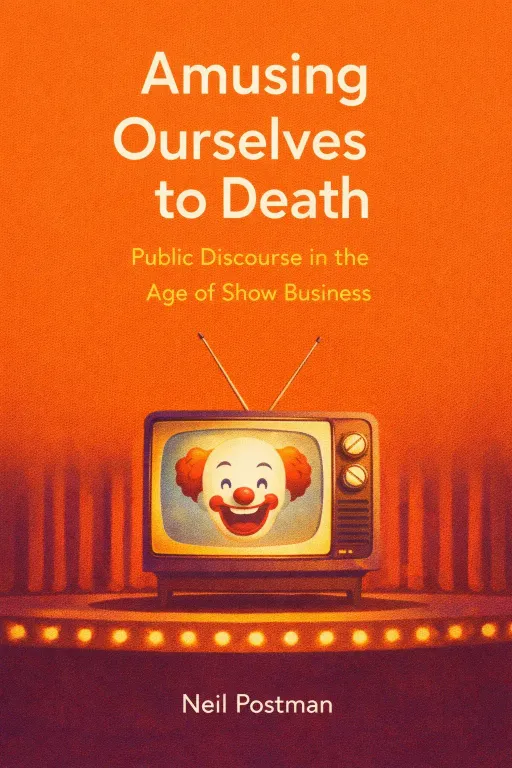
Olivia: Everyone worries about an Orwellian future—Big Brother, censorship, banned books. But what if the real threat isn't what we're forced to endure, but what we willingly, happily, choose to consume? What if what we love is what will ruin us? Jackson: Whoa, that's a dark start to the day. But it definitely gets you thinking. It’s like choosing the candy over the medicine every single time, until you realize the candy was the poison all along. Olivia: That’s the chilling question at the heart of Neil Postman's Amusing Ourselves to Death. He frames it as a choice between two dystopian visions. George Orwell, in 1984, feared a world controlled by inflicting pain and suppressing information. Aldous Huxley, in Brave New World, feared a world controlled by inflicting pleasure, where people are so overwhelmed by trivial distractions that they lose all appetite for truth. Jackson: And Postman’s big bet was on Huxley. What’s wild is that this book was written way back in 1985. That’s before the internet as we know it, before smartphones, before social media. Yet it’s become this foundational text in media criticism, widely seen as prophetic for our current digital age. He was basically calling out the future before it even happened. Olivia: He absolutely was. And his central argument is that to understand this Huxleyan slide, we can't just look at the content of our media. We have to look at the technology itself.
The Medium is the Metaphor
SECTION
Jackson: Okay, so this is where it gets a little academic, right? He dives into some pretty deep concepts. I remember seeing the phrase "The Medium is the Metaphor." What does that actually mean in plain English? Olivia: It’s a brilliant and simple idea, actually. Postman argues that every medium of communication—whether it's smoke signals, the printed word, or a television screen—isn't just a neutral pipe for information. The form of the medium shapes what kind of ideas can even be expressed. It creates a metaphor for how we see the world. Jackson: I think I need an example. How does a medium do that? Olivia: Postman gives a great one. Try to do philosophy using smoke signals. You can’t. The medium is too simple. You can signal "danger" or "all clear," but you can't express a complex thought like "to be or not to be." The form of smoke signals excludes philosophical content. Jackson: Right, you'd run out of blankets and wood before you got through your first axiom. Olivia: Exactly! And Postman argues that every medium has these built-in biases. This affects our epistemology. Jackson: Okay, 'epistemology'—that's a heavy word. Break that down for us. What does he mean our 'way of knowing' changes? Olivia: It’s about what a culture accepts as 'truth.' What feels real and authoritative. To make this concrete, let's travel back to what Postman calls "Typographic America"—the 18th and 19th centuries. This was a world dominated by the printed word. Jackson: The good old days of... pamphlets? Olivia: Pamphlets, books, newspapers! And it created a very specific kind of mind. He uses the Lincoln-Douglas debates of 1858 as his prime example. These weren't 90-second soundbites. The format was: one person speaks for an hour, the other gets an hour and a half to respond, and the first gets a final half-hour rebuttal. Three hours of debate. Jackson: Wait, wait. Three hours? And who was watching this? Just a handful of political nerds? Olivia: No, that's the incredible part! Thousands of regular people—farmers, merchants, laborers—would stand for hours in the hot sun, listening intently. Contemporary reports say you could hear a pin drop. They were following complex, grammatically dense arguments about policy and law, with no applause lines, no "gotcha" moments. Jackson: That is absolutely mind-blowing. I get restless during the trailers at the movie theater. I can barely get through a 15-second TikTok without my thumb getting twitchy. How is that even possible? Were they just built differently? Olivia: Their minds were! They lived in a print culture. From childhood, they were trained to consume information linearly, to follow a sustained, logical line of thought from beginning to end. Reading a book requires that kind of focus. So for them, a long, complex, spoken argument felt natural. It was their 'normal'. That was their epistemology—truth was found through rational, sequential, and verifiable propositions.
The Peek-a-Boo World & The Age of Show Business
SECTION
Jackson: Okay, so they were basically intellectual marathon runners. What happened? How did we go from that to... well, us? Olivia: Postman says that 'normal' was completely shattered by two inventions in the mid-19th century: the telegraph and the photograph. The telegraph was the first technology to separate communication from transportation. Suddenly, information could travel faster than a person. Jackson: The original instant message. Olivia: Right. And it created a firehose of information from all over the country, and eventually the world. But this information was, for the most part, completely irrelevant to the person receiving it. A crop failure in another state, a political squabble in a distant city... you couldn't do anything about it. It was just... news. Jackson: So this is the origin story of the newsfeed! Irrelevant facts from all over the world, popping up and disappearing. It reminds me of that great line from Thoreau he quotes, worrying that the first news from the transatlantic cable would be that "Princess Adelaide has the whooping cough." Olivia: Precisely. It created what Postman calls the "Peek-a-Boo World." Information appears, then vanishes, with no context or consequence. And photography made it worse. It gave a face to this decontextualized information, creating the illusion of knowing something. You see a picture of a battle, and you feel like you understand it, but an image can't explain causes, history, or consequences. It's just a frozen moment. Jackson: It’s a world of fragments. And I guess television is the final boss of that world. Olivia: Television perfected it. It took that fragmented, peek-a-boo world and made it irresistibly entertaining. This, for Postman, is the "Age of Show Business." And the perfect symbol for it is the phrase used by newscasters: "Now... this." Jackson: Oh, I know that phrase. It’s the pivot. Olivia: It's the ultimate tool of incoherence. It signals that what you just saw—a devastating earthquake, a political crisis, a stock market crash—has absolutely no connection to what you're about to see, which might be a commercial for toothpaste, a celebrity interview, or a story about a waterskiing squirrel. Jackson: And the music! The news theme song that sounds like an action movie overture. It frames the whole thing as a performance. Postman calls this 'disinformation'. It’s not that the information is false; it's that it's so fragmented, out of context, and presented as entertainment that it becomes misleading. It creates the illusion of being informed while actually making you less capable of understanding anything deeply. Olivia: Exactly. The goal is not to inform, but to keep you watching. The supreme ideology of television is not truth, it's entertainment.
The Consequences for Politics & News
SECTION
Jackson: And once entertainment is the main goal, everything else has to bend to its rules. That must have huge consequences for serious stuff, like politics. Olivia: Massive. Postman argues that politics has transformed from what he calls a 'spectator sport'—which at least had clear rules and a focus on performance—into pure show business. He points to the 1984 presidential debates. The most memorable moment, the one that was declared a 'knockout punch,' wasn't a policy argument. It was Ronald Reagan's witty one-liner about his age. Jackson: "I will not make age an issue of this campaign. I am not going to exploit, for political purposes, my opponent's youth and inexperience." That’s the one. It was a great line! Olivia: It was a fantastic line! But it had nothing to do with his fitness for office. The debate was judged on performance, on zingers. Postman says the television commercial has become the dominant metaphor for all political discourse. Jackson: That makes so much sense. A commercial isn't about giving you a list of verifiable facts. It's about creating a feeling, an image. It’s not about the product, it’s about making you, the consumer, feel a certain way. Olivia: And that's exactly what image politics does. It's not about the candidate's policies; it's about making the voter feel good, feel seen, feel validated by the candidate's image. This is why Postman says politicians have become celebrities. They appear on entertainment shows, they tell jokes, they focus on their looks. Their job is to be likable performers. Jackson: And the news itself becomes a performance. You mention the newscasters—they have to be attractive, they have to have this air of calm authority, no matter what horrors they're describing. Their hair and their reassuring tone are more important than the script. Olivia: Postman argues that on television, the credibility of the teller replaces the truth of the tale. We believe the news not because the facts are verifiable, but because the anchor seems so trustworthy and looks so good. The whole enterprise is a carefully constructed performance designed for our amusement. Jackson: It's why we can watch a report on a famine, then a commercial for a cruise, and feel nothing. The structure of the show tells us none of it is meant to be taken that seriously. It’s all just part of the flow.
Synthesis & Takeaways
SECTION
Olivia: So when you put it all together, Postman's warning from 1985 is terrifyingly accurate. We've moved from a culture based on rational argument to a culture based on spectacle and entertainment. Jackson: And the scariest part is that we don't even notice. He says the problem isn't what people watch, but that we watch. We've so completely accepted this new reality that incoherence seems normal, and the demand to be entertained at all times feels natural. Olivia: Right. And he’s not optimistic about easy fixes. He dismisses the idea of just turning off the TV as naive. The medium's influence is too pervasive. He says the only real, though desperate, solution lies in education. But not the kind of education that just uses more technology. Jackson: What kind, then? Olivia: The kind that teaches 'media demystification.' Teaching students to see the hidden ideology in every technology. To ask not "What can I do with this computer?" but "What is this computer doing to me?" To understand how the form of their information is shaping their minds. Jackson: That’s a huge task, especially when schools themselves are being pressured to be more entertaining to compete with screens. So the question he leaves us with is a tough one. He quotes Huxley at the very end, and it’s a chilling thought. Olivia: What's the quote? Jackson: He says what afflicted the people in Brave New World was not that they were laughing instead of thinking, but that they did not know what they were laughing about and why they had stopped thinking. It makes you wonder... what are we laughing about today? Olivia: A question worth sitting with. And it's one that feels even more urgent in the age of the internet and social media. We'd love to hear your thoughts on this. Does Postman's critique of television hold up in the world of Twitter, TikTok, and YouTube? Find us on our socials and let's discuss. Jackson: This is Aibrary, signing off.