

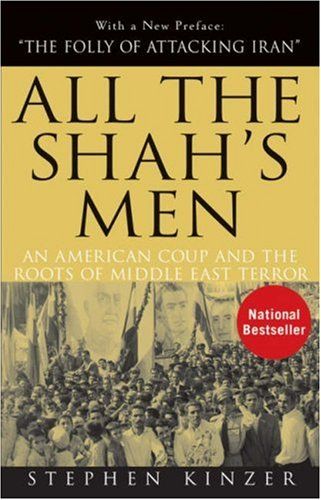
All the Shah's Men
An American Coup and the Roots of Middle East Terror
Introduction
Nova: Imagine for a second that you are a CIA agent in 1953. You have one million dollars in a safe, a suitcase full of propaganda, and a mission to topple a democratically elected government in the Middle East. It sounds like the plot of a spy thriller, right? But as Stephen Kinzer shows in his book All the Shahs Men, this actually happened. And the ripples from that one week in Tehran are still hitting our shores today.
Atlas: It is wild how many people have never heard of Operation Ajax. We talk about the 1979 Revolution and the hostage crisis all the time, but we rarely talk about the event that many historians say actually planted the seeds for all of it. Kinzer basically argues that if you want to understand why the Middle East looks the way it does today, you have to look at this specific coup.
Nova: Exactly. He calls it the roots of Middle East terror. It is a bold claim, but he backs it up with this incredible narrative that follows the rise and fall of Mohammad Mossadegh, the man who dared to challenge the British Empire over a single resource: oil.
Atlas: And Mossadegh is such a fascinating character. He is not your typical revolutionary. He was an aristocrat, a doctor of law, and he famously conducted business while wearing pajamas and lying in bed. He was eccentric, but he was also a hero to his people. Today, we are diving deep into Kinzer's masterpiece to see how a struggle over oil profits turned into a geopolitical disaster.
Key Insight 1
The Spark of Oil
Nova: To understand the coup, we have to talk about the Anglo-Iranian Oil Company, or AIOC. Back then, Britain basically treated Irans oil as its own. They had this massive refinery at Abadan, which was the largest in the world. Kinzer describes it as a colonial bubble. The British executives had manicured lawns, swimming pools, and private clubs, while the Iranian workers lived in these horrific slums without running water or electricity.
Atlas: It is that classic colonial contrast. The British were making a fortune, and the Iranians were getting pennies. I think Kinzer mentioned that in some years, the British government actually made more in taxes from the oil company than the Iranian government made in royalties from their own oil.
Nova: That is a staggering statistic. It is no wonder Mossadegh became a national hero when he pushed for nationalization. He wanted that wealth to belong to Iran. In 1951, the Iranian parliament voted unanimously to nationalize the oil industry, and Mossadegh was named Prime Minister. He was so popular that Time Magazine named him Man of the Year, even beating out Winston Churchill and Dwight Eisenhower.
Atlas: But the British were not just going to walk away from their most valuable asset. They saw this as a direct attack on the Empire. How did they react initially? Because they did not just call the CIA on day one, right?
Nova: No, at first they tried to crush Iran economically. They imposed a global boycott on Iranian oil. They even sent warships to the Persian Gulf. They tried to sue Iran in the International Court of Justice, but Mossadegh went there himself and won. He was a brilliant lawyer. He argued that no international body had the right to tell a sovereign nation what to do with its own resources.
Atlas: So Mossadegh is winning the legal battle, he is winning the PR battle, and the British are getting desperate. This is where the story shifts from a corporate dispute to a Cold War operation. How did the British convince the United States to get involved?
Nova: That is the pivot point of the whole book. At first, President Harry Truman was actually sympathetic to Mossadegh. He told the British they needed to compromise. But then, the 1952 election happened. Eisenhower took office, and he brought in the Dulles brothers. John Foster Dulles became Secretary of State, and Allen Dulles became the head of the CIA.
Atlas: And these guys were Cold War hawks. They saw everything through the lens of the struggle against the Soviet Union.
Nova: Precisely. The British realized they could not win by talking about oil profits anymore. So they changed the narrative. They told the Americans that Mossadegh was weak and that he was going to let the Tudeh Party, the Iranian communists, take over. They framed it as a choice: either we topple Mossadegh, or Iran falls behind the Iron Curtain.
Atlas: It is the classic Red Scare tactic. Even though Mossadegh was a devout nationalist and actually quite wary of the communists, the Dulles brothers bought the British argument hook, line, and sinker.
Key Insight 2
The Players and the Plot
Nova: Once the US was on board, the operation got a code name: Operation Ajax. And the man they sent to run it was Kermit Roosevelt, the grandson of Teddy Roosevelt. Kinzer portrays him as this real-life James Bond, but with a lot more cash and a lot less oversight.
Atlas: Kermit Roosevelt. I mean, the name alone sounds like something out of a novel. He sneaks into Iran under a fake name, hiding in the back of a car, right?
Nova: Yes, he crossed the border from Iraq and set up shop in a safe house in Tehran. He had a million dollars in cash to spend on bribes. His job was to create the appearance of a popular uprising against Mossadegh. He hired journalists to write hit pieces, he paid off religious leaders to denounce Mossadegh as an atheist, and he even hired gang leaders to provide muscle in the streets.
Atlas: Wait, he actually hired gangs? Like, professional rioters?
Nova: Exactly. Kinzer details how the CIA recruited these colorful characters, like a giant of a man known as Shaban the Brainless, who led a group of weightlifters and wrestlers. Their job was to start fights, smash windows, and make it look like the city was descending into chaos. The goal was to make people believe that Mossadegh had lost control and that only the Shah could save the country.
Atlas: And the Shah, Mohammad Reza Pahlavi, was he all in on this? Because Kinzer describes him as being pretty indecisive at first.
Nova: The Shah was terrified. He was young, he was insecure, and he did not want to move against Mossadegh unless he was 100 percent sure the US and Britain had his back. Roosevelt had to have these secret midnight meetings with the Shah in the back of a car just to convince him to sign the firmans, the royal decrees that would officially dismiss Mossadegh.
Atlas: So they have the money, they have the mobs, and they have the royal signature. It sounds like a foolproof plan. But the first attempt actually failed, didn't it?
Nova: It was a total disaster. On the night of August 15, the colonel sent to deliver the dismissal notice was arrested by Mossadeghs loyalist guards. The coup was exposed. The Shah panicked and fled the country in his private plane, first to Baghdad and then to Rome. The CIA headquarters in Washington actually sent Roosevelt a cable telling him to get out of the country immediately because the mission was over.
Atlas: But Kermit Roosevelt did not leave. This is the part of the book that feels like a movie. He basically ignores his bosses and decides to try again, solo.
Key Insight 3
The Turning Point
Nova: Roosevelt was a gambler. He realized that even though the first attempt failed, the city was still on edge. He spent the next few days doubling down. He flooded the streets with more money. He got the CIA-controlled newspapers to print the Shahs decree, making it look like Mossadegh was the one staging an illegal coup by staying in power.
Atlas: It is a brilliant bit of psychological warfare. You flip the script so the democratically elected leader looks like the usurper.
Nova: Exactly. And then came Wednesday, August 19, 1953. This is the climax of Kinzers book. Roosevelt unleashed everything. He had his rented mobs marching through the streets shouting Long Live the Shah. He had military units that had been bribed or swayed by the royal decree join the marchers. Meanwhile, Mossadegh, who was a man of the law, told his supporters to stay home to avoid bloodshed. He did not want a civil war.
Atlas: So the people who actually supported him were off the streets, while the paid protesters and the military were taking over. That is a recipe for a very lopsided fight.
Nova: It was. By the end of the day, the mobs had seized the radio station. They were broadcasting that Mossadegh had been toppled. They attacked Mossadeghs house with tanks. He actually had to climb over a garden wall to escape while his home was being looted and burned. About 300 people died in the fighting that day.
Atlas: And just like that, the democratically elected government is gone. The Shah flies back from Rome, and suddenly he is no longer a constitutional monarch. He is an autocrat.
Nova: That is the tragedy of it. Before the coup, the Shah was a figurehead. After the coup, he knew he owed his throne to the CIA. He spent the next 25 years building up one of the most feared secret police forces in the world, the SAVAK, to make sure nothing like Mossadegh ever happened again. He crushed the liberals, he crushed the nationalists, and he crushed the secular opposition.
Atlas: Which, as Kinzer points out, left only one place for opposition to grow: the mosques. Because the Shah could not easily shut down the religious institutions without causing a massive backlash.
Key Insight 4
The Butterfly Effect
Nova: This is where Kinzers thesis about the roots of terror comes in. By destroying the moderate, secular path to democracy that Mossadegh represented, the US and Britain inadvertently created a vacuum. And that vacuum was eventually filled by Ayatollah Khomeini and the Islamic Revolution of 1979.
Atlas: It is a classic case of blowback. The CIA thought they had won a great victory in 1953. They thought they had secured the oil and stopped communism. But they did not see the long-term cost. When the revolutionaries took over the US Embassy in 1979, they were not just angry about the Shah being in the US for medical treatment. They were terrified that the CIA was about to stage another 1953-style coup.
Nova: Kinzer makes that point very clearly. The hostage-takers actually cited the 1953 coup as their justification. They thought if they did not hold the embassy, the Americans would just hit the reset button again. So, the trauma of 1953 directly led to the 444-day hostage crisis, which poisoned US-Iran relations for decades.
Atlas: And it goes even further. That crisis helped lead to the rise of political Islam across the region. It emboldened movements that saw the US as the Great Satan. Kinzer even links it to the Soviet invasion of Afghanistan and the eventual rise of groups like Al-Qaeda. It is a massive chain reaction.
Nova: He also points out how it changed the CIA itself. Operation Ajax was seen as such a cheap, easy success that it became the blueprint for the rest of the Cold War. The CIA went on to try the same thing in Guatemala, in the Congo, in Vietnam, and in Chile. It gave American policymakers this dangerous illusion that you could just swap out world leaders like lightbulbs without any messy consequences.
Atlas: It is a sobering thought. We often look at history as a series of isolated events, but Kinzer shows us that it is more like a web. You pull one string in Tehran in 1953, and the whole thing starts to unravel in ways you could never predict.
Nova: One of the most moving parts of the book is the end, where Kinzer visits Mossadeghs grave. He is buried in his own home because the Shah would not allow a public funeral. Even decades later, Mossadegh is still a symbol of what might have been. A democratic, independent Iran that was a partner to the West rather than an adversary.
Conclusion
Nova: All the Shahs Men is more than just a history book. It is a cautionary tale about the dangers of short-term thinking in foreign policy. Stephen Kinzer reminds us that when we intervene in the affairs of other nations, we are not just changing their present; we are altering their future in ways that can come back to haunt us.
Atlas: It really makes you rethink the headlines we see today. When you understand the history of 1953, the rhetoric coming out of Iran starts to make a lot more sense. It does not excuse the actions of the current regime, but it provides the essential context that is so often missing from our public discourse.
Nova: If there is one takeaway from this book, it is that democracy is fragile and that sovereignty matters. Mossadegh was not a perfect man, but he was Irans man. And when that was taken away, the path to a peaceful, democratic Middle East became a lot steeper.
Atlas: It is a powerful read. Whether you are a history buff or just someone trying to make sense of the world, this book is essential. It shows that the past is never truly dead; it is not even past.
Nova: Thank you for joining us on this journey through one of the most pivotal moments of the 20th century. This is Aibrary. Congratulations on your growth!