

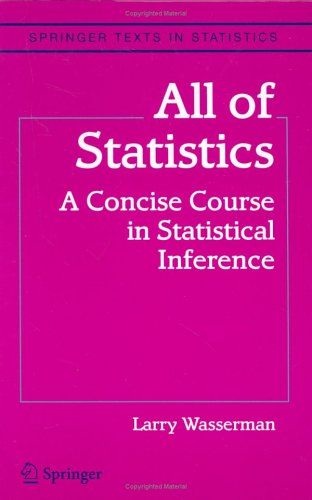
All of Statistics
A Concise Course in Statistical Inference
Introduction
Nova: Imagine you walk into a brain surgery operating room, scrubs on, scalpel in hand, and the head surgeon turns to you and says — alright, you're up. Only problem? You've never even put on a band-aid. That, according to Larry Wasserman, is exactly what it's like when people jump into neural networks and boosting and support vector machines without understanding basic statistics. Welcome to Aibrary, I'm Nova.
Nova: A little bit of both, honestly. We're diving into a book that has become something of a legend in the data science and machine learning world — "All of Statistics: A Concise Course in Statistical Inference" by Larry Wasserman. Published in 2004 by Springer, this book has been cited over 4,800 times and has become the go-to reference for computer scientists who suddenly realized they needed to know statistics.
Nova: Wasserman himself admits in the preface that the title is an exaggeration — but in spirit, he argues it's apt. This single volume covers everything from basic probability to modern topics like nonparametric curve estimation, bootstrapping, causal inference, and classification. Topics that are usually spread across three or four separate courses. It's 24 chapters across about 440 pages, which is astonishingly compact for the territory it covers.
Nova: That's the key. Wasserman is a professor in both the Department of Statistics and the Machine Learning Department at Carnegie Mellon University. He watched as computer science students were flocking to data mining and machine learning courses without any formal statistics background. The book was his response — a fast-track, mathematically rigorous introduction to probability and statistics specifically designed for CS undergraduates. He assumes you know calculus and linear algebra, but not much else.
Who Is Larry Wasserman?
The Man Behind the Mission
Nova: Before we dig into the book itself, let's talk about the author, because his credentials are seriously impressive. Larry Wasserman was born in Windsor, Ontario, earned his PhD in Biostatistics from the University of Toronto in 1988, and has been at Carnegie Mellon ever since. He's what they call a UPMC University Professor — the highest faculty distinction at CMU.
Nova: Absolutely. In 1999 he won the COPSS Presidents' Award, which is given to the outstanding statistician under age 40 — that's basically the field's version of being named a genius before you hit middle age. He's an elected fellow of the American Statistical Association, the Institute of Mathematical Statistics, and the American Association for the Advancement of Science. And just this year, in 2026, he received the COPSS Distinguished Achievement Award — making him the fourth person from CMU's Statistics and Data Science department to win it.
Nova: Exactly. His research spans nonparametric inference, asymptotic theory, causality, and applications to astrophysics, bioinformatics, and genetics. He also wrote a companion volume called "All of Nonparametric Statistics." The man has range. And what makes "All of Statistics" so distinctive is that it carries the voice of someone who's deeply embedded in cutting-edge research but also understands what a computer science student needs to know to be dangerous — in the productive sense of the word.
Nova: In the early 2000s, machine learning was exploding inside computer science departments, largely disconnected from classical statistics. Statisticians and computer scientists were essentially solving the same problems using different languages and different assumptions. Wasserman saw CS students wielding sophisticated tools without understanding the inferential framework underneath. His preface includes a "Statistics/Data Mining Dictionary" that maps terms between the two fields — things like "classification" in CS is "discriminant analysis" in statistics, "regression" maps to "regression" fortunately, but "unsupervised learning" is "density estimation" or "clustering."
Nova: That's exactly the right way to think about it. And the book itself is the extended translation.
The Structure of the Book
Three Pillars of Statistical Knowledge
Nova: The book is organized into three major parts. Part one is Probability — chapters on random variables, expectation, inequalities, and convergence. Part two is Statistical Inference — models, estimation, the bootstrap, parametric inference, hypothesis testing, p-values, Bayesian inference, and statistical decision theory. Part three is Statistical Models and Methods — regression, multivariate models, causal inference, graphical models, nonparametric curve estimation, classification, stochastic processes, and simulation methods.
Nova: That's the Wasserman style — and it's also the most debated aspect of the book. Each chapter is remarkably concise. He states the concept, gives the mathematical definition, shows the key theorems, and provides a worked example, often with R code. There's very little hand-holding. The book reads almost like an encyclopedia or a reference manual. Which is exactly what some people love about it and others find absolutely maddening.
Nova: Definitely not. Eric Cai, who writes The Data Copywriter newsletter and has recommended the book, put it bluntly: he does not encourage people to use "All of Statistics" as their first introduction to mathematical statistics. He says it's clear — but only for students who are already prepared to study at that level. If you haven't learned mathematical statistics from gentler introductory books first, Wasserman will be difficult to digest.
Nova: Jason Brownlee at Machine Learning Mastery suggests it's ideal for computer science students who are already in math-learning mode. For practitioners with some previous statistics background or a strong mathematical foundation, it's an excellent reference. You can flip to any topic and get a crisp, clean presentation. But if you're a self-taught developer who's never seen a probability density function before, this book will feel like drinking from a fire hose.
Modern Topics That Set This Book Apart
The Bootstrap and Beyond
Nova: One of the things that really distinguishes "All of Statistics" from traditional introductory statistics textbooks is how much modern material it includes. Most intro books stop at linear regression and maybe ANOVA. Wasserman gives you entire chapters on the bootstrap, nonparametric curve estimation, classification, causal inference, and graphical models.
Nova: The bootstrap is a resampling technique invented by Bradley Efron in 1979. The core idea is beautifully simple: you have a sample of data and you want to know how reliable your estimate is — say, the standard error of the median. Classical theory requires you to derive formulas that can be extremely complicated or impossible for many statistics. The bootstrap says: just take your original sample, resample from it with replacement thousands of times, compute your statistic each time, and look at the distribution of those results. It's computationally intensive but conceptually elegant, and it freed statisticians from having to derive asymptotic approximations for every new estimator.
Nova: Exactly. And Wasserman devotes a full chapter to it, which was forward-thinking for a 2004 textbook. He connects it to later chapters on classification and even to ensemble methods in machine learning like bagging and random forests. The bootstrap is also the foundation for understanding why those ensemble methods work.
Nova: Hugely ahead of its time. Causal inference has exploded in the last decade, driven by researchers like Judea Pearl and others. But Wasserman included a chapter on it back in 2004, covering counterfactuals, confounding, and the difference between association and causation. He also has two chapters on graphical models — directed and undirected graphs — which are the mathematical backbone of how we reason about conditional independence and causal relationships. Those chapters connect directly to Bayesian networks and modern probabilistic programming.
Nova: In many ways, yes. Wasserman saw that statistics was converging with computer science, and he wrote the book that would prepare students for that convergence. Twenty years later, with the rise of causal machine learning and probabilistic graphical models, his choices look prescient.
Why This Book Still Matters
The Band-Aid and the Brain Surgeon
Nova: Let's come back to that quote — it's probably the most famous line Wasserman ever wrote: "Using fancy tools like neural nets, boosting, and support vector machines without understanding basic statistics is like doing brain surgery before knowing how to use a band-aid."
Nova: That's the tension. And Wasserman would probably argue — and many practitioners agree — that you can get results without deep understanding, but you'll be limited. You won't know when your model is overfitting in a statistically meaningful way. You won't understand why your confidence intervals are misleading. You won't recognize when you're making a causal claim from observational data that the data can't actually support.
Nova: Right. And here's what's interesting: despite being nearly 22 years old, this book is still widely recommended and cited. It's used in graduate courses at top universities. It's referenced constantly on Reddit and StackExchange when people ask how to build a statistics foundation. The fact that it's still relevant speaks to how well Wasserman identified the enduring core of statistical thinking.
Nova: That's the classic tension between mathematical statistics and applied statistics. "All of Statistics" is unapologetically mathematical. It's theorem-proof-example. If you want intuition and storytelling, you go to something like "Statistics in Plain English" or "Naked Statistics." If you want mathematical rigor in a compact package, you go to Wasserman. Interestingly, many people on Reddit and in the statistics community recommend pairing Wasserman with Casella and Berger's "Statistical Inference" — Casella and Berger gives you deeper theoretical treatment, and Wasserman gives you broader coverage and modern topics.
Nova: Exactly. And the ideal path that many have recommended is: start with something gentle like Blitzstein's "Introduction to Probability," then tackle Casella and Berger for depth, then use Wasserman as a capstone that connects everything to modern machine learning and data science. It's a trilogy approach.
Conclusion
Nova: So what have we learned about "All of Statistics" by Larry Wasserman? First, it's a book born from a genuine need — bridging the gap between classical statistics and the exploding field of machine learning. Second, it's remarkably broad, covering 24 chapters from basic probability to advanced topics like causal inference and graphical models, all in about 440 pages. Third, it's not for beginners — it assumes mathematical maturity and works best as a reference or a capstone text, not a first introduction.
Nova: Beautifully put. If you're a machine learning practitioner who's been getting by on intuition and Stack Overflow, "All of Statistics" might be exactly the challenge you need. Just be prepared for a workout — this book demands that you engage with it mathematically. But the reward is a deeper, more unified understanding of the field.
Nova: This is Aibrary. Congratulations on your growth!