Algorithmic Wisdom for Human Decisions
Golden Hook & Introduction
SECTION
Nova: Atlas, give me your brutal five-word review of your daily decision-making process.
Atlas: Exhausting, endless, and completely broken.
Nova: That is exactly why we are here today. We are going to completely rebuild that engine.
Atlas: Oh, thank goodness, because honestly, by the time I have to choose what to make for dinner, my brain feels like a computer running thirty open tabs in a windstorm.
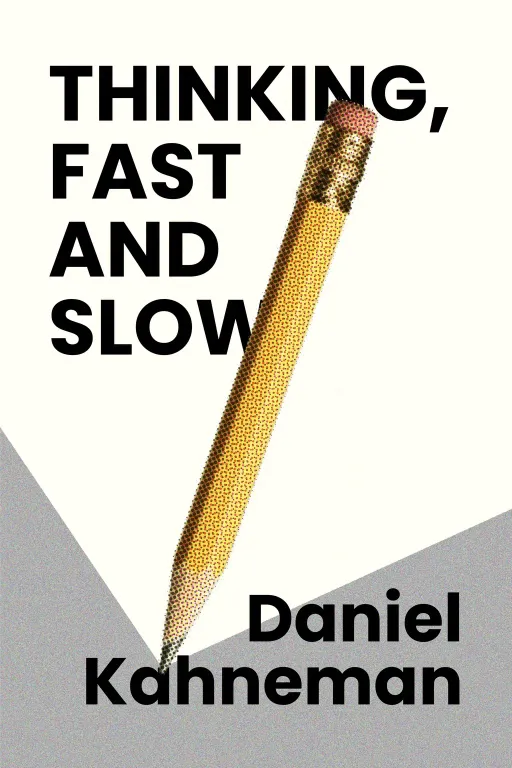
Nova: You are experiencing decision fatigue, and it is a very real, very physical limitation of the human mind. Today we are diving into two phenomenal books that offer a brilliant escape hatch from this cognitive overwhelm. We are looking at Thinking, Fast and Slow by Daniel Kahneman, the legendary psychologist who actually won a Nobel Prize in Economics for proving that humans are not the rational calculators we think we are. And we are pairing his insights with Algorithms to Live By, a brilliant collaboration between science writer Brian Christian and cognitive scientist Tom Griffiths.
Atlas: Oh, I love that pairing. It is like taking a deep diagnostic scan of why our brains stall, and then handing us a sleek, computer-science-approved blueprint to fix it.
Nova: Precisely. Kahneman gives us the anatomy of our mental exhaustion, and Christian and Griffiths give us the mathematical algorithms to bypass it entirely. We are going to explore how to stop overthinking, how to automate the trivial stuff, and how to use a specific mathematical rule to make major life choices with absolute confidence.
The Cognitive Engine and the Tax of Choice
SECTION
Nova: To understand why we get so paralyzed by choices, we have to look at the machinery inside our heads. Kahneman famously showed that our brains operate on two distinct systems. System one is our fast, intuitive, automatic pilot. It is what allows you to read a billboard without trying, or duck when a baseball flies at your head. It requires almost zero energy.
Atlas: Right, it is like the background processing on your phone. It just runs. But what about when we actually have to do some heavy lifting?
Nova: That is where System two steps in. System two is our slow, analytical, logical processor. It is what you use when you are calculating a tax return, or trying to park a car in a tight parallel space, or making a major career move. It is incredibly precise, but here is the catch, it is incredibly expensive to run. It drains our physical glucose levels and exhausts our mental energy rapidly.
Atlas: Wow, so System two is basically a gas-guzzler. And I imagine we only have a tiny fuel tank of that high-grade analytical energy every day.
Nova: Exactly. Every single time you force yourself to make a choice, even a tiny one like choosing between two brands of toothpaste or drafting the perfect opening sentence of an email, you are tapping into that limited System two reservoir. By the time afternoon rolls around, your cognitive fuel tank is running on empty. Kahneman and his colleagues documented a terrifying real-world example of this involving parole judges.
Atlas: Oh, I have heard whispers about this study. It is about how the timing of a judge's lunch break can literally decide someone's freedom, right?
Nova: Yes, it is one of the most striking and sobering studies in behavioral science. Researchers analyzed over a thousand parole decisions made by experienced judges. They found that at the start of the day, a prisoner had about a sixty-five percent chance of being granted parole. But as the morning wore on and the judges made decision after decision, that rate steadily plummeted. Right before the judges took their mid-morning snack break, the probability of getting parole dropped to almost zero percent.
Atlas: That is absolutely terrifying. These are professional, highly trained judges who are supposed to be objective. But wait, what happened after they ate?
Nova: Immediately after their snack break, the parole rate shot right back up to sixty-five percent. Then, as the afternoon progressed and cognitive fatigue set in again, the rate steadily marched back down to zero. What actually happens here is that when System two is completely depleted of energy, the brain takes a lazy shortcut. It defaults to the easiest, safest, lowest-effort option, which in this case was simply keeping the prisoner behind bars.
Atlas: That makes so much sense, but it is deeply unsettling. If professional judges default to the status quo when they are tired, then the rest of us stand no chance when we are trying to make complex decisions at the end of a long workday. We are just defaulting to whatever is easiest.
Nova: We absolutely are. When we run out of cognitive fuel, we suffer from decision fatigue. We either freeze and postpone the decision, or we make impulsive, poor choices that we regret later. This is why high-performing individuals often feel completely stuck. They are trying to run their System two engine on every single detail of their lives, and they are burning out before they even get to the decisions that actually matter.
Atlas: Honestly, that sounds exactly like my Monday mornings. I want to make sure every single email is perfect, every task is prioritized flawlessly, and by noon, I am so exhausted that I cannot even decide which project to start first. It is like a form of perfectionism that backfires completely.
Nova: It is a classic trap. We believe that being disciplined means analyzing every option to the absolute limit. What we are actually doing is wasting our most valuable cognitive resource on low-stakes choices. The breakthrough moment comes when we realize that we must actively protect our System two energy. We have to treat our attention and our decision-making capacity as a finite, precious currency.
Atlas: So how do we actually do that? If our brains are naturally wired to burn through this fuel, how do we stop the leak?
Nova: We do it by outsourcing our decisions to algorithms. This is where computer science steps in to save us from our own biology.
Algorithmic Sanity and the 37 Percent Rule
SECTION
Nova: In Algorithms to Live By, Brian Christian and Tom Griffiths show that computer scientists have spent decades solving the exact same problems we face every day. Computers have limited memory, limited processing power, and limited time. To survive, they have to use highly efficient shortcuts. And one of the most powerful concepts they use is called the optimal stopping rule.
Atlas: Optimal stopping. That sounds like a fancy way of knowing when to stop looking and finally make a commitment.
Nova: That is exactly what it is. Think about a classic human dilemma, like searching for an apartment in a competitive city, or hiring a new team member, or even finding a life partner. You want to find the best possible option, but you cannot search forever. If you commit too early, you might miss out on a much better option later. But if you wait too long just to see what else is out there, the great options you already saw will be taken, and you will end up exhausted and empty-handed.
Atlas: Oh, I know that anxiety intimately. It is the classic fear of better options. You are always wondering if the next click, the next interview, or the next open house is going to be the perfect one. So how does computer science solve this?
Nova: The math yields a surprisingly precise answer, and it is known as the thirty-seven percent rule. To maximize your chances of picking the absolute best option, you should spend the first thirty-seven percent of your total search time or pool of options simply exploring without committing. You use this phase to gather data and establish a clear baseline of what is out there.
Atlas: Okay, so during that first thirty-seven percent, I am completely off the hook for making a decision? I am just window shopping?
Nova: Yes, you are strictly gathering information. You are not allowed to commit, no matter how amazing an option seems. But the moment you cross that thirty-seven percent threshold, the rules change. From that point forward, you must immediately commit to the very next option that is better than the baseline you established during your exploration phase.
Atlas: Wait, let me make sure I have this straight. Let us say I am giving myself thirty days to find a new apartment. Under this rule, I would spend the first eleven days just looking at apartments, taking notes, and figuring out what a realistic standard is. I cannot sign a lease during those eleven days.
Nova: Exactly. Eleven days is roughly thirty-seven percent of thirty days.
Atlas: Right. And then, starting on day twelve, the very first apartment I see that is better than any of the ones I saw during those first eleven days, I have to sign the lease right there on the spot? No more looking, no more wondering if there is something even better next week?
Nova: Yes, you commit immediately. The math proves that this strategy gives you the highest mathematical probability of landing the best possible outcome while minimizing the time and cognitive energy spent searching. It completely eliminates the agonizing back-and-forth and the endless search for perfection.
Atlas: That sounds incredibly liberating, but I have to admit, it also makes my analytical brain a little nervous. What happens if the absolute best apartment was actually the very first one I saw on day two? Under this rule, I would have walked away from it because I was in the exploration phase.
Nova: That is a completely valid concern, and indeed, that is the risk you take. But look at it from another angle. If you do not use this rule, you have no baseline. You might sign that first apartment on day two, only to find out later that it was overpriced and infested with pests because you had nothing to compare it to. Or, you might reject it, search for thirty days, realize it was indeed the best one, go back, and find out someone else rented it three weeks ago. The thirty-seven percent rule is not about guaranteed perfection. It is about maximizing your odds in an uncertain world while preserving your sanity.
Atlas: I see. It is about shifting our goal from finding a mythical, perfect choice to securing a highly strategic, mathematically optimal outcome. It takes the emotional weight out of the decision and replaces it with a clear, actionable protocol.
Nova: It really does. It reframes the entire process. Instead of viewing decision-making as a test of your intuition or a quest for perfection, you view it as an execution of a system. This shift in mindset is incredibly powerful for dismantling decision fatigue. You are no longer wasting System two energy on endless, circular debates in your head. You just run the algorithm.
Atlas: Can we apply this to smaller, everyday things too? Because I can see how this works for big life decisions like apartments or hiring, but what about the daily deluge of small choices that wear us down?
Nova: Absolutely. The principle of strategic minimalism is all about reducing the number of low-stakes choices we make every day. Think of it as automating the background noise. For example, you can decide to eat the exact same breakfast every weekday, or adopt a simple personal uniform for work, or set a hard fifteen-minute time limit for researching any purchase under fifty dollars. Once that fifteen-minute timer goes off, you must buy the best option you have found so far, no exceptions.
Atlas: Oh, I love that. It is like setting up a firewall for your brain. You are deliberately refusing to let trivial choices consume your precious System two fuel.
Nova: Exactly. You are saving your cognitive capital for the things that truly matter, like your creative work, your deep relationships, and your long-term strategic goals.
Synthesis & Takeaways
SECTION
Atlas: This conversation is giving me a completely new perspective on how to navigate a busy day. It feels like we are talking about a form of mindful leadership, but starting with how we lead our own minds.
Nova: It is the ultimate form of self-leadership. When we release the need for perfection and trust these structured systems, we actually create the space for our intuition and our intelligence to thrive. We are no longer constantly redlining our cognitive engines.
Atlas: So, for our listeners who are ready to reclaim their mental energy today, what is the first step? How do they translate this into immediate action?
Nova: Start with one tiny, automated step today. Look at your daily routine and identify one low-stakes choice that constantly drains your energy. It could be deciding what to wear, what to eat for lunch, or how to schedule your morning tasks. Automate it completely. Create a fixed rule and stick to it for a week.
Atlas: And if they are facing a complex, overwhelming decision right now?
Nova: Use the thirty-seven percent rule. Set a clear deadline or a specific number of options to explore. Dedicate the first thirty-seven percent strictly to research and baseline-setting, and then commit immediately to the first option that surpasses that baseline. Trust the system, release the need for a perfect outcome, and let the algorithm do the heavy lifting for you.
Atlas: That is such a powerful shift. It is about realizing that progress, not perfection, is the real victory. By simplifying our choices, we are not losing control, we are actually gaining the freedom to focus on what truly aligns with our purpose.
Nova: Well said, Atlas. When we protect our cognitive energy, we sustain our professional impact and find that equilibrium we all crave.
Atlas: Thank you so much for exploring this with me today, Nova. And to everyone listening, try automating just one choice today and feel the immediate relief of a lighter cognitive load.
Nova: This is Aibrary. Congratulations on your growth!