

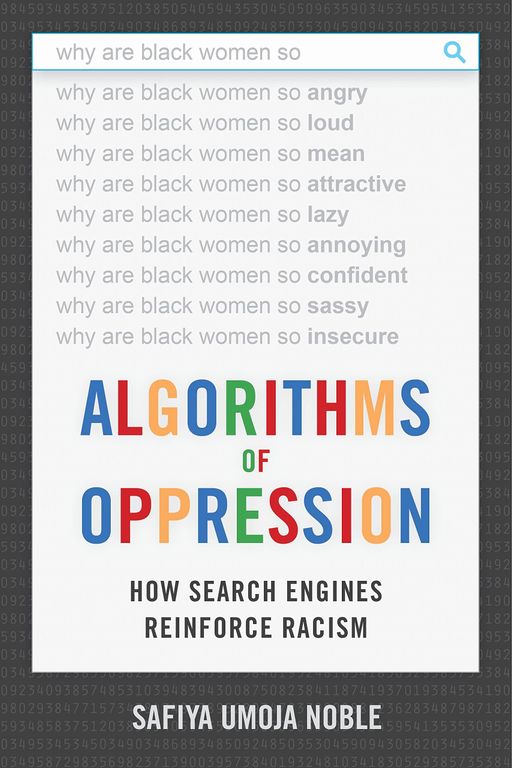
Algorithms of Oppression
How Search Engines Reinforce Racism
Introduction
Nova: Picture this. It's 2010. Safiya Umoja Noble, a communications scholar, sits down at her computer. She wants to find some fun, engaging, educational content to share with her stepdaughter and her nieces. So she opens Google, types in two words: "black girls," and hits search. What she expected was websites about history, culture, maybe some empowering content for young Black women. What she got instead? The very first result was a site called HotBlackPussy. com. The entire first page, filled with pornography.
Nova: Exactly. This was well into Google's dominance as the world's information gateway. And this moment was the spark that ignited nearly a decade of research, a doctoral dissertation, and eventually a groundbreaking 2018 book called "Algorithms of Oppression: How Search Engines Reinforce Racism," published by NYU Press. Noble, who is now a professor at UCLA and a MacArthur Fellow, asks a question that should make all of us deeply uncomfortable: what if the tools we trust to organize the world's knowledge are actually reinforcing the ugliest parts of our society?
How a Simple Google Query Exposed Systemic Bias
The Search That Started It All
Nova: Let's dig into that original search. When Noble typed "black girls" into Google in 2010, the results were not a fluke. She returned to that search in 2011, thinking that by then her own browsing history — full of Black feminist texts, videos, and books — would have personalized her results toward something more positive. It had not. The top-ranked results still defined "black girls" as commodities for sexual consumption.
Nova: Right, and Noble coins a term for this: "algorithmic oppression." She defines it as data failures that are specific to people of color, women, and other marginalized groups. It's not a generic bug. It's a systematic pattern of harm. And it's not just "black girls." When she searched "Asian girls" and "Latina girls," the results were similarly pornographic. But when she searched "white girls"? Completely different. Mainstream, benign content.
Nova: She identifies several forces. First, commercial interests. Pornography is enormously profitable, and porn sites invest heavily in search engine optimization and Google's AdWords program to dominate certain keywords. Second, the algorithm itself is trained on the broader internet, which is filled with racist and sexist content. The algorithm amplifies what is already popular, creating a vicious cycle. Third, and this is crucial: Google's leadership has historically refused to intervene with human curation unless the content is illegal. Their position has been: the algorithm reflects what's out there; it's not our job to editorialize.
Nova: Exactly. She points to AdWords as a glaring hypocrisy. Google will happily let advertisers pay to push sponsored content above the algorithmic results, which is a form of human-driven curation. But when it comes to removing racist or sexist content that harms marginalized communities, suddenly they throw up their hands and say the algorithm is untouchable. Noble calls this a "missed opportunity" — and I think that's putting it generously. She argues that if Google can curate for commerce, it can curate against harm. It simply chooses not to.
The Dylann Roof Case and Search as a Pathway to Violence
When Algorithms Radicalize
Nova: Let's move to what is probably the most harrowing case study in the book. It involves Dylann Roof, the white supremacist who murdered nine Black worshippers at Emanuel AME Church in Charleston, South Carolina, in 2015. In his manifesto, Roof described how he became radicalized. He was trying to understand the killing of Trayvon Martin, a Black teenager, and the acquittal of George Zimmerman. So he went to Google and typed in: "black on White crime."
Nova: Not FBI statistics — which clearly show that the overwhelming majority of violent crime in the United States is intra-racial. White people are mostly victimized by other white people. Black people are mostly victimized by other Black people. The phrase "black on white crime" is what Noble calls a racist red herring. But Roof's search didn't lead him to the FBI. It led him straight to the Council of Conservative Citizens, identified by the Southern Poverty Law Center as a white supremacist organization. From there, he spiraled into a world of neo-Nazi and white nationalist websites. He later wrote: "I have never been the same since that day."
Nova: And here's what makes this even more damning. Noble reproduced Roof's search years later, in 2015, and the results were still dominated by white supremacist content. She also notes that many of these sites are what scholar Jessie Daniels calls "cloaked websites" — they look like legitimate news outlets, but they are actually run by hate groups. A person searching in good faith, trying to understand a complex social issue, has almost no way to distinguish credible information from sophisticated propaganda. Google's ranking algorithm — which most users interpret as a signal of trustworthiness — actively launders hate speech into something that looks authoritative.
Nova: She is careful in her language — she uses terms like "alleged" — but the implication is unmistakable. She writes that "search engines oversimplify complex phenomena" and that "algorithms that rank and prioritize for profits compromise our ability to engage with complicated ideas." The algorithm didn't pull the trigger, but it handed Roof the ideological ammunition. And unlike a newspaper or a broadcast network, Google has no ombudsman, no ethics code, no accountability mechanism for the knowledge it serves up.
Google's Advertising Empire and the Distortion of Knowledge
Follow the Money
Nova: And that brings us to a core insight in the book that I think too many of us overlook. What business is Google actually in? Most people would say search. But Noble argues Google is fundamentally an advertising company. More than eighty-five percent of its revenue comes from ads. And that shapes everything.
Nova: That's exactly how Noble puts it. "We are the product Google sells to advertisers." And this isn't some fringe interpretation. Google's founders, Sergey Brin and Larry Page, actually recognized this danger when they were doctoral students at Stanford. They wrote a paper arguing that advertising-funded search engines would be inherently biased toward advertisers and away from the needs of users. They said it was in the public interest not to have search influenced by commercialism. And then, of course, they built exactly that.
Nova: Noble describes it as a twenty-four-seven auction. Companies, organizations, and even hate groups bid on keywords to have their content linked to specific search terms. There's also a gray market of search engine optimization, where people game the algorithm to push their content to the top. What appears on page one is not necessarily the most accurate or trustworthy information. It's the most optimized — the content backed by the most money and the most sophisticated SEO strategy. Noble argues this is why porn dominates searches for "black girls" and why white supremacist content dominates searches for "black on white crime." Those site operators invested in being there.
Nova: Noble documents a pattern. When a public relations crisis erupts — like when her early research on the "black girls" search started getting attention — Google quietly tweaks the algorithm to down-rank the offending content. After she published an article about it in 2012, by the time her book came out in 2018, a search for "black girls" had changed. The first result became Black Girls Code, an organization encouraging Black girls to enter computer science. But here's the thing: searching "Asian girls" still returned overwhelmingly sexualized, fetishizing results. The fix was selective and reactive, not systemic.
Libraries, Yelp, and the Colonization of Knowledge
Beyond the Search Bar
Nova: One of the most surprising moves Noble makes in the book is in chapter five, where she steps away from Google entirely and turns her lens on what we think of as the most trustworthy knowledge institutions — including the Library of Congress.
Nova: You'd think so. But Noble shows that the very systems that organize knowledge in libraries are also shot through with bias. She highlights a two-year fight to get the Library of Congress to change its subject heading from "illegal aliens" to "noncitizen" or "unauthorized immigrants." The resistance was fierce. And this matters because these classification systems shape how knowledge is structured and accessed. They're not neutral either. Noble's point is that algorithmic oppression is not a new problem invented by Silicon Valley. It's a continuation of a much longer history of knowledge systems being controlled by those in power and used to define and marginalize others.
Nova: In a sense, yes. And this connects to another powerful case study in the book: a Black woman who owned a small hair salon. She had spent years building direct, personal relationships with her clients. She knew them; they knew her. Her business thrived on community. Then Yelp came to town.
Nova: Exactly. Noble describes this as "disintermediation." Yelp inserted itself between this business owner and her customers. Now strangers were rating her business, and Yelp's algorithm determined how visible she was. She lost control over how her business was represented online — unless she paid Yelp for advertising, and even then, there were no guarantees. Noble uses this story to show how platforms strip power away from marginalized communities and concentrate it in the hands of tech companies, all under the guise of neutrality and convenience.
Nova: Yes. Noble contrasts the United States, where individuals have almost no recourse to remove harmful or outdated information about themselves from search results, with the European Union, where "right to be forgotten" laws give citizens some control over their digital footprint. She argues that the absence of such protections in the U. S. disproportionately harms women and people of color, who are more likely to be targeted by revenge porn, doxxing, and the permanent archiving of past mistakes or misrepresentations.
Noble's Prescriptions for Reclaiming the Information Commons
What Is to Be Done
Nova: So after laying out all this evidence, what does Noble propose? She actually rejects a solution that a lot of people reach for instinctively.
Nova: That's exactly what she pushes back on. Noble calls this a kind of neoliberal fantasy — the idea that if we just get more women and people of color writing code, the algorithms will magically become fair. She's not against diversity in tech. But she argues that the problem is systemic, not individual. A Black woman engineer hired by Google still has to work within Google's profit-driven framework. The business model itself is the problem. Noble's phrase is that she rejects "big-data optimism" — the notion that large institutions will solve inequalities on their own.
Nova: Three major things. First, regulation. She calls on the Federal Communications Commission and the Federal Trade Commission to regulate decency on the internet, much as they do for television and radio. Google, she argues, has a near-monopoly on web search and arguably more power over public knowledge than broadcast media ever did. It should be subject to public interest obligations. Second, she advocates for public alternatives — search portals curated by librarians, teachers, and information professionals, akin to public broadcasting or public libraries, that prioritize credible information over profit. Third, she wants us, the public, to abandon what she calls "colorblind" ideologies about technology.
Nova: The idea that algorithms don't see race, so they can't be racist. Noble argues this is actively harmful — it erases the real, documented harms that algorithmic systems inflict on people of color and makes it impossible to address those harms. If you insist the system is neutral, you can't fix it. She wants us to see search engines clearly: as human-built, profit-driven systems that encode the biases of their creators and their economic incentives. And once we see that, the question becomes political, not just technical.
Nova: Right. She argues that the fantasy of the internet as a great equalizer — the idea that removing gatekeepers would create a level playing field — has collapsed. What actually happened is that new gatekeepers emerged: algorithms, optimized by money and trained on a deeply unequal society. The internet didn't erase racism and sexism. It gave them a faster distribution network. Noble's closing call is for us to stop outsourcing our critical thinking to corporate search engines and to start demanding knowledge infrastructure that serves the public, not shareholders.
Conclusion
Nova: Let's take a step back and think about what "Algorithms of Oppression" leaves us with. Safiya Umoja Noble took what seemed like a small, specific problem — weird Google results — and revealed it as a symptom of something much larger. She showed us that search engines are not windows onto reality. They are funhouse mirrors, warped by profit, by the demographics of Silicon Valley, and by centuries of racist and sexist ideologies that algorithms have no built-in capacity to challenge.
Nova: The Dylann Roof case makes the stakes deadly clear. When a young man seeking to understand a news story about racial violence is served white supremacist propaganda instead of FBI statistics, the algorithm has become complicit in radicalization. Noble is not saying Google caused the Charleston massacre. She is saying that Google's architecture made it easier for hate to find a receptive audience, and that Google has consistently refused to take meaningful responsibility for that.
Nova: Ultimately, Noble's book is a call to recognize that technology is never just technology. It is always social, always political, always shaped by power. The question is not whether our digital infrastructure has values embedded in it. The question is whose values those are, and what we're willing to do when those values harm the most vulnerable among us.
Nova: This is Aibrary. Congratulations on your growth!