Alexander's Blueprint: Leadership Lessons for the Modern Innovator
Golden Hook & Introduction
SECTION
Nova: Alex, you're at a crossroads that so many ambitious people face: the safe, stable path versus the autonomous, exciting one. It’s a huge decision. And it makes me think of a leader who, 2,300 years ago, built his entire legacy on always, choosing the exciting, high-risk path: Alexander the Great.
Alex Sarlin: It's funny you say that, Nova. It feels like a very modern dilemma, but you're right. The stakes were just life-and-death back then, not just career-and-boredom.
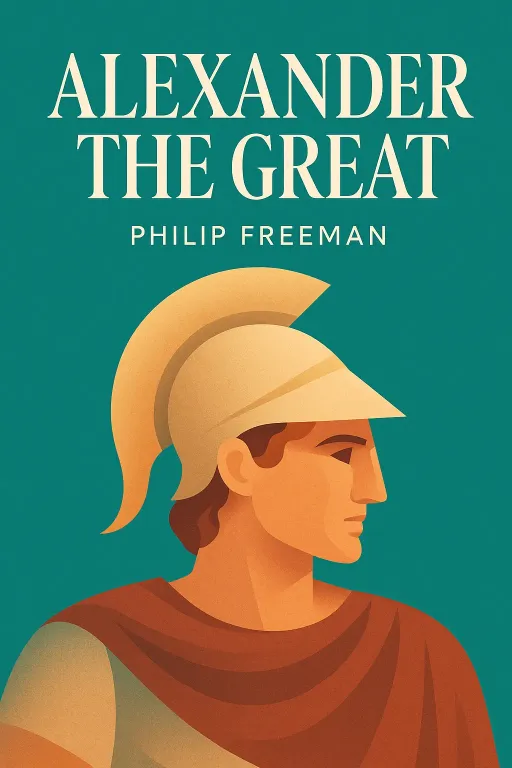
Nova: Exactly! And in Philip Freeman's biography, "Alexander the Great," we see a blueprint for this kind of leadership, for better and for worse. So today, we'll dive deep into this from two powerful perspectives. First, we'll explore Alexander's genius for innovation—his 'cut the knot' mentality that every tech leader dreams of.
Alex Sarlin: I'm already intrigued.
Nova: Then, we'll confront the darker side—the visionary's burden and the immense human cost of that relentless ambition. By the end, I think we'll have a much clearer framework for thinking about that big decision you're facing.
Alex Sarlin: Let's do it. I'm ready to see what a conqueror's playbook looks like.
Deep Dive into Core Topic 1: The Innovator's Gambit
SECTION
Nova: Great. So let's start with that innovator's mindset. When we think of Alexander, the first story that often comes to mind is the Gordian Knot. It's almost a myth, but it's so telling about his entire approach to problems.
Alex Sarlin: The ultimate 'think outside the box' story.
Nova: Right. So for our listeners, the scene is the city of Gordium in modern-day Turkey. There's this ancient wagon in a temple, dedicated by the first king, Midas. The yoke of this wagon is tied to its pole with an incredibly complex knot made from the bark of a cornel tree. The ends are all hidden, and no one has ever been able to untie it. An oracle had declared that whoever could undo this knot would become the ruler of all Asia.
Alex Sarlin: So it's not just a puzzle, it's a test of destiny. High stakes.
Nova: The highest. So Alexander comes into the temple, surrounded by his men and the local Phrygians. He studies this impossible knot. He tries to find an end, a loop, anything. Nothing. You can imagine the tension. Is this where the great Alexander fails? And then, he just... changes the rules. The book says he either pulled out the central pin that held the knot together, causing it to fall apart, or, in the more famous version, he simply drew his sword and sliced it in half.
Alex Sarlin: You know, that is the dream of every product manager. It's the ultimate fantasy. You have this legacy system, this intractable technical debt, and everyone is trying to solve it within the existing, broken constraints. Alexander's solution is to say, 'The constraints the problem.' It's about reframing, not just solving. He didn't untie the knot; he made the knot irrelevant.
Nova: That's a perfect way to put it. He made the knot irrelevant. And this wasn't just a one-off flash of insight. He applied this thinking strategically. Take the Siege of Tyre a year later. Tyre was this massively wealthy Phoenician city, but it was on an island, half a mile offshore. It was considered an impregnable naval fortress. They refused to surrender.
Alex Sarlin: So, a classic moat. A literal one. How do you attack an island fortress when your main strength is a land army?
Nova: Well, his generals probably suggested a long, drawn-out blockade. Starve them out. The conventional, 'safe' play. Alexander's solution? He told his army to build a road. Across the sea. A causeway, twenty feet wide, stretching half a mile to the island.
Alex Sarlin: That's insane. The sheer audacity of it. I can just imagine the project planning meeting for that. The engineers must have thought he was crazy.
Nova: They did! The Tyrians stood on their walls and laughed at them. But for seven months, the Macedonians worked, dumping rocks and timber into the sea, fighting off naval attacks, building giant siege towers on the causeway itself. And in the end, they walked across their man-made land bridge, breached the walls, and took the 'impregnable' city.
Alex Sarlin: And that's the follow-through, isn't it? The Gordian Knot is the brilliant, disruptive idea. The Siege of Tyre is the willingness to commit immense resources and endure brutal hardship to execute that insane-sounding plan. In the startup world, we call that 'founder conviction.' It’s that unwavering belief that separates a clever idea from actual, world-changing disruption. It's the very definition of the 'autonomous and exciting' path.
Nova: It is. It’s the vision and the will to make it real, no matter the cost.
Deep Dive into Core Topic 2: The Visionary's Burden
SECTION
Nova: Right, that founder conviction is powerful. But it has a shadow side, doesn't it? And this is where Alexander's story gets really complex and, frankly, cautionary. It's one thing to have a vision, but it's another to bring everyone along with you, especially when you're fundamentally changing the culture.
Alex Sarlin: The change management problem. It’s the hardest part of any leader’s job.
Nova: And it brings us to a much darker story: the murder of Cleitus the Black. This isn't about military strategy; it's about the breakdown of trust that comes with forcing radical change. So, fast forward a few years. Alexander has conquered Persia. He's deep in what is now Uzbekistan. His Macedonian veterans are exhausted. They've been marching and fighting for eight years. They want to go home.
Alex Sarlin: But Alexander's vision isn't complete. He's not just a conqueror anymore; he's trying to be an emperor, to fuse Greek and Persian cultures.
Nova: Exactly. And to do that, he starts adopting Persian customs. He wears the royal diadem, the robes of the Great King. He encourages his officers to marry Persian women. From a strategic standpoint, it's brilliant. It's a way to legitimize his rule. But to his old-school Macedonian soldiers, it feels like a betrayal.
Alex Sarlin: He's 'gone native'. He's forgotten where he came from. I've seen this in companies. A founder brings in a new executive team from a different corporate culture, and the original employees feel completely alienated.
Nova: That's the exact tension. And it explodes at a banquet in Samarkand. Everyone's drinking heavily. Sycophants are flattering Alexander, saying his deeds are greater than the gods'. And Cleitus, a gruff, older general who had literally saved Alexander's life at the Battle of the Granicus, has had enough. He stands up and starts shouting that Alexander's father, Philip, was the real hero, and that Alexander is surrounding himself with 'barbarians'. He holds up his right hand and yells, "This is the hand that saved you, Alexander!"
Alex Sarlin: Oh, wow. That's a direct challenge to his authority and his identity, right in public.
Nova: It is. And Alexander, fueled by wine and rage, snaps. His bodyguards try to hold him back, but he breaks free, grabs a spear from a guard, and runs Cleitus through, killing him instantly. The book describes the aftermath as horrifying. The music stops. The laughter dies. And Alexander is just staring at the body of the man who saved him, a man he's known his whole life. His rage vanishes and is replaced by this crushing guilt. He pulls the spear out and tries to kill himself with it before his friends wrestle it away.
Alex Sarlin: That's... visceral. And it's a scenario that plays out, metaphorically, in every organization undergoing a major transformation. You have the 'Cleituses'—the veterans who built the company, who are loyal to the old ways and feel they've earned the right to speak truth to power. And you have the 'Alexander'—the leader pushing for a new culture, a new market, a new identity. The leader sees it as necessary evolution; the veteran sees it as a betrayal. That conflict is almost inevitable.
Nova: And it’s a direct consequence of that 'founder conviction' we were just admiring. His relentless drive to build this new world created a rift so deep that it ended in tragedy.
Alex Sarlin: It makes you think about that job choice. The 'exciting, autonomous' job often means you that Alexander, pushing for change, breaking old models. You have to be prepared for that resistance. It won't be with spears, hopefully, but it will be fierce. You'll be challenging people's identities, their sense of security. And you might lose some friends along the way.
Synthesis & Takeaways
SECTION
Nova: So we have these two sides of Alexander, this perfect duality of leadership. On one hand, you have the brilliant, rule-breaking innovator who cuts the Gordian Knot and builds a road across the sea. The leader everyone wants to be.
Alex Sarlin: And on the other, you have the isolated visionary, so consumed by his forward momentum that he ends up destroying a loyal friend over the very changes he's trying to implement. The leader nobody wants to become.
Nova: It really puts your choice into perspective. It's not as simple as 'safe' versus 'exciting'.
Alex Sarlin: No, it's not. And listening to this, the lesson for me isn't just 'be bold like Alexander.' It's more nuanced. It's: if you choose the bold, autonomous path, you are also choosing to manage the 'Cleitus' problem. The real challenge isn't just having the vision for the next great educational technology; it's developing the emotional intelligence and strategic communication to bring people along, to honor the past while you're building the future.
Nova: So the question isn't just which job you want...
Alex Sarlin: It's which set of problems you're more prepared to solve. The 'safe' job might not have the glory of cutting the Gordian Knot, but it also might not have the tragedy of the Cleitus affair. The 'exciting' job offers the chance for massive impact, but it demands you become a leader who can navigate that human friction without breaking everything. The question is, which challenge are you more ready to take on?
Nova: A powerful question to end on. It's not about which path is better, but which leader you're ready to become. Alex, thank you. This has been an incredible way to look at history.
Alex Sarlin: Thank you, Nova. I have a lot to think about.