

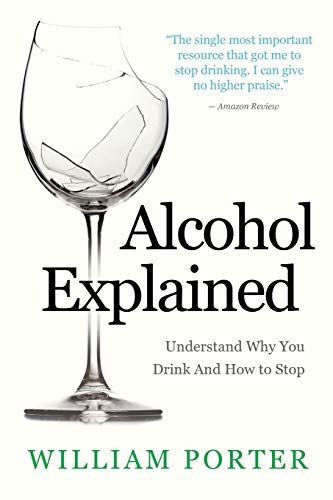
Alcohol Explained
Introduction
Nova: Picture this. It's 3:17 in the morning. You jolt awake, heart pounding, mouth dry, mind racing through every embarrassing thing you said at dinner. And the worst part? You're not just anxious. You're also utterly, bone-deep exhausted. That combination of wired and tired at the same time — it feels unnatural because it is unnatural. And according to William Porter, that's exactly what alcohol does to you, chemically, every single time you drink.
Nova: : Okay, that is way too specific and way too relatable. So you're telling me that the 3 a. m. wake-up-of-doom is actually a predictable chemical reaction, not just bad luck?
Nova: Exactly. And that's the core promise of Porter's book, Alcohol Explained. He calls it the definitive guide to alcohol and alcoholism, and he argues that once you truly understand — on a chemical, physiological, and psychological level — what alcohol is doing to you, the desire to drink simply evaporates. No willpower battles, no white-knuckling it, no counting down days. Just clarity.
Nova: : So this isn't a standard self-help quit-drinking book? It sounds more like a forensic investigation of what ethanol actually does once it enters your body.
Nova: That's exactly right. And the author, William Porter, is not some addiction medicine specialist or neuroscientist with a lab coat. He's a former British Army paratrooper who served in Iraq, later became a lawyer in London's financial district, and from age 14 to his late 30s, he was a heavy drinker himself. He quit in February 2014 after a five-day binge and decided to write down everything he had learned about how alcohol really works. The result was a self-published book that now has thousands of five-star reviews and is widely considered one of the most important works in the so-called quit lit genre.
Nova: : A paratrooper turned lawyer turned accidental addiction expert. I'm already intrigued. So what is the single biggest revelation in this book?
Nova: I'd say it's this: alcohol addiction isn't a moral failing, and it isn't even primarily about the conscious choices you make. It's a learned, chemical process driven by a phenomenon called homeostasis — your brain's relentless drive to maintain balance. And once you see that process clearly, you can't unsee it. Today we're going to unpack the science, the psychology, and the practical wisdom from Alcohol Explained, and by the end, you'll never look at a glass of wine the same way again.
Why Your Brain Works Against You
The Homeostasis Trap
Nova: So let's start with the fundamental chemical mechanism that Porter builds his entire argument on. Alcohol is a sedative, a central nervous system depressant. That's not a controversial statement — it's accepted medical fact. When you drink, it slows down nerve activity. You feel relaxed, loose, maybe a bit euphoric. So far so good, right?
Nova: : That's the part everyone knows. It's why people drink after a stressful day — to take the edge off.
Nova: Right. But here's what most people don't know. Your brain is reactive. It operates through something called homeostasis — a delicate chemical balance. Think of it like a thermostat. When alcohol floods your system and starts depressing nerve activity, your brain doesn't just sit there passively. It fights back. It releases stimulants and stress hormones — cortisol, adrenaline — to counteract the sedative and keep you functional.
Nova: : So while you're enjoying that relaxed feeling, your brain is secretly mounting a counter-offensive?
Nova: Exactly. Porter uses a brilliant analogy here. Imagine you're driving a car trying to maintain 30 miles an hour. Suddenly you hit a patch of mud — that's the alcohol — and the car slows down. So you press harder on the accelerator to maintain speed. Now, when you suddenly leave the mud and hit dry concrete, the car shoots forward way too fast. That's what happens when the alcohol wears off. Your brain has been pressing the accelerator the whole time, and now there's nothing slowing it down.
Nova: : So the anxiety I feel the next morning — that's not just guilt or dehydration. That's my own brain in overdrive?
Nova: Bingo. Porter says this is why hangover anxiety, sometimes called hangxiety, is a chemical certainty, not a personality flaw. For every unit of relaxation alcohol gives you, there's an equal and opposite reaction of anxiety waiting on the other side. And here's the kicker — with repeated drinking, your brain gets more efficient at mounting this counter-attack. That's tolerance. You need more alcohol just to feel normal, and the anxiety rebound gets worse.
Nova: : Which means the very thing you're using to fix your anxiety is actually making your baseline anxiety higher over time.
Nova: That is the cruelest irony of alcohol dependence. Porter calls it a spiral. You drink to relieve stress, which creates more stress, which makes you want to drink more. And the conscious part of your brain — which Porter points out is only about 17% of your total brain — is rationalizing this the entire time, while your subconscious, the other 83%, is quietly learning that alcohol equals relief. Relief from what? From the anxiety that alcohol itself created in the first place.
The 3 A.M. Wake-Up, Explained
Sleep Is a Lie
Nova: Let's talk about sleep, because Porter spends considerable time on this, and it's one of the most powerful motivators in the book. He makes a startling claim: drinking alcohol is the equivalent of setting your alarm for 3 a. m., getting up, and downing a few shots of strong espresso, then trying to go back to sleep.
Nova: : Wait, wait. That's not an exaggeration? He's being literal?
Nova: He's being literal about the physiological effect. Here's what happens. Alcohol is a sedative, so yes, it helps you fall asleep faster. But it completely destroys your sleep architecture. It suppresses REM sleep, which is the restorative phase where your brain processes emotions and consolidates memories. And then, about four to five hours after you've fallen asleep, the alcohol has been metabolized out of your system, and that counter-reaction — that brain overdrive we talked about — kicks in. You wake up, wired, and can't get back to sleep.
Nova: : So the sedation is a bait-and-switch. You think you're getting good sleep, but you're actually getting sedated unconsciousness followed by chemically induced insomnia.
Nova: Beautifully put. And Porter adds another layer. If you drink regularly, your brain actually stops going through its natural wind-down process at night. It becomes reliant on the alcohol to do that job. So when you try to quit, for the first few days or even a week, you genuinely can't fall asleep. Your brain has outsourced its sleep mechanism to ethanol.
Nova: : Which then feeds the myth that you need alcohol to sleep.
Nova: Exactly. The drinker thinks, "I tried not drinking and I couldn't sleep at all. Clearly alcohol helps me sleep." But as Porter explains, that's like wearing tight shoes all day just to feel the relief of taking them off. The alcohol caused the problem it appears to solve. It's a closed loop of deception.
Nova: : And this isn't just a nightly inconvenience — what's the cumulative effect?
Nova: Porter argues that chronic drinkers are essentially sleep-deprived for years or decades. They never get a truly restorative night. And when you consider that poor sleep is linked to depression, obesity, weakened immune function, and cognitive decline, you start to see how alcohol's damage extends far beyond the liver. It's quietly ruining your mental and physical health through the back door of your bedroom every single night.
How Your Memory Betrays You
Fading Affect Bias
Nova: Now we have to talk about one of the most fascinating psychological concepts in the book — Fading Affect Bias, or FAB. Porter considers this one of the biggest hurdles to staying sober.
Nova: : Fading Affect Bias — let me guess. It's the reason I look back fondly on my college drinking days while forgetting the hangovers and the bad decisions?
Nova: That's exactly it. FAB is a well-documented psychological phenomenon where negative memories fade faster than positive ones. Your brain naturally softens the edges of painful experiences and preserves the pleasant ones. It's probably an evolutionary mechanism to keep us from being paralyzed by trauma. But when it comes to alcohol, FAB is a saboteur.
Nova: : So a month after quitting, I'll vividly remember the laughter at the dinner party but conveniently forget the crushing anxiety at 3 a. m.?
Nova: Yes. And Porter is very clear — FAB doesn't mean you completely forget the bad stuff. It's more nuanced. The negative memories are still there, but they lose their emotional charge. They become abstract, intellectual facts rather than visceral warnings. Meanwhile, the warm glow of that first glass of wine on a Friday evening remains vivid and emotionally potent.
Nova: : That is terrifying. Your own brain is essentially gaslighting you into romanticizing a poison.
Nova: It really is. And Porter says this is why relapse often happens weeks or months into sobriety, not in the first few days. In the first few days, the misery is fresh, the hangover is recent, the shame is raw. But give it a few months of FAB doing its work, and suddenly you find yourself thinking, "It wasn't really that bad. I could probably handle just one." Porter calls this one of the eight key hurdles that people face when stopping, and he argues that simply being aware of FAB — knowing that your brain will try to trick you — is a powerful defense.
Nova: : So the tool is basically: when that nostalgic feeling hits, you actively and deliberately recall the full picture — the sleep disruption, the anxiety, the dependency, the mornings you lost.
Nova: Yes, and Porter emphasizes that you have to do this consciously. Your subconscious won't do it for you. He suggests actually writing down the worst drinking experiences while they're still vivid, so that months later, when FAB is working its magic, you have documentary evidence of the truth. It's like keeping a police file on your own memory.
Why 'Just One Drink' Is a Trap
The Myth of Moderation
Nova: Let's tackle the question that probably every listener has in their mind right now: what about moderation? Can't I just cut back?
Nova: : Right. Because Porter was a heavy drinker — maybe his advice only applies to people with a serious problem. If I'm just someone who drinks a bit too much sometimes, surely I can learn to moderate.
Nova: Porter's response to this is withering, and it's one of the most controversial but also the most compelling parts of the book. He argues that the very nature of alcohol makes moderation nearly impossible for anyone who has developed a pattern of regular drinking. Here's his logic: the first drink reduces your inhibitions. That's literally what it does — it's a disinhibitor. So you're using a substance that impairs your decision-making in order to make the decision to stop.
Nova: : So you're asking your drunk self to make responsible decisions that your sober self already struggles with.
Nova: Exactly. Porter puts it bluntly: if you can't resist drink number one, you won't resist drink number two, or three, or four. Willpower is irrelevant because the tool you're using to exercise willpower has been chemically compromised by the first drink. It's like trying to use a wet match to light a fire.
Nova: : But lots of people do seem to drink moderately — someone who has one glass of wine with dinner and stops. Aren't they proof that moderation works?
Nova: Porter addresses this too. He says those people exist, but they're typically people for whom alcohol has never become a crutch, a coping mechanism, or a habit. For everyone else — and that's a lot of people — the brain has already learned that alcohol equals relief. The neural pathways are already carved. And once that learning has happened, moderation becomes a constant, exhausting battle against your own subconscious programming. Porter argues that for these people, complete abstinence is actually easier than moderation because it removes the decision entirely. No negotiating, no bargaining, no mental gymnastics.
Nova: : That's almost counterintuitive — giving up completely is easier than cutting back.
Nova: It is counterintuitive. But Porter's point is that moderation requires you to constantly fight a battle you've already lost before it's even started, because the first sip tips the scales. Abstinence, on the other hand, is a single decision made once with a sober mind. It's cleaner, simpler, and in Porter's experience, far more sustainable.
Practical Wisdom for Stopping
The Eight Hurdles and a Better Way
Nova: So if someone is convinced by all of this and wants to stop, what does Porter actually recommend? He's not a fan of traditional approaches like willpower-based cold turkey, which he describes as unnecessarily agonizing.
Nova: : Because if you're just gritting your teeth and denying yourself something you still believe is pleasurable, you're setting yourself up for a lifetime of misery and eventual relapse.
Nova: Exactly. Porter's central thesis is that complete understanding is the key to the cure. Once you truly grasp that alcohol gives you nothing of genuine value — that the relaxation is borrowed from tomorrow's anxiety, that the sleep is fake, that the confidence is chemical illusion — the desire to drink simply dissolves. You're not depriving yourself of a pleasure. You're freeing yourself from a trap.
Nova: : That's a pretty radical reframe. Most people think of quitting as a sacrifice.
Nova: It is radical. And Porter lays out eight specific hurdles that people face when quitting. We've touched on several already: physical withdrawal, cravings, navigating social events without alcohol, finding new coping mechanisms, Fading Affect Bias, and so on. The eighth hurdle is particularly interesting — it's what he calls A New Found Confidence. This is when you've been sober for a while, you feel great, and you start thinking, "I've clearly got this under control now. I could probably have just one."
Nova: : The classic trap. You feel so good from not drinking that you convince yourself you can drink.
Nova: Right. And Porter says this is where many relapses happen. The confidence that sobriety gives you becomes your undoing. His advice is to stay vigilant, to remember that the problem isn't your character or your willpower — it's the chemical nature of alcohol interacting with human biology. That interaction doesn't change just because you've been sober for six months.
Nova: : So Porter's method isn't really a method in the traditional sense — no counting days, no chips, no meetings necessarily. It's more like education as liberation.
Nova: That's exactly right. And this is where Porter diverges from some traditional recovery models. He discusses Alcoholics Anonymous respectfully but notes what he sees as its limitations — particularly the disease model, which he feels can sometimes be disempowering. Porter prefers to frame alcoholism as a learned behavior driven by chemical and psychological mechanisms that can be unlearned through understanding. He also separates himself from the spiritual dimensions of AA. His approach is secular, rational, and rooted entirely in biochemistry and psychology. The question isn't "Am I an alcoholic?" It's "Do I understand what this substance is doing to me?" And once you do, the decision makes itself.
Conclusion
Nova: So let's pull this all together. William Porter's Alcohol Explained is not a warm, hand-holding self-help book. It's a clinical dismantling of every reason you've ever given yourself for drinking. Layer by layer, he shows that the relaxation is borrowed, the sleep is counterfeit, the confidence is chemical, and the fond memories are filtered through a psychological bias that actively erases the pain.
Nova: : What I keep coming back to is that thermostat metaphor. Your brain is always fighting to return to baseline, and alcohol forces it into this exhausting chemical arms race where you're the loser every time. The feeling you're chasing — that ease, that relief — is literally creating its opposite inside your own head.
Nova: And Porter's most powerful argument, I think, is that none of this is your fault. You're not weak, you're not morally defective, you're not constitutionally incapable of moderation. You're a human being with a human brain, and you've been using a substance that hijacks that brain's most fundamental operating system — homeostasis — and then blames you when the system malfunctions. That's the trap.
Nova: : So the actionable takeaway — if someone listening wants to explore this further, what would you recommend?
Nova: First, you can actually read the first five chapters of Alcohol Explained for free on Porter's website, alcoholexplained. com. He deliberately put them there as a no-risk introduction. If the book resonates, you can buy the full version or the audiobook, which many people say is excellent. There's also a sequel, Alcohol Explained 2, subtitled Tools for a Stronger Sobriety, which goes deeper into the practical side of maintaining a life without alcohol.
Nova: : And I think what's so valuable about this book is that you don't even have to be ready to quit to benefit from it. You just have to be willing to understand what's actually happening in your body when you drink. The decision can come later. The understanding comes first.
Nova: Beautifully said. And that's really Porter's legacy — he's taken a subject shrouded in shame, stigma, and moral judgment and said, "Let's just look at the chemistry. Let's look at what this molecule does. The rest will follow." For tens of thousands of readers, it has.
Nova: : This is Aibrary. Congratulations on your growth!