

The Logic of the Illogical
Introduction
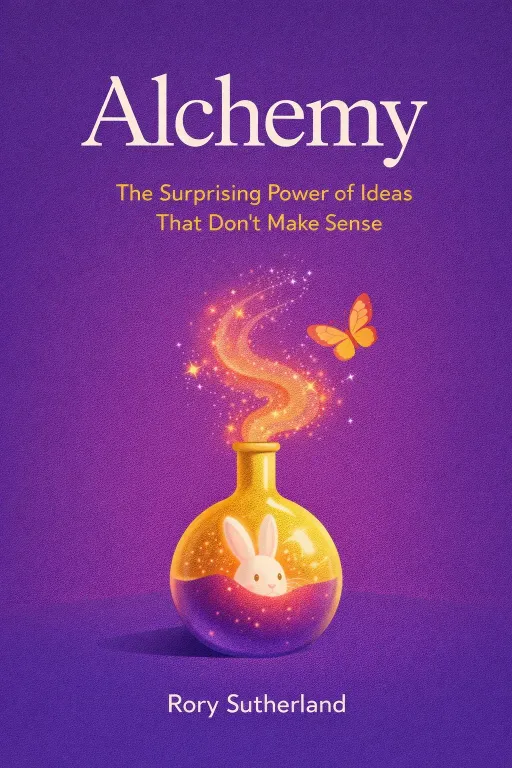
Narrator: What if the secret to launching a billion-dollar brand was to create a product that was small, expensive, and tasted, by most accounts, kind of disgusting? Conventional business logic would dismiss the idea as absurd. Yet, this is precisely the strategy that launched Red Bull, a soft drink that became a worthy global rival to Coca-Cola. It defied every rule in the marketing textbook, and in doing so, it revealed a hidden truth about how the world actually works. This is the kind of puzzle that obsessed advertising executive Rory Sutherland, leading him to write his book, Alchemy: The Surprising Power of Ideas That Don’t Make Sense. Sutherland argues that our world, from business to politics to our personal lives, is not governed by the clean, predictable rules of logic, but by a messier, more powerful force he calls "psycho-logic."
The Human Mind Runs on Psycho-Logic, Not Petrol
Key Insight 1
Narrator: Sutherland’s central argument is that we have mistakenly applied the logic of physics and engineering to the deeply complex and unpredictable realm of human behavior. We assume people are rational actors, but as he puts it, "the human mind does not run on logic any more than a horse runs on petrol." It runs on an evolved, context-dependent operating system of "psycho-logic."
To illustrate this, he describes an experiment conducted for a charity. The goal was to increase donations for hurricane relief. Four different envelopes were sent to 100,000 households each. The first simply announced that it was hand-delivered by volunteers. The second used higher-quality paper. The third used a portrait-style envelope. The fourth, the "logical" option, included a form to help donors claim a 25% tax rebate on their contribution. An economist would predict that only the tax rebate would significantly increase donations. The results were stunning. The "logical" tax rebate option actually reduced donations by over 30%. Meanwhile, the seemingly trivial, "illogical" changes—hand-delivery, better paper, and a different envelope orientation—all increased donations by over 10%. The psycho-logic was clear: the tax rebate made the donation feel like a financial transaction, while the other changes signaled care, effort, and importance, triggering a more powerful emotional and reciprocal response.
The Power of Waste: Why Costly Signals Build Trust
Key Insight 2
Narrator: In a world of "cheap talk," how do we know who to trust? Sutherland explains that the answer lies in costly signaling—actions that are so expensive, difficult, or time-consuming that they are hard to fake. This "waste" is not waste at all; it is the very thing that creates meaning and trust.
He points to the London black cab drivers and their legendary test, "The Knowledge." To become a licensed driver, applicants must spend three to four years memorizing 25,000 streets and thousands of landmarks. In the age of GPS, this seems absurdly inefficient. But its true purpose is not navigation; it’s signaling. The immense, costly effort serves as an ironclad guarantee of a driver's commitment and trustworthiness. A person who has invested years of their life to gain that license is highly unlikely to cheat a passenger for a few extra pounds. The costliness of the signal is what makes it reliable. This same principle explains why we value expensive engagement rings, why flowers have vibrant petals to attract bees, and why major brands spend millions on Super Bowl ads. The apparent inefficiency is a powerful, honest signal of commitment.
Hacking the Unconscious with Commercial Placebos
Key Insight 3
Narrator: Sutherland argues that we can influence our own behavior and feelings indirectly, through what he calls "subconscious hacking." This is most evident in the placebo effect, where belief and expectation can create real physiological and psychological changes. Many successful products, he suggests, are essentially commercial placebos.
Red Bull is a perfect example. Its high price, medicinal taste, and small can all subconsciously signal potency. The brain’s psycho-logic infers: "If it's this expensive and tastes this weird, it must be powerful stuff." A study confirmed this, giving participants identical vodka cocktails but labeling them differently. The group told they were drinking a "vodka Red Bull cocktail" reported feeling drunker, took more risks in a gambling game, and were more confident approaching women. The branding and expectation alone changed their behavior. This principle shows that what a product means is often more important than what it is. The packaging, the price, and the story are not just wrappers; they are active ingredients in the experience.
The Wisdom of 'Good Enough': Why We Satisfice, Not Optimize
Key Insight 4
Narrator: Conventional economics assumes that humans are "maximizers" who always seek the single best, or optimal, solution. Sutherland argues this is a dangerous fallacy. In the real world, which is full of uncertainty and incomplete information, humans are "satisficers." We don't look for the perfect answer; we look for one that is good enough and, crucially, avoids catastrophic failure.
He illustrates this with the simple act of buying a second-hand car. A purely rational approach might involve creating a spreadsheet to find the objectively best car for the lowest price anywhere in the country. But in reality, most people will buy a slightly more expensive car from someone they vaguely know and trust. They aren't trying to solve the question, "What is the best car?" They are solving a different, more important question: "Who can I trust not to sell me a complete lemon?" This is a clever satisficing strategy that prioritizes minimizing the worst-case scenario over achieving the best-case one. This explains brand loyalty, the appeal of McDonald's (low quality, but zero variance), and why we often stick with what’s familiar. It’s not irrational; it’s an intelligent adaptation to an uncertain world.
The IKEA Effect: How Effort and Context Create Value
Key Insight 5
Narrator: One of the most counter-intuitive principles of alchemy is that making things less convenient can sometimes make them more valuable. This is because our perception of reality is not objective; it is shaped by context and our own involvement.
The classic example is the story of Betty Crocker cake mixes in the 1950s. The initial product was a complete mix—just add water. It was a marvel of convenience, but it failed to sell. Psychologists discovered that homemakers felt a sense of guilt, as if they were cheating. The solution was alchemical: General Mills reformulated the mix to require the user to add an egg. This tiny bit of extra effort was all it took. It gave the user a sense of contribution and ownership, transforming the experience from a convenience product into a homemade creation. Sales soared. This phenomenon, now known as the "IKEA effect," shows that we value things more when we have invested our own effort into them. The context of our involvement changes the product's perceived value, proving that in the world of human psychology, the packaging—and the process—is often the product itself.
Conclusion
Narrator: The single most important takeaway from Alchemy is that our obsession with a narrow, mechanical form of logic is a creative straitjacket. By assuming the world is a predictable machine, we blind ourselves to a universe of "magical" solutions that operate on the peculiar, but powerful, principles of human psychology. Sutherland’s work is a call to rebel against the "arithmocracy"—the tyranny of spreadsheets and optimization models—and to re-legitimize intuition, experimentation, and the courage to test ideas that don’t make sense.
The book challenges us to look at the world differently, to see the hidden logic in the seemingly illogical. It leaves us with a profound question: What if the most valuable opportunities for innovation and progress are not in finding the next logical improvement, but in daring to be trivial, in scenting the soap, and in understanding that the opposite of a good idea can sometimes be an even better one?