

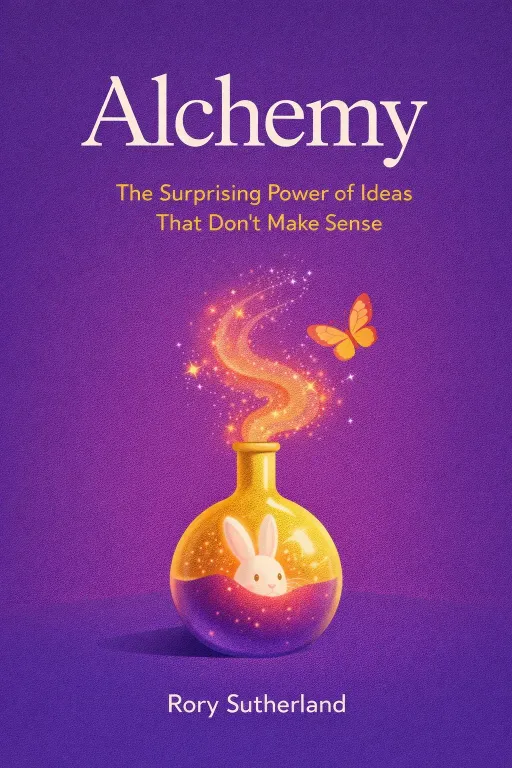
The Alchemy of Illogic
Golden Hook & Introduction
SECTION
Michelle: Mark, quick question. A charity wants to increase donations. What's the better move: tell people they can get a 25% tax rebate, or just use slightly nicer paper for the donation envelope? Mark: The tax rebate, obviously. That’s free money. It’s a no-brainer. Michelle: That’s what logic says. But in a real-world test with hundreds of thousands of households, the tax rebate option actually decreased donations by 30%. The nicer paper? It boosted them by over 10%. Mark: Wait, what? How is that even possible? That makes zero sense. You're telling me people turned down free money but were swayed by fancy paper? Michelle: That's the exact question at the heart of Alchemy: The Surprising Power of Ideas That Don’t Make Sense by Rory Sutherland. And what makes his take so compelling is that he's not an academic theorizing from an ivory tower; he's the Vice Chairman of the advertising giant Ogilvy. He’s someone who has spent decades testing these 'senseless' ideas in the real world with real money on the line. Mark: Okay, so he has skin in the game. I like that. So what’s his explanation for this bizarre charity result? Michelle: He argues that our minds don't run on the clean, simple logic of an economist's spreadsheet. They run on what he calls 'psycho-logic'—a messy, evolved, and often unconscious operating system that cares more about meaning, context, and emotion than it does about pure rationality. The tax rebate made the donation feel like a cold financial transaction, while the nice paper felt like a respectful, meaningful gift exchange. Mark: Psycho-logic. I like that. It sounds like a much more accurate description of my brain, especially before my first coffee. Michelle: Exactly. And Sutherland’s book is a treasure trove of examples where this psycho-logic completely demolishes conventional wisdom.
The Tyranny of Logic and the Rise of 'Psycho-Logic'
SECTION
Michelle: The perfect, almost absurd, example of psycho-logic in action is the story of Red Bull. If you were to launch a new soft drink today to compete with Coca-Cola, what would your logical strategy be? Mark: I’d make it taste better, sell it in a bigger bottle, and price it cheaper. That’s just basic business sense. Michelle: Right. Well, Red Bull did the exact opposite of every single one of those things. They launched a drink that came in a ridiculously small can, was priced significantly higher than Coke, and, according to their own pre-launch market research, tasted, and I quote, "kind of disgusting." Mark: Hold on. They knew it tasted bad? Michelle: Oh, they knew. One of the most famous quotes from their focus groups was, "I wouldn't drink this piss if you paid me to." A logical company would have killed the project right there. Mark: I mean, yeah! You can't build a business strategy on just being weird and hoping for the best. That sounds like a recipe for bankruptcy, not a global brand. Michelle: And that's where the psycho-logic comes in. Sutherland argues that Red Bull wasn't selling a soft drink; it was creating a new category. The tiny can and the high price weren't bugs; they were features. They sent a powerful, unconscious signal of potency. Your brain doesn't see a tiny, expensive can and think "bad value for a soda." It thinks, "this must be powerful stuff, like medicine or a shot of alcohol." Mark: Huh. So the small can makes it feel like a dose of something, not a beverage to quench your thirst. Michelle: Precisely. And the so-called "bad taste"? It actually reinforced that feeling. It tasted medicinal, which made people believe it was working. It wasn't a pleasant, sugary drink; it was a functional product that "gives you wings." They weren't competing on taste; they were competing on effect, and every illogical choice they made was a piece of psychological theater to prove that effect. Mark: Wow. So the very things that should have made it fail were the secret ingredients to its success. It’s completely backward. Michelle: It’s alchemy. It’s turning the lead of bad taste and a high price into the gold of a multi-billion dollar brand, simply by understanding that the human mind doesn't run on logic any more than a car runs on its instruction manual.
Signaling: The Hidden Language of Cost, Trust, and Peacocks
SECTION
Mark: That idea of the can and price being a message is really sticking with me. It’s like the product was communicating something without words. Michelle: Exactly. And Sutherland dedicates a huge part of the book to this idea, which he calls 'Signaling.' It's this hidden language we all use to build trust and show commitment. And the key rule of this language is that for a signal to be believable, it has to be costly. Mark: Okay, hold on. 'Costly signaling' sounds like academic jargon. What does that actually mean in plain English? Like, setting money on fire to prove you're rich? Michelle: In a way, yes! Think about it. Talk is cheap. Anyone can say "trust me" or "this product is high quality." How do you prove it? You do something that is difficult, expensive, or time-consuming to demonstrate your commitment. You put your money where your mouth is. And the most vivid, almost mythical, example of this is the London Black Cab driver. Mark: Ah, the famous London cabbies. Michelle: Right. To become a licensed black cab driver, you have to pass a test called "The Knowledge." This involves memorizing 25,000 streets and about 20,000 landmarks within a six-mile radius of the city center. It takes, on average, three to four years of full-time study, usually driving around the city on a moped, and the failure rate is over 70%. Mark: That's insane. We have GPS now! My phone can do that in a second. Why would anyone go through that? Michelle: That's the alchemical question! From a purely logical, efficiency-focused perspective, it's obsolete. But from a psycho-logical perspective, it's a masterpiece of signaling. The sheer, brutal difficulty of The Knowledge is a costly signal. It tells you that the person driving your cab is incredibly dedicated, professional, and has invested years of their life into this profession. They have too much to lose by being dishonest or unsafe. You instinctively trust them, especially in a city where you might be a vulnerable tourist. Mark: Wow. So it's like a peacock's tail. It's a massive, inefficient burden, but that's why it's an honest signal of fitness. You can't fake having a giant, healthy tail, and you can't fake The Knowledge. It’s proof of work. Michelle: That's a perfect analogy. Sutherland even says that biologists understand advertising better than economists, because nature is full of costly signaling. He has this brilliant line: "A flower is a weed with an advertising budget." The beautiful petals are incredibly costly for the plant to produce. They're a huge energy drain and they attract things that might eat it. But they are an honest signal to the bee: "I've invested so much in this display, I must have good nectar worth your time." Mark: So the "wastefulness" is the whole point. It's the guarantee. That’s a powerful idea. It explains so much, from why we buy brand names to why engagement rings have to be expensive. Michelle: Exactly. The costliness carries the meaning. It’s a language our unconscious minds understand perfectly, even if our logical brains scream "inefficient!"
Hacking Perception: How to Create Value from Thin Air
SECTION
Michelle: And this idea that meaning is more important than objective fact leads us to the most powerful, and as some readers have pointed out, the most controversial part of alchemy: you don't always need to change reality to change the experience. You just need to hack perception. Mark: Hacking perception. That sounds a little… manipulative. Michelle: It can be! And that's a really important point. Let me give you an example that walks right up to that line. Have you ever noticed how a painkiller like Nurofen is sold in different boxes? There's one for 'Migraine Pain,' one for 'Tension Headache,' one for 'Period Pain,' and so on. Mark: Yeah, and the one for 'Back Pain' is always a bit more expensive, I've noticed. Michelle: Well, a few years ago in Australia, the consumer protection agency took the company, Reckitt Benckiser, to court. Because it turned out that all of those different products contained the exact same active ingredient—ibuprofen—in the exact same dose. The only difference was the box and the price. Mark: Okay, I get the placebo effect, but this feels like a line has been crossed. Is this 'alchemy' or is it just a fancy word for tricking people into paying more for the same thing? That feels ethically provocative. Michelle: It's a fantastic question, and it’s where the book gets really interesting. The company's defense, essentially, was that the targeted packaging made the placebo effect stronger. People who took the 'Migraine Pain' pill reported more relief from migraines than people who took the generic version, even though they were chemically identical. The specific packaging created a stronger belief, which in turn created a real, tangible, physical outcome. So, the question becomes: if the patient genuinely feels less pain, is a harm being done? Mark: That's a tricky one. You're paying for the story, not just the chemical. But it still feels a bit dishonest. Michelle: It's what Sutherland calls "benign bullshit." Let me give you a more clearly benign example. In the 1950s, Betty Crocker launched a line of instant cake mixes. All you had to do was add water. It was a miracle of convenience. And it was a total flop. Mark: Why? It sounds amazing. Michelle: Psychologists were brought in, and they discovered that the housewives of the era felt guilty. It was too easy. It felt like cheating. They weren't really 'baking a cake' for their family. So, the company made a tiny, illogical change. They reformulated the mix so that the user had to add their own egg. Mark: They made the product less convenient? Michelle: Yes! And sales shot through the roof. That tiny act of cracking an egg was enough to make the baker feel like they were contributing. It gave them a sense of ownership and authorship. The cake went from being "the mix's cake" to "my cake." They didn't change the objective quality of the cake; they changed the psychological experience of making it. That's hacking perception for a positive outcome. Mark: The 'IKEA effect' before IKEA! That's brilliant. You value it more because you put a little bit of yourself into it. Okay, I can see how that's 'benign.' It's about enhancing the experience, not just exploiting a belief.
Synthesis & Takeaways
SECTION
Michelle: And that really gets to the heart of it. Whether it's Red Bull's potency, the cabbie's trust, or the feeling of baking a cake, the most powerful forces at play are often the ones that you can't put on a spreadsheet. Mark: So the big takeaway here isn't just to be creative in a brainstorming session. It's to have the courage to test ideas that seem genuinely illogical, because the biggest opportunities are often hidden in the places that spreadsheets and purely rational models tell us to ignore. We're trained to look for the single, optimal, logical answer. Michelle: Exactly. Sutherland's point is that we live in a world obsessed with the physics of a problem—the engineering, the numbers, the ingredients. But we consistently ignore the psychology. The real magic, the alchemy, happens when you start solving for the human mind. It’s about understanding that perception isn't a distortion of reality; in many cases, perception is the reality. Mark: It comes back to that amazing line you mentioned earlier. Michelle: "A flower is simply a weed with an advertising budget." It’s the same physical object. The only thing that changes is the story we tell ourselves about it. The meaning we give it. Mark: That’s such a powerful way to think about it. It makes you wonder, where in our own lives—in our jobs, in our relationships—are we being too logical and missing a 'magical' solution? Michelle: A great question to reflect on. We'd love to hear your thoughts. What's an 'alchemical' solution you've seen in the wild? An idea that made no sense but worked beautifully? Let us know on our socials. We love hearing from the Aibrary community. Mark: This is Aibrary, signing off.