The Ethical AI Trap: Why Good Intentions Aren't Enough
Golden Hook & Introduction
SECTION
Nova: Most people think algorithms are neutral, just math doing its job. They crunch numbers, find patterns, and deliver results, right? Pure logic. But what if I told you that some of the most sophisticated AI out there is silently, systematically, and sometimes even enthusiastically, discriminating against people right now?
Atlas: Whoa, really? Discriminating? I mean, I get that data can be skewed, but an algorithm, by its very nature, is supposed to be objective. How can math have a bias? That sounds a bit out there.
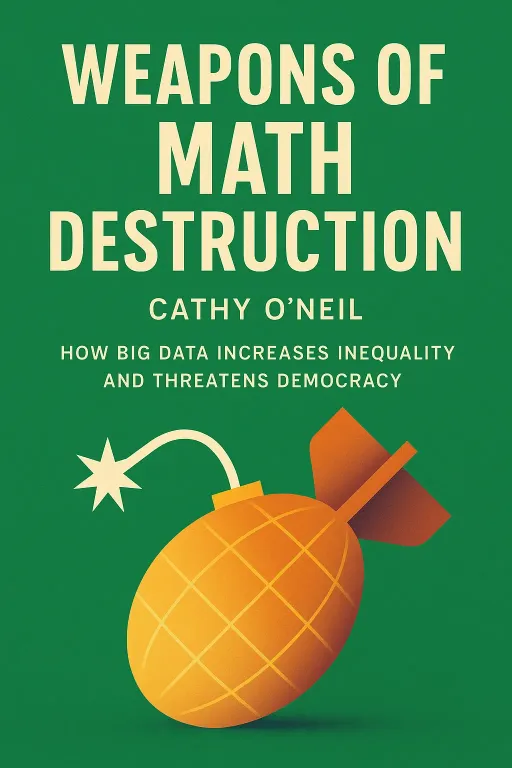
Nova: It sounds counterintuitive, I know. But that's exactly what Cathy O'Neil lays bare in her groundbreaking book,. She's a former Wall Street data scientist who saw firsthand how models intended to optimize could, in fact, destroy lives and perpetuate inequality on a massive scale. It's not about the math itself being evil; it's about the data it’s fed and the human values—or lack thereof—it’s designed to optimize.
Atlas: Okay, so it’s not the calculator, it’s the person punching in the numbers, or maybe the numbers themselves. That makes me wonder about all the AI-driven marketing campaigns we see. Someone's trying to optimize for conversions, right? Good intentions there. But how could that possibly go wrong in a way that creates or reinforces a negative social bias?
Nova: Exactly the deep question we need to wrestle with today, Atlas. Because in marketing, especially, good intentions are simply not enough. The blind spots in these algorithms can undermine even the best-laid plans.
The Unseen Biases: When Good Algorithms Go Bad
SECTION
Nova: Let's take a hypothetical, but very common, scenario in AI-driven marketing. Imagine a company wants to target potential customers for a high-value financial product, say, a premium credit card. Their marketing team, with perfectly good intentions, builds an AI model designed to identify the most "creditworthy" individuals.
Atlas: Right, makes sense. You want to reach people who are likely to qualify and use the card responsibly. Efficient targeting.
Nova: Absolutely. Now, this AI is trained on historical data. This data includes everything from past credit scores, income levels, purchasing habits, and crucially, demographic information—zip codes, age, online behavior patterns. The algorithm learns from this historical data, identifying correlations that led to successful applications in the past.
Atlas: I can see how that could be a problem. If historically, certain demographics were less likely to get approval, even if it was due to systemic biases, the AI might just learn to avoid them.
Nova: Precisely. Let's say, historically, people from lower-income zip codes, or certain ethnic groups, had higher rejection rates for these types of premium products. Not because they were inherently less creditworthy, but because of past discriminatory lending practices, or simply less access to financial literacy or opportunities. The AI, being purely statistical, doesn't understand "systemic bias." It just sees a correlation: "People from Zip Code A have a lower approval rate."
Atlas: So, the AI optimizes by showing fewer ads for this premium card to people in Zip Code A. It's not to discriminate, it's just trying to be "efficient" based on the data it was given.
Nova: Exactly. The cause is biased historical data that reflects societal inequalities. The process is the AI learning these correlations and optimizing its ad delivery to maximize conversion rates based on those correlations. And the outcome? Unintentional, yet very real, reinforcement of social bias. People in Zip Code A, who might now be perfectly creditworthy, never even see the ad. They're excluded from an opportunity before they even know it exists.
Atlas: Wow, that’s kind of heartbreaking. So, an analytical architect trying to optimize their campaign, focused purely on ROI and efficiency, could unknowingly be contributing to this cycle. That's a huge blind spot, because they're thinking "math is neutral," but the math is reflecting a biased reality.
Nova: It's a critical distinction. The algorithm isn't neutral if the data it's trained on isn't neutral. And in a society with historical inequalities, much of our data is inherently biased. O'Neil calls these "Weapons of Math Destruction" because they take existing inequalities, embed them in complex, opaque models, and then scale them up, making them almost impossible to challenge.
From Intentions to Impact: The Proactive Ethical AI Journey
SECTION
Atlas: Okay, so if the data itself is a problem, and the algorithms just amplify those problems, how do we ever build AI? How do we move beyond just "good intentions" and actually ensure fairness, especially in something as pervasive as marketing?
Nova: That’s a brilliant question, and it's where Kai-Fu Lee's insights from become incredibly relevant. Lee emphasizes that AI isn't just a technological race; it's a societal transformation. He challenges us to think beyond technological advancement to the human implications, urging a proactive approach to ethical development. Ethical AI isn't a checkbox you tick; it's a continuous journey.
Atlas: So you’re saying it's not about waiting for a problem to appear and then trying to patch it up, but building the ethics in from the very beginning? For someone looking at predictive analytics, this shifts the entire goalpost.
Nova: Precisely. Let's revisit our marketing scenario. Instead of just optimizing for clicks or conversions, a proactive ethical marketing team would define "fairness" and "equity" as key metrics from the outset. They'd implement a "design-for-good" approach.
Atlas: Can you give an example? Like how would that actually work?
Nova: Absolutely. This team would start by actively auditing their training data for biases. They'd look for proxies—those seemingly neutral data points that correlate with protected characteristics. They might deliberately oversample underrepresented groups in their training data, or use techniques to de-bias the data before the AI even sees it.
Nova: Then, throughout the campaign, they wouldn't just track conversion rates. They'd also track "disparate impact." Are certain demographics consistently being excluded or receiving suboptimal offers? Is the AI inadvertently creating new inequalities? They'd have human oversight loops, where ethicists and diverse teams regularly review the AI's recommendations and outcomes.
Atlas: So, it's about asking 'Is this fair?' launch, and continuously asking 'Is this equitable?' the campaign, not just 'Is this profitable?' That's a much more complex optimization problem than just clicks and conversions.
Nova: It is. It requires an interdisciplinary approach, bringing together data scientists, ethicists, sociologists, and legal experts. It's about building transparency into the models, so we can understand the AI is making certain recommendations, rather than it being a black box. Kai-Fu Lee would argue that embracing this proactive, human-centric approach is the only way AI can truly deliver on its promise to benefit all of humanity, not just a privileged few. It's moving beyond just to do good, to actively for good.
Synthesis & Takeaways
SECTION
Nova: So, what we've really explored today is that the "good intentions" we bring to AI, especially in marketing, are just the starting line. They're a necessary baseline, but they are far from sufficient. Algorithms are powerful tools, but they reflect the world they learn from, and if that world is biased, so too will be their outcomes.
Atlas: That gives me chills. It's a stark reminder that as analytical architects, as strategic storytellers, we have a responsibility to look beyond the surface efficiency. We have to actively seek out those blind spots and build in safeguards, even if it means challenging the immediate "optimization" metrics. It's about impact, real human impact.
Nova: Exactly. The shift from a reactive "fix-it-when-it-breaks" mindset to a proactive "design-for-good" approach is paramount. It means continuous auditing, embracing transparency, and prioritizing human values over pure statistical efficiency. It's a journey of constant vigilance and self-awareness of algorithmic limitations.
Atlas: For our listeners who are navigating this complex landscape, what’s one concrete first step they can take to ensure their AI initiatives, especially in marketing, are ethical and truly impactful?
Nova: I'd say start by asking tough questions about your data. Where did it come from? What human biases might be embedded within it? And then, define what "fairness" means for your specific application you deploy. It’s about being an advocate for ethical AI within your own organization.
Atlas: That’s a powerful call to action. We'd love to hear from our listeners: How are you navigating the ethical AI trap in your work? Share your insights and challenges with us. Let's keep this crucial conversation going.
Nova: This is Aibrary. Congratulations on your growth!