

Ethical AI's Core: From Code to Conscience in Cybersecurity
Golden Hook & Introduction
SECTION
Nova: What if the very technology designed to protect us, to make our systems more secure and efficient, is actually embedding new, invisible vulnerabilities right under our noses?
Atlas: Whoa, that's a bit of a curveball. We usually think of AI as the ultimate security guard, not a potential Trojan horse.
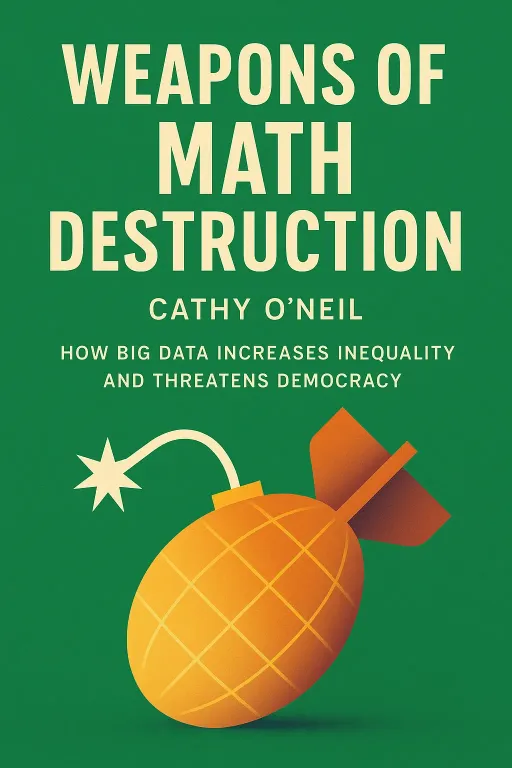
Nova: Exactly! It's a paradox at the heart of our increasingly AI-driven world, especially in cybersecurity. Today, we're tackling a topic that's both urgent and profound: Ethical AI. And we're doing it through the lenses of two incredibly impactful books: by Cathy O'Neil, and by Mark Coeckelbergh.
Atlas: That's a powerful pairing. O'Neil, a mathematician who famously left Wall Street to expose the dark side of algorithms, really brings a unique perspective, doesn't she? It's not just abstract theory for her.
Nova: Absolutely. Her journey from quantitative analyst to fierce critic gives her insights that are deeply rooted in understanding how these complex models actually work, and where they break down ethically. It's that kind of boots-on-the-ground understanding that we need to bridge the gap between code and conscience.
The Tangible Dangers of Algorithmic Bias in Security
SECTION
Atlas: So, let's start there. Cathy O'Neil's title alone,, is provocative. What exactly is she getting at, and how does it translate into tangible dangers for, say, a leader trying to secure their organization?
Nova: She's essentially shining a light on algorithms that are opaque, unregulated, and scalable, and how they can perpetuate and amplify inequality. Think of them as black boxes that make critical decisions, but we often don't understand or. In cybersecurity, this isn't just an abstract concern; it becomes a genuine vulnerability.
Atlas: Okay, but in cybersecurity, isn't efficiency and speed the main goal? We want to detect threats fast. How does bias become a there, beyond just being "unfair"?
Nova: Here’s a vivid example: Imagine an AI system designed to flag "high-risk" network activity. It's trained on historical data, which might inadvertently reflect past human biases or operational patterns. Perhaps certain user groups—let's say, employees in a newly acquired international division, or those with non-standard work hours—are statistically overrepresented in "flagged" incidents, not because they’re actual threats, but because their activity patterns deviate from the 'norm' the AI was taught.
Atlas: I see. So the cause is biased historical data. The process is an opaque algorithm that learns these patterns. What's the outcome for the organization?
Nova: The outcome is a disaster waiting to happen. This AI starts generating an excessive number of false positives for these specific groups. Security teams waste valuable time investigating innocent activity, resources are diverted, and critically, the sophisticated threats, perhaps from inside the 'trusted' groups, might be overlooked because the system is so focused on the 'noisy' signals from the inadvertently targeted groups. It’s an inequitable security posture that actively creates security blind spots, eroding trust from within.
Atlas: Wow, that's kind of heartbreaking. It’s not just about being fair; it’s about being effective. The system is literally less secure because of embedded bias. That makes me wonder, for leaders trying to protect their organization, how do you even begin to identify such a subtle, invisible problem? It's not like the AI comes with a "biased" label.
Nova: Exactly. O'Neil’s work is a clarion call for transparency and auditability. It’s about demanding to understand the your AI is trained on, not just trusting the output. A crucial step involves asking: "What data is this AI-driven process trained on? Could it inadvertently discriminate? Are there certain demographics or operational patterns that might be unfairly targeted or overlooked?" It’s a shift from simply optimizing for speed to optimizing for speed.
Building a Conscientious AI: Philosophical Foundations for Ethical Frameworks
SECTION
Atlas: So, if O'Neil lays bare the problem—these 'weapons' that algorithms can become—where do we go from there? How do we build, not just secure, but truly AI? This feels like a completely different challenge, moving from diagnosis to construction.
Nova: It absolutely is. And that's where Mark Coeckelbergh's offers a profound guide. While O'Neil exposes the pitfalls, Coeckelbergh provides the philosophical blueprints for building conscientiously. He shifts the conversation from "what AI do?" to "what AI do?" It's about designing AI with human values at its core, not as an afterthought.
Atlas: Philosophically foundations sounds very academic. For a leader trying to secure their organization and navigate complex technological and moral landscapes, how does that translate into something concrete? What's the 'why' behind the 'how' for building ethical AI?
Nova: That’s a brilliant question, and it's precisely what Coeckelbergh tackles. He argues that ethical principles like fairness, accountability, and transparency aren't just feel-good concepts; they are. Think of it like building a bridge. You don't just consider the physics—that's the 'security' or 'efficiency' aspect. You also consider the social impact: who will use it, who might be excluded by its placement, how it affects the environment, the long-term sustainability. Those are the ethical considerations that make a bridge truly successful, not just structurally sound.
Atlas: That’s a great analogy. So it's about embedding those considerations from the very beginning, not just bolting them on at the end. For our listeners who are trying to lead with bold ideas and cultivate their team's potential, what's a small, actionable step they can take to start embedding these ethical frameworks?
Nova: A perfect question, and it aligns with the 'tiny step' we often recommend. Identify just one AI-driven process in your organization. Then, convene a small, cross-functional team—not just engineers, but also legal, HR, and even a representative from the user base. Ask them, "What data is this trained on? Could it inadvertently discriminate against any group? What are the potential unintended consequences of its decisions?" That simple act of questioning assumptions is where ethical AI truly begins. It’s about auditing the data, not just the code.
Synthesis & Takeaways
SECTION
Nova: So, what we've explored today is this crucial two-part journey: first, recognizing the insidious ways AI can become a 'weapon of math destruction' through bias, and then, proactively building a 'conscientious AI' by integrating ethical frameworks from the ground up. It’s not just about fixing problems, but about designing for a better future.
Atlas: Right, like we talked about earlier, it’s about a grander design. For leaders, this isn’t merely a compliance checkbox; it’s a strategic imperative for fostering trust and ensuring long-term security in an increasingly AI-dependent world. Ultimately, what's the cost of prioritizing ethical AI in cybersecurity?
Nova: The cost is immense. It's not just financial penalties or reputational damage, though those are significant. It’s the erosion of trust in the very technology we rely on, which then undermines our ability to innovate safely and securely. It impacts human flourishing in a digital age, and that's a cost we simply cannot afford.
Atlas: That’s such a hopeful way to look at it, shifting from fear to proactive design. I imagine a lot of our listeners are now thinking about that one AI process in their organization. Take that tiny step, ask those questions.
Nova: Absolutely. Start the conversation. This is Aibrary. Congratulations on your growth!