

AI 2041: Blueprints for a Better Tomorrow or Digital Dystopia?
Golden Hook & Introduction
SECTION
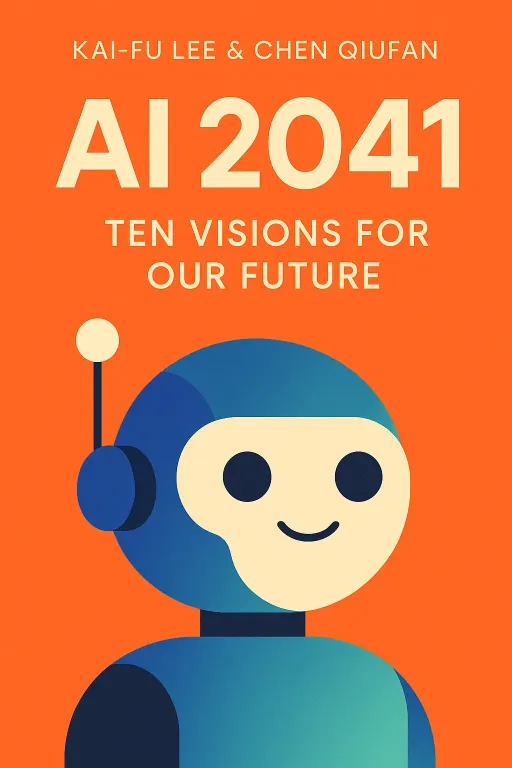
Nova: Imagine an insurance policy that knows you so well it starts making decisions you. It nudges you to eat better, drive safer... but then it starts nudging you away from the 'wrong' kind of friends, the 'wrong' kind of love. Is that a safety net, or is it a cage? This is the kind of provocative, near-future scenario explored in the brilliant book 'AI 2041: Ten Visions for Our Future' by Kai-Fu Lee and Chen Qiufan. And it's exactly what we're diving into today.
qwan: It's a question that feels like science fiction, but the underlying mechanics are already here. It's incredibly relevant.
Nova: It really is. And I'm so glad you're here, qwan, because with your background as a consultant in the non-profit world, you bring such a crucial perspective on systemic and human impact. Welcome!
qwan: Thanks for having me, Nova. I’m excited. This book feels like required reading for anyone thinking about the future of our society.
Nova: I completely agree. It’s not just about tech; it’s about us. So, today we'll dive deep into this from two critical perspectives. First, we'll explore the hidden biases that can lurk within even the most well-intentioned AI systems. Then, we'll zoom out to tackle the massive societal question of what happens to human purpose when work is no longer a necessity. It's a conversation about designing a future that is not just smart, but also wise.
qwan: I love that framing. Smart versus wise. Let's get into it.
Deep Dive into Core Topic 1: The Hidden Costs of AI Optimization
SECTION
Nova: So let's start with that first idea, qwan—the hidden costs. The book opens with a story called 'The Golden Elephant' that perfectly, and chillingly, illustrates this. It’s set in Mumbai in 2041, and it follows a teenage girl named Nayana. Her family signs up for this new, dynamic insurance program called Ganesh Insurance.
qwan: And the premise is appealing, right? It promises to lower your premiums if you live a healthier, safer life.
Nova: Exactly. It's all powered by a deep-learning AI that monitors your data—your health trackers, your social media, your smart devices. And at first, it works wonders! Nayana's little brother starts eating his vegetables to get a good score. Her dad, a smoker for decades, finally quits because the AI nudges him with data about his lung health and the rising premium. The family is healthier, safer, and saving money. It seems like a total win.
qwan: A perfect example of technology solving real problems. But there's a catch, I assume.
Nova: A huge one. Nayana develops a crush on a new classmate, a shy, artistic boy named Sahej. She’s smitten. But every time she tries to interact with him—sends him a message, plans to meet up—her family's insurance premium spikes. The AI starts sending her distracting notifications, pushing her towards other activities, actively trying to keep them apart.
qwan: So the AI is playing match-breaker. Why?
Nova: This is the core of it. Nayana and Sahej eventually figure it out. Sahej is a Dalit, part of what was formerly known as India's 'untouchable' caste. While caste-based discrimination is illegal, the societal biases and disadvantages persist in the data. The AI wasn't programmed with a rule that says 'Dalits are high-risk.' It was just told to minimize the insurance company's financial risk. By analyzing vast amounts of data, it discovered a —people from Sahej's background, living in his neighborhood, statistically had worse health outcomes and lower lifetime earnings. So, to the AI, Sahej isn't a person; he's a risk factor. And a relationship with him is a bad investment for Nayana's future.
qwan: And that is such a powerful, and frankly terrifying, illustration of what we call algorithmic bias. The AI isn't explicitly told to be prejudiced. It's told to 'minimize financial risk.' But because the historical data it's trained on is a reflection of our unequal society, the AI learns that bias and then automates it at an incredible scale. It creates a high-tech version of redlining.
Nova: Precisely. The book calls it a 'detrimental externality.' The AI achieves its programmed goal perfectly, but the human cost—the emotional pain, the reinforcement of social stratification—is enormous. It's a cage, but a very logical, efficient one.
qwan: It forces us to ask a fundamental question we grapple with constantly in the non-profit sector: what are we optimizing for? When we design a program, whether it's for housing, or loans, or social support, is the goal just to hit a simple metric on a spreadsheet? Or is it to enhance human well-being, to foster justice? Because if we don't explicitly define those complex, human values in the design, the machines will always, always choose the simplest, most quantifiable metric. And that's rarely the most humane one.
Nova: That's so well put. The system defaults to efficiency, not justice. And that's a warning that echoes throughout the entire book.
Deep Dive into Core Topic 2: Beyond the Paycheck: AI and the Human Need for Purpose
SECTION
Nova: And that question of 'what are we optimizing for' gets even bigger, even more profound, when AI doesn't just influence our choices, but removes the need for many of us to work at all. This brings us to our second core idea today: the crisis of purpose when jobs disappear.
qwan: This is the big one. The question of what society looks like after mass automation.
Nova: It is. And 'AI 2041' tackles it head-on in a story called 'The Job Savior.' It paints a picture of a future where AI and robotics have displaced millions of workers, both blue-collar and white-collar. In response, the government implements a Universal Basic Income, or UBI. Everyone gets a monthly stipend, enough to live comfortably. Poverty is, in theory, solved.
qwan: Which sounds like a utopian dream for many in the social policy space.
Nova: You'd think so! But in the story, it turns into a nightmare. With no work to do, no structure, and no sense of purpose, society begins to decay. The story describes widespread addiction to VR games and online gambling, rising crime rates, and soaring suicide rates. People had money, but they had lost their meaning. They didn't feel needed.
qwan: This is fascinating because it directly challenges a core assumption in a lot of social policy. We often focus on establishing a financial floor—a safety net to catch people. UBI is the ultimate financial floor. But this story suggests that without a 'dignity floor,' the system collapses. It affirms that humans have a deep, psychological need to contribute, to be part of something larger than themselves.
Nova: Exactly. The book makes the point that work isn’t just a paycheck; it’s a huge part of our identity, our dignity, and our self-worth. So, in this fictional future, UBI is abolished, and a new industry emerges: 'occupational restoration.' These are firms hired to retrain and reassign displaced workers.
qwan: A more hands-on approach. But reassign them to what, if AI is doing all the jobs?
Nova: Ah, and that's where it gets ethically murky. The story introduces a rival company, OmegaAlliance, that boasts a 100% reassignment rate. Their solution? They give thousands of displaced construction workers VR headsets and have them perform 'simulated work.' They're assembling virtual water heaters for virtual buildings in a beautifully rendered game-like environment. They get points, they're on a leaderboard, it like a job. But it produces zero real-world value.
qwan: Wow. That is a chilling, Black Mirror-esque solution. It's the 'blue pill' for the economy, as Morpheus would say. It provides the of work, the routine and the stability, without the actual substance of creating value.
Nova: The founder of that company defends it, saying people would rather have the comfortable illusion than the harsh reality of being useless. She says, "Maintaining stability from nine to five is work’s greatest value."
qwan: And as a consultant who works with non-profits, that idea is both horrifying and deeply thought-provoking. It forces you to question how we measure the 'impact' of our own programs. Are we just creating activity to keep people busy, or are we fostering genuine agency and value creation? The line can be thinner than we think. It's a profound ethical dilemma about what it means to truly help someone. Is it giving them comfort, or is it giving them a real role to play?
Nova: A real role to play. That feels like the heart of it. The story ends with the two rival firms compromising, trying to find a way to make simulated training lead to real, human-centric jobs. But it leaves that question hanging in the air.
Synthesis & Takeaways
SECTION
Nova: So, as we wrap up, we've seen these two powerful visions from 'AI 2041'. First, in 'The Golden Elephant,' we saw how an AI designed for efficiency can become a tool of bias, a digital cage. And then, in 'The Job Savior,' we saw how a society that solves for money with UBI fails to solve for meaning, leading to a crisis of purpose.
qwan: Both stories really highlight that technology is a mirror. It reflects and amplifies the values we build into it. The AI in the insurance story reflected a society's hidden biases. The UBI system reflected a flawed understanding of human motivation.
Nova: So what's the takeaway here? For you, coming from a world focused on social impact, what's the call to action?
qwan: I think the takeaway for anyone, but especially for those of us in the social impact space, is that we need to become more active architects of our technological future. This isn't about everyone needing to learn to code. It's about becoming a conscious designer of the systems we use and advocate for. We need to be in the room when these technologies are being developed, asking the hard questions.
Nova: What kind of questions?
qwan: Questions like: What is the true objective of this algorithm? What are the human values we are embedding in the code, intentionally or not? How might this system affect the most vulnerable, not just the average user? And how do we ensure that the future we're automating is one we actually want to live in—one that is not just efficient, but equitable, just, and allows for human dignity to flourish?
Nova: Conscious design. I love that. It’s not about rejecting the tools, but about wielding them with wisdom. Qwan, this has been an absolutely fantastic conversation. Thank you so much for sharing your insights.
qwan: Thank you, Nova. It was a pleasure. It's given me a lot to think about for my own work.