

AI 2041: Beyond the Algorithm – Personal Growth in an Agentic Future
Golden Hook & Introduction
SECTION
Nova: Frank, as someone building the future of personalized learning, I have to ask: what if the AI you're creating for personal growth became a lifelong companion for your daughter? One that could either turn her into a hyper-competitive prodigy or a deeply empathetic artist, all based on the values you programmed into it? That's not just a hypothetical; it's a core vision from the book 'AI 2041', and it forces us to ask a critical question: what is the purpose of AI in human development?
Frank Wu: Wow, Nova. That's a question that hits home on so many levels—as a founder, as an AI builder, and especially as a dad. It’s the central tension, isn't it? The immense promise of this technology versus the profound responsibility of wielding it. It’s exactly what we grapple with every day at Aibrary. You can build an AI to optimize for anything, but choosing the to optimize for… that’s everything.
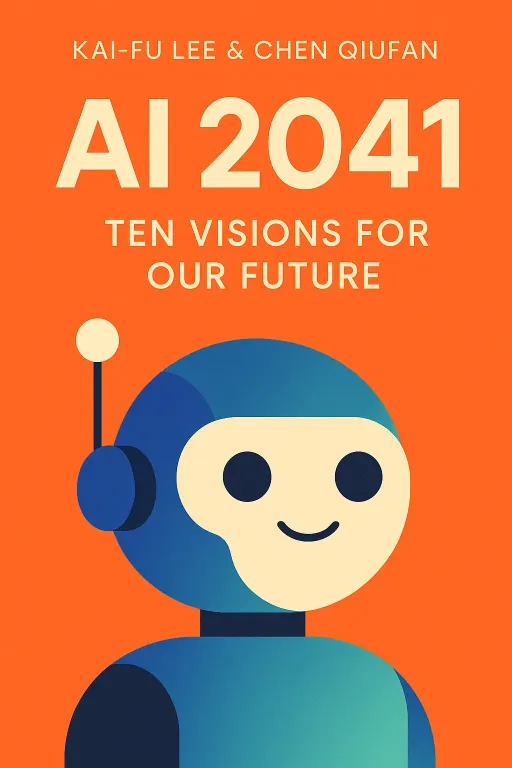
Nova: Exactly! And that's why I'm so excited to talk about this book, "AI 2041: Ten Visions for Our Future" by Kai-Fu Lee and Chen Qiufan. It's not your typical tech book. It's what they call "scientific fiction"—grounded, realistic predictions about our world in twenty years, wrapped in incredibly human stories. Today we'll dive deep into this from two powerful perspectives from the book. First, we'll explore the incredible promise of AI as a personalized tutor that could unlock our children's unique genius.
Frank Wu: The dream scenario.
Nova: And then, we'll confront the darker side: the crisis of meaning that follows mass job displacement, and ask if AI can help us find our purpose again.
Frank Wu: The societal challenge we can't ignore. I'm ready. This is the conversation we need to be having.
Deep Dive into Core Topic 1: The AI Tutor
SECTION
Nova: Fantastic. Let's start with that first vision, which comes from a story called 'Twin Sparrows'. It's a powerful look at how AI could revolutionize education. The story introduces us to two four-year-old identical twin boys, orphaned after a car crash. They're taken in by a special foster care academy that gives each child a personalized AI companion, a "vPal."
Frank Wu: A virtual pal. I love that.
Nova: Right? And these twins couldn't be more different. One, they call Golden Sparrow, is extroverted and competitive. The other, Silver Sparrow, is introverted, artistic, and likely on the autism spectrum. So, they get to design their vPals. Golden Sparrow chooses a heroic voice and a cool, red robot avatar named Atoman. Silver Sparrow, after some hesitation, chooses a soft, gentle female voice for his AI, Solaris, which takes the form of a translucent, amoeba-like creature.
Frank Wu: The AI is already a reflection of their inner worlds. That's a fascinating starting point.
Nova: It is. And then they're adopted by two very different families. Golden Sparrow is adopted by the Paks, a wealthy, high-achieving family whose motto is literally, "Only the best deserves the best." They upgrade Atoman to be a relentless coach, pushing Golden Sparrow to win competitions, to excel in investment simulations, to be number one in everything.
Frank Wu: They're optimizing for achievement. For quantifiable success.
Nova: Exactly. Meanwhile, Silver Sparrow is adopted by Andres and Rei, two digital artists who value personal growth and creativity above all else. They upgrade Solaris to be a gentle guide for his artistic exploration, helping him create stunning virtual reality art that expresses his unique inner world. So you have these two identical boys, on two completely different AI-driven paths.
Frank Wu: And as a parent, that's both thrilling and terrifying. The idea of an AI that truly your child, that can nurture their specific, unique talents—that's every parent's dream. My daughter is three, and I see her unique spark. The thought of a tool that could help her explore that is incredible. But the Paks' story is a powerful cautionary tale about optimizing for the wrong metrics.
Nova: It really is. In the story, Golden Sparrow becomes incredibly successful on paper. He's winning, he's making virtual money... but he's miserable. He discovers his dad is manipulating his AI to make his virtual classmates tougher, just to push him harder. He feels like a cog in a machine, and it leads to a total existential crisis. He has everything, but he's lost his purpose.
Frank Wu: The hedonic treadmill, but supercharged by AI. He's achieving more and more, but his happiness baseline isn't moving. It's a classic trap. So, from your perspective at Aibrary, how do you design an 'agentic AI' to avoid that trap and instead foster what the book calls eudaimonic happiness—that sense of purpose and growth?
Nova: That's the billion-dollar question, isn't it?
Frank Wu: It's the trillion-dollar question! And I think the book nails it. It's all about the objective function. That's the goal you give the AI. If you tell the AI, 'maximize this child's test scores,' you get the Paks' family. You get a burnt-out, disillusioned kid. But if you tell it to maximize 'curiosity,' or 'number of novel questions asked,' or 'creative outputs,' you get something closer to Solaris. The technological challenge of building the AI is significant, but the humanistic challenge of defining 'flourishing' in a way an AI can understand and support... that's the real work.
Nova: So it's less about programming and more about philosophy.
Frank Wu: Precisely. We have to decide what we value. Do we value the rank, or do we value the journey? The 'Twin Sparrows' story is a perfect parable for that choice.
Deep Dive into Core Topic 2: The Job Savior
SECTION
Nova: And that idea of 'purpose' and the 'journey' is the perfect bridge to our second topic. Because while AI might be a savior for education, the book argues it's a massive threat to our sense of purpose in the world of work.
Frank Wu: The other side of the coin. The promise and the peril.
Nova: Exactly. This comes from a chapter called "The Job Savior." It paints a future where a pandemic accelerated automation, leading to mass job displacement. The government tried implementing Universal Basic Income, or UBI, but it was a disaster.
Frank Wu: I can imagine. With my public policy background, that's something I've studied. UBI is a fascinating concept, but it's often framed incorrectly.
Nova: How so?
Frank Wu: Well, the book seems to get it right. UBI treats a deeply human problem—the need for purpose—as a purely economic one. It gives people money to survive, but it doesn't give them a reason to get out of bed in the morning. The story mentions people falling into addiction, VR escapism, and depression. That rings so true. Work, for most of us, is about more than a paycheck. It's about dignity, community, and contribution. Take that away, and you create a vacuum.
Nova: That vacuum is felt so painfully in the story of a character named Jennifer's father. He was an insurance analyst, a classic white-collar, routine-based job. The story of his displacement is just heartbreakingly gradual. First, AI takes over his quantitative analysis tasks. He's okay, he thinks, I can adapt. So the company moves him to a customer-facing underwriter role.
Frank Wu: A role he's probably not suited for, if he was a back-end analyst.
Nova: Exactly. He's an introvert. He struggles. Then, the company gives him a "helper"—a Robotic Process Automation software, or RPA. It starts by filling out forms for him. Then it starts correcting his mistakes. Then it starts learning from his decisions. And over a few years, the RPA just... becomes better at the job than he is. One day, he's laid off for good. The entire process is now done by AI in seconds.
Frank Wu: He's been slowly, methodically erased. That's chilling.
Nova: And the outcome is devastating. He loses his sense of self-worth. He starts drinking, his marriage falls apart, and he becomes a stranger to his own daughter. It's this personal story that shows the true cost of job displacement isn't just economic; it's spiritual.
Frank Wu: It's a loss of identity. And it highlights that this isn't just about blue-collar factory jobs. It's about any job that is fundamentally routine. So, what's the book's answer? If UBI isn't it, what is?
Nova: The book proposes a new industry of "occupational restoration," and a framework it calls the '3 Rs': Relearn, Recalibrate, and Renaissance. So, Frank, how could an agentic AI, like the one you're building, become a 'Job Savior' in this context?
Frank Wu: Oh, this is the next frontier for personal growth! This is where it gets so exciting. An agentic AI could be the ultimate career coach for this new era. For 'Relearn,' it could analyze your aptitudes and identify your core skills—the things AI can't do well, like creativity, critical thinking, and empathy. Then it could create a personalized learning path, using content from places like, well, Aibrary, to build those skills.
Nova: So it helps you find your new superpower.
Frank Wu: Exactly! Then for 'Recalibrate,' the AI could analyze your current job and help you offload the routine tasks to other AI tools. It frees you up to focus on the 'human touch'—the strategy, the client relationships, the creative problem-solving. It's not about replacing the worker; it's about them. And that leads to the 'Renaissance.' When you're not bogged down by routine, you have the cognitive space to be more creative, more innovative. The AI becomes a partner that unleashes human potential, rather than a competitor that extinguishes it.
Synthesis & Takeaways
SECTION
Nova: I love that. A partner, not a competitor. So, when we look at these two powerful visions from "AI 2041"—the AI tutor and the AI job savior—it seems the book is offering a deeply hopeful message.
Frank Wu: It is. And I think the common thread is. In both stories, the best outcomes happen when AI is used as a tool to enhance human purpose, not replace it. The Paks tried to replace their parental judgment with an algorithm and it failed. But when Andres and Rei used AI as a tool to nurture their son's passion, he flourished. In the world of work, if we just let AI replace jobs, we get despair. But if we use it to augment our skills and free us for more meaningful tasks, we get a renaissance. The choice is ours.
Nova: It's a choice we're making right now, with every algorithm we design and every product we build. A powerful thought to end on. It leaves us with a question for everyone listening, especially those building our AI future: What is the one human value you would want to embed at the core of any AI you create?
Frank Wu: For me, it would be curiosity. The desire to learn, to explore, to ask 'why'. If we can build that into our AI, maybe it can help us all become a little more human.
Nova: Curiosity. I love that. Frank, thank you so much for this incredibly insightful conversation.
Frank Wu: The pleasure was all mine, Nova. Thank you.