

Personalized Podcast
Golden Hook & Introduction
SECTION
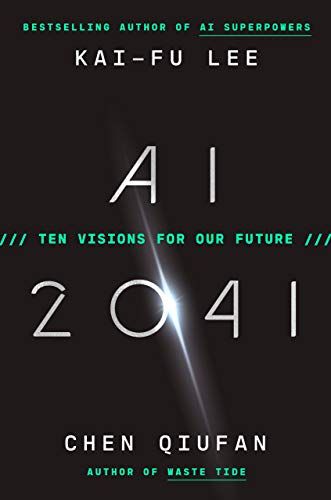
Nova: Imagine receiving a video call from your best friend. They look exactly like themselves, their voice has that familiar warm cadence, and they are asking you for urgent help. You don't hesitate, right? But what if I told you that entire call was generated in real-time by an algorithm that cost less than a cup of coffee to run? Welcome to the year 2041. How does our brain handle a world where our very senses can no longer be trusted? Today, we are diving deep into Kai-Fu Lee and Chen Qiufan's groundbreaking book, AI 2041, but we are looking at it through a very specific lens: the psychological impact of this brave new world. And I am absolutely thrilled to have laiba with us today. Laiba is a wonderfully analytical thinker who loves connecting the dots between technology and the human mind. Welcome, laiba!
laiba: Thanks, Nova! It is so great to be here. You know, when I read AI 2041, I wasn't just fascinated by the neural networks or the quantum computing. I kept asking myself: what does this do to our inner lives? How do we adapt psychologically when the boundary between the real and the synthetic completely dissolves? It is a massive cognitive shift, and I can't wait to unpack it with you.
Nova: Oh, absolutely! We are going to tackle this from two really fascinating angles today. First, we'll explore the psychological toll of synthetic reality and deepfakes on our collective trust. And then, we'll shift gears to look at emotional AI—how artificial companions might re-wire our relationships, our empathy, and our sense of self. It is going to be a wild ride, so let's jump right in!
Deep Dive into Core Topic 1
SECTION
Nova: Let's start with that first point: synthetic reality. In AI 2041, there is this gripping story called The Golden Sparrow, set in Seoul. It paints a picture of a world where deepfakes are so flawless that they are used for everything from elaborate financial scams to sophisticated political manipulation. The technology behind this, Generative Adversarial Networks, or GANs, has advanced to the point where anyone can create a perfect digital clone of anyone else. Laiba, when you read about this, what went through your analytical mind regarding how we, as humans, process trust?
laiba: It really made me think about the concept of epistemic trust—basically, how we decide what is true and who to believe. For thousands of years, human survival relied on a simple rule: seeing is believing. Our brains are hardwired to treat visual and auditory inputs as ground truth. But when a GAN can generate a photorealistic video of you saying something you never said, that ancient cognitive shortcut completely breaks down. We enter a state of perpetual cognitive dissonance.
Nova: Wow, cognitive dissonance. That sounds exhausting! So, are we just going to walk around constantly doubting everything we see and hear?
laiba: Exactly, Nova. Psychologists call this epistemic anxiety. When we can't trust our senses, our baseline anxiety levels shoot up. Think about the mental energy required to constantly verify every piece of information. In The Golden Sparrow, we see characters who have to use cryptographic keys just to prove their identity to their own family members. That constant state of vigilance—always wondering, is this real or is this an algorithm?—takes a massive psychological toll. It erodes the social fabric. Trust is the gravity that holds society together, and without it, we start to drift into isolation.
Nova: That is such a powerful way to put it—trust as gravity. And it makes me think about how we cope. In the book, Kai-Fu Lee points out that we will need technological solutions, like blockchain verification and deepfake detectors, to combat this. But psychologically, do you think humans can develop a sort of digital immunity? Like, will our brains naturally adapt to treat digital media with a healthy dose of skepticism?
laiba: I think we will have to, but the transition period is going to be incredibly messy. We might see a psychological retreat back to physical, face-to-face interactions as the only 'pure' form of connection. It is almost ironic, isn't it? The more advanced our digital communication becomes, the more we might crave the raw, unmediated presence of another human being. But there is also a dark side to this adaptation. If we become too skeptical, we fall into absolute cynicism, where we reject all information that doesn't align with our pre-existing beliefs. That is a psychological trap.
Nova: Oh, absolutely. It is like a cognitive defense mechanism. 'If everything could be fake, then I'll only believe what makes me feel safe.' That is a scary thought for public discourse. It reminds me of how the book describes the polarization of media. But let's look at the positive side for a second. Kai-Fu Lee is ultimately an optimist. He suggests that this crisis of trust will force us to value authenticity more than ever. Do you see a path where this psychological challenge actually makes us more resilient?
laiba: I do, actually. It could force us to develop higher-level critical thinking skills. Instead of passively consuming media, we will have to become active investigators. We will look at context, consistency, and source credibility rather than just emotional impact. It is like upgrading our mental software. But it requires intentional effort. We can't just rely on our primitive brain structures anymore; we have to engage our prefrontal cortex to navigate this synthetic landscape.
Deep Dive into Core Topic 2
SECTION
Nova: That is a perfect transition to our second topic, because upgrading our mental software is going to be incredibly important when we talk about emotional AI. In another story from the book, The Contactless Love, we see a world shaped by pandemic-induced isolation where people rely heavily on AI companions. These aren't just smart speakers; they are highly sophisticated emotional AI systems that can read your micro-expressions, analyze your voice tone, monitor your heart rate, and respond with perfect, algorithmically tailored empathy. It sounds comforting, but it also raises some major psychological red flags, doesn't it?
laiba: It really does. This is where we get into the territory of parasocial relationships, but on steroids. Traditionally, a parasocial relationship is one-sided, like a fan's connection to a celebrity. But with emotional AI, the relationship feels reciprocal. The AI says exactly what you need to hear, when you need to hear it. It never gets tired, it never argues, and it has no needs of its own. From a psychological perspective, that is incredibly seductive. But it is also a simulation of intimacy, not the real thing.
Nova: Right! It is like a relationship with zero friction. But, as we know, real human relationships are full of friction! We disagree, we hurt each other's feelings, we have to compromise. That friction is actually how we grow, isn't it?
laiba: Spot on, Nova. That is precisely the danger. Psychologists talk about 'attachment theory'—how we learn to form secure bonds with others. We learn empathy and emotional regulation by navigating the messy, unpredictable nature of other people. If a child grows up with an AI companion that is perfectly compliant and always emotionally validating, what happens when they encounter a real human who has their own bad days, their own boundaries, and their own opinions? We risk emotional atrophy. We might become incapable of handling the discomfort of real human relationships.
Nova: Emotional atrophy—that is a chilling phrase. It is like our empathy muscles just wasting away because we are lifting zero emotional weight. But let's look at the other side of the coin. What about people who are profoundly isolated, or elderly individuals who have no one else? Couldn't an emotional AI companion be a lifesaver for them?
laiba: Oh, absolutely. And this is the empathy paradox. For someone suffering from severe loneliness, depression, or social anxiety, an AI companion can provide a safe, non-judgmental space to practice social skills or simply feel heard. In AI 2041, we see how AI tutors can customize education for children, acting as a supportive mentor. If designed ethically, these systems can act as a bridge to human connection, rather than a replacement for it. The key is therapeutic intent. Is the AI helping you build the capacity to connect with humans, or is it keeping you hooked on a digital substitute because it is easier?
Nova: That is such a crucial distinction. It is all about the design and the intent. If the algorithm is optimized for engagement—to keep you staring at the screen or interacting with the app—it will naturally try to replace human connection. But if it is optimized for human well-being, it should encourage you to step away and connect with real people. It makes me think of the story Twin Sparrows in the book, where AI is used to foster creativity and collaboration among children. It shows that technology can be a catalyst for deeper human interaction if we set the right boundaries.
laiba: Exactly. And as an analytical thinker, I look at the feedback loops here. If we rely on AI for emotional regulation, we are outsourcing a core part of our humanity. We need to ask ourselves: what are the psychological boundaries we are unwilling to cross? For instance, should an AI be allowed to simulate a deceased loved one? The book touches on these profound ethical questions. The psychological grief process is painful, but it is necessary for healing. If we use AI to bypass grief by keeping a digital ghost of a loved one alive, we might get stuck in a state of arrested development.
Nova: Wow, digital ghosts. That is a heavy concept, but so relevant. It really highlights how these technological advancements aren't just changing our external world; they are reaching deep into our internal, emotional architecture.
Synthesis & Takeaways
SECTION
laiba: It really shows that the future of AI isn't just a technical challenge; it is a psychological one. We are going to need to develop what I call 'cognitive hygiene'—a set of practices to protect our mental well-being, our attention, and our capacity for genuine connection in an AI-saturated world.
Nova: I love that term, 'cognitive hygiene.' It sounds like something we should all start practicing right now! As we wrap up this incredibly deep conversation, laiba, what would be your main takeaway for our listeners? If they want to start preparing their minds for the world of 2041, what is one actionable thing they can do?
laiba: I would say: practice leaning into intentional friction. In a world that is increasingly optimized for convenience and comfort, make a conscious effort to seek out the messy, unpredictable parts of life. Have that difficult conversation face-to-face. Read a book that challenges your worldview. Spend time in nature without any devices. By embracing the friction of the real world, we keep our empathy muscles strong and preserve the very things that make us uniquely human.
Nova: That is beautiful, laiba. Lean into intentional friction. I am definitely going to take that to heart, even if it means having to deal with a few awkward conversations! Thank you so much for sharing your brilliant insights with us today. This has been such an eye-opening discussion.
laiba: Thank you, Nova! It was an absolute pleasure.
Nova: And to all our listeners out there, thank you for joining us on this journey into the psychological frontier of AI 2041. Remember, the future isn't just something that happens to us; it is something we actively shape with every choice we make. Until next time, keep your minds curious, your empathy muscles strong, and your cognitive hygiene sparkling clean. Take care!