

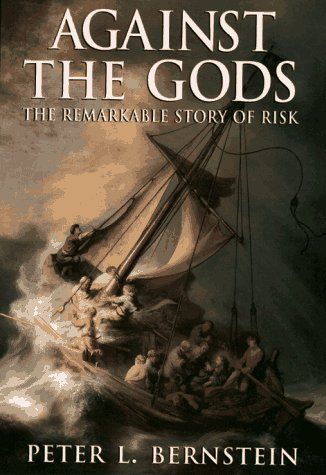
Against the gods
The Remarkable Story of Risk
Introduction
Nova: Imagine you're a merchant in ancient Babylon, around 3200 BC. You're about to send a shipment of grain down the Euphrates River. There's a real chance the boat sinks, bandits strike, or the crops rot before they arrive. How do you protect yourself? You don't calculate probability. You don't hedge. You pray. You make offerings to the gods. Because as far as you're concerned, the future isn't a set of odds. It's a divine decree.
Nova: : And today we check our weather apps, buy insurance, diversify our retirement portfolios, and basically take it for granted that we can manage the unknown. So what changed? What happened in between?
Nova: That's exactly the question Peter L. Bernstein tackles in his 1996 classic Against the Gods: The Remarkable Story of Risk. And his answer is stunning in its simplicity. He argues that the single most important thing separating the modern world from the ancient one isn't the steam engine, electricity, or the internet. It's the mastery of risk. The revolutionary idea that the future is not a whim of the gods, but something we can measure, manage, and even harness.
Nova: : So this is a book about how humanity went from sacrificing goats to appease the heavens to building trillion-dollar derivatives markets.
Nova: Exactly. And it's a wild ride through gambling addicts, mathematical geniuses, insurance pioneers, and Nobel Prize winners. Along the way, Bernstein shows us that every insurance policy, every retirement fund, every stock portfolio you own is built on ideas that were once radical, even heretical. Today we're going to explore how humans dared to go against the gods. I'm Nova.
Nova: : And I'm Kai. Let's roll the dice.
From Fate to Numbers
Why the Greeks Never Invented Probability
Nova: So here's a puzzle that Bernstein poses right at the start. The ancient Greeks were brilliant. They gave us geometry, philosophy, democracy, the foundations of Western thought. They gambled with dice constantly. And yet, they never developed anything resembling probability theory. Why?
Nova: : That does seem weird. If you're rolling dice all day, wouldn't you eventually notice patterns and start calculating odds?
Nova: You would think so. But Bernstein's argument is fascinating. He says the Greeks didn't lack brainpower. They lacked desire. To them, the world was a drama directed by the Fates. A roll of the dice wasn't a random event you could calculate. It was a message from the gods. Trying to predict it mathematically would have been almost sacrilegious. The concept of risk as something manageable simply didn't exist in their worldview.
Nova: : So it was almost a philosophical barrier rather than a mathematical one.
Nova: Precisely. And this mindset persisted for millennia. Bernstein traces how ancient civilizations from Babylon to Rome viewed uncertainty through the lens of superstition, divination, and divine will. He writes that the very notion of bringing risk under control is one of the central ideas distinguishing modern times from the distant past.
Nova: : But people were still pragmatically managing risk, right? I read that Babylonian merchants had contracts to mitigate commercial losses as early as 3200 BC.
Nova: Good catch. Yes, there were embryonic forms of risk management. Maritime insurance emerged in medieval Italy. Guilds provided mutual protection. But these were ad hoc measures. What was missing was a theoretical framework, a systematic way to think about uncertainty. And for that, Bernstein says, you needed something deceptively simple: the right numbering system. Hindu-Arabic numerals, including the concept of zero, had to replace Roman numerals before anyone could do the serious math. Try calculating probability with Roman numerals and you'll quickly see the problem.
Nova: : I've never thought about something as basic as zero being a prerequisite for modern finance, but it makes total sense.
Nova: It does. And this is one of Bernstein's great strengths as a storyteller. He shows how the tools we take for granted, the number zero, the bell curve, the idea of a diversified portfolio, each had to be invented by someone who saw the world differently. The Renaissance is where things really begin to shift. The authority that once belonged to the gods starts to be seized by mathematicians.
Nova: : And the first major figure in this story, as I understand it, was a Renaissance gambler with a pretty wild life.
Birth of Probability Theory
The Gambler, The Lawyer, and The Religious Zealot
Nova: Gerolamo Cardano. What a character. He was a physician, a mathematician, an astrologer, and a compulsive gambler in 16th-century Italy. Bernstein paints him as this brilliant but tormented figure. Cardano wrote the first serious book on the mathematics of games, called Liber de Ludo Aleae, or The Book on Games of Chance.
Nova: : And he wrote it partly because he needed to understand why he kept losing at dice?
Nova: Exactly. He was trying to survive his own gambling addiction by systematizing it. He introduced the concept of equally likely outcomes and began thinking about probability in a rudimentary way. But the real breakthrough comes a century later, with the famous correspondence between Blaise Pascal and Pierre de Fermat in 1654.
Nova: : This is the story everyone mentions. A gambler asks Pascal for help with a puzzle.
Nova: Right. The problem was called the problem of points. Imagine two players are in the middle of a game of chance, and the game gets interrupted. How do you fairly split the pot? It seems simple, but nobody had ever solved it rigorously before. The gambler, the Chevalier de Méré, brought it to Pascal. Pascal wrote to Fermat, and their exchange of letters essentially created probability theory.
Nova: : What did they actually figure out?
Nova: They realized you should look forward, not backward. You calculate the probability of each player winning if the game had continued, and you split the pot according to those probabilities. It sounds obvious now, but it was revolutionary. They invented the concept of expected value. For the first time, humans could put a numerical value on an uncertain future outcome. Bernstein calls this the moment when the future stopped being a mystery and started being a number.
Nova: : So this is the foundation of everything. Every insurance policy, every stock trade, every retirement plan.
Nova: Every single one. And from there, the floodgates opened. The Bernoulli family, a dynasty of Swiss mathematicians, took these ideas and ran with them. Daniel Bernoulli in particular introduced something called utility theory. He noticed that the mathematical expected value of a gamble isn't the same as what it's actually worth to a real person. A dollar means more to a poor person than to a rich person. This seems intuitive, but grounding it mathematically changed economics forever.
Nova: : That's the famous St. Petersburg paradox, right?
Nova: That's the one. A coin-flipping game with an infinite expected value, mathematically speaking, but nobody would pay more than a few dollars to play it. Bernoulli resolved this by introducing diminishing marginal utility. The more wealth you have, the less satisfaction each additional dollar provides. It explains why we buy insurance, why we're risk-averse, and ultimately, why we're not all reckless gamblers.
Nova: : Meanwhile, across the English Channel, something equally important was happening with death records and a London haberdasher.
Statistics and the Quantified World
Dead Bodies, Bell Curves, and the Invention of Insurance
Nova: John Graunt. A haberdasher. In 1660s London, he started analyzing the Bills of Mortality, which were weekly records of births and deaths in the city, along with causes of death. This was the birth of statistical demography. Graunt realized something profound: while you cannot predict when any individual person will die, the death rate of a population is remarkably stable.
Nova: : And suddenly you have a business model for life insurance.
Nova: Exactly. Edmund Halley, of comet fame, built on Graunt's work with data from Breslau, Germany. He calculated the odds of a person of a given age dying in a given year. These were the first actuarial tables, and they made the life insurance industry possible. Scottish Widows, one of the earliest life insurance companies, was founded by mathematically-minded priests looking after actual widows in their parishes.
Nova: : That's a beautiful origin story. Priests doing math to protect widows.
Nova: It is. And it illustrates Bernstein's larger point. These weren't just abstract mathematical exercises. They were practical tools that reshaped how society functioned. Meanwhile, Abraham de Moivre, a French Protestant refugee living in London, was helping gamblers calculate odds and accidentally discovered the bell curve, the normal distribution. He found that the more trials you have, the more results cluster around a central average. This gave us what he called moral certainty.
Nova: : So we can't be sure about one event, but we can be very sure about the average of many events.
Nova: That's it. Then Carl Friedrich Gauss took De Moivre's bell curve and applied it to measurement errors in astronomy and geodesy. He showed that error itself follows a predictable pattern. The bell curve went from a gambling tool to a universal scientific law.
Nova: : And then we get Francis Galton, Darwin's cousin, who discovered something he really didn't want to find.
Nova: Bernstein tells this story beautifully. Galton was obsessed with proving that genius is hereditary. He wanted to show that exceptional parents produce exceptional children. He was a founder of eugenics, which is a dark legacy. But his data kept showing the opposite. Extremely tall parents tended to have children who were closer to average height. Exceptionally brilliant parents had children who were bright but less brilliant. What he discovered was regression to the mean.
Nova: : Nature's great leveler.
Nova: Galton himself described it as a succession tax on inheritance. The law is even-handed, he wrote. It levies the same tax on the transmission of badness as it does on goodness. If it discourages extravagant expectations of gifted parents, it no less discountenances extravagant fears that they will inherit all their weaknesses. In finance, this concept is everything. Hot streaks don't last. Disasters rarely stay permanent. What goes up tends to come down.
Nova: : And yet, as Bernstein points out, investors constantly forget this. They chase hot stocks and panic-sell at the bottom.
Nova: Which brings us to the human factor. Because here's the twist in Bernstein's story. After centuries of building ever more sophisticated mathematical tools to master risk, we discovered that the biggest wild card was us all along.
Risk, Uncertainty, and Behavioral Economics
When the Models Meet the Messy Human Mind
Nova: So by the early 20th century, we had probability theory, statistics, the bell curve, regression to the mean, and an ever-growing confidence that we could quantify and control risk. Then the First World War happened.
Nova: : An event so catastrophic it shattered the Victorian confidence in rational order.
Nova: Bernstein captures this shift perfectly. He introduces two thinkers who pushed back hard against mathematical hubris: Frank Knight and John Maynard Keynes. Both argued, independently, that there's a crucial distinction between risk and uncertainty. Risk is when you know the odds. You may not know which number the roulette wheel will land on, but you know there are 38 slots. Uncertainty is when you don't even know what the possible outcomes are. You can't calculate the odds of a world war or a technological revolution.
Nova: : So all those elegant models only work within the boundaries of known unknowns. They're useless for unknown unknowns.
Nova: Exactly. Bernstein quotes Knight's sobering observation that there is much question as to how far the world is intelligible at all. And yet, the mathematical march continued. Harry Markowitz gave us Modern Portfolio Theory, proving that diversification isn't just common sense, it's mathematically optimal. You reduce risk by combining assets that don't move in lockstep. It's the only free lunch in finance, as the saying goes.
Nova: : William Sharpe gave us the Capital Asset Pricing Model and the concept of beta.
Nova: Right. Beta measures how much a stock moves relative to the whole market. It tells you if you're being compensated for the risk you're taking. And then Black and Scholes created their options pricing model, which unlocked the derivatives market. This was the era when, as Bernstein writes, risk became a commodity you could slice, dice, and trade.
Nova: : But Bernstein published this book in 1996. He missed the Long-Term Capital Management collapse in 1998 and the 2008 financial crisis. His optimism about these models feels almost innocent in retrospect.
Nova: That's a fair critique. But to his credit, Bernstein does close the book with a deep dive into the emerging field of behavioral economics. He discusses the work of Daniel Kahneman and Amos Tversky, who demonstrated that humans are systematically irrational about risk. We feel the pain of a loss roughly twice as intensely as the pleasure of an equivalent gain. This is loss aversion, the centerpiece of prospect theory.
Nova: : So we hold onto losing stocks too long and sell winners too early. We prefer a sure gain over a probable larger gain. But we'll gamble to avoid a sure loss.
Nova: Exactly. And he tells the wonderful story of Kenneth Arrow, the Nobel laureate, who during World War II was a weather forecaster for the US Air Force. Arrow quickly realized his long-range forecasts were useless, no better than random guesses. When he argued they should be discontinued, the reply came back: the Commanding General is well aware that the forecasts are no good. However, he needs them for planning purposes.
Nova: : That's both hilarious and terrifying. It captures the whole paradox. We build these models knowing they're flawed, but we need them anyway because the alternative is planning blind.
Nova: And that brings us back to Bernstein's central tension. We have broken the chains of the gods, but we are now at the mercy of our own hubris and the models we've created to replace them. The mastery of risk is a genuine triumph of human ingenuity, but it comes with a permanent warning label: the information you have is not the information you want. The information you want is not the information you need.
Conclusion
Nova: So Kai, as we wrap up, what's the big takeaway from Against the Gods for you?
Nova: : I think it's Bernstein's core insight that risk is a choice rather than a fate. That shift in mindset is everything. For most of human history, we were passive before the unknown. Now we engage with it. We measure it. We insure against it. We diversify to manage it. That's not just a financial revolution. It's an existential one.
Nova: Beautifully put. And I would add that Bernstein leaves us with a crucial humility. The tools are extraordinary. Probability theory, statistics, portfolio diversification, options pricing. They have created unprecedented prosperity and security. But they rest on assumptions. That the future will resemble the past. That variables are independent. That markets are efficient. When those assumptions break, the models break. And they always break eventually.
Nova: : Like Leibniz warned Jacob Bernoulli centuries ago: nature establishes patterns, but only for the most part. New illnesses flood the human race. No matter how many experiments you've done on corpses, you have not thereby imposed a limit on the nature of events so that in the future they could not vary.
Nova: That quote is stunningly prescient. It could have been written about the 2008 financial crisis, or a pandemic, or any black swan event. Bernstein's book is ultimately a celebration and a warning all at once. We should marvel at what we've achieved. Going from sacrificing to the gods to building actuarial tables and derivatives markets is an astonishing intellectual journey. But we should never confuse our models with reality.
Nova: : So here's a practical question for our listeners. What's one thing they can take away from this book and actually apply?
Nova: Understand regression to the mean. That hot stock or fund that's been crushing it for three years? It probably won't keep doing that forever. That terrible period for your portfolio? It probably won't last forever either. Diversify, not because you're pessimistic, but because diversification is the only rational response to a world where even the best models have blind spots. And accept that being wrong is part of the system, not a failure of it.
Nova: : Risk isn't something to avoid. It's the price of having any agency at all. If there's no risk, there's no choice. And if there's no choice, we're back in the ancient world where the gods decided everything for us.
Nova: Against the Gods is the story of how humanity dared to take control of its own future. It's a story of gamblers and geniuses, priests and physicists, all contributing to the most underrated invention in human history: the ability to look an uncertain future in the eye and say, I can work with this.
Nova: : This is Aibrary. Congratulations on your growth!